Home
» Wiki
»
What is an integer? What is a positive integer? What is a negative integer?
What is an integer? What is a positive integer? What is a negative integer?
What is an integer? What is a positive integer? This article will give you the answer.
In mathematics, there are many sets of numbers such as sets of natural numbers, sets of integers, mixed numbers , real numbers , natural numbers ... The following article will introduce you to sets of integers so that you can understand what integers are, what positive integers are, what negative integers are, how integers are different from other sets of numbers, please refer to it.
In Mathematics, integers are the set of whole numbers and negative numbers. Similar to integers, integers also do not include fractional parts. Hence, we can say, integers are those numbers that can be positive, negative or zero, but cannot be fractional. We can perform all arithmetic operations, such as addition, subtraction, multiplication and division, on integers. Examples of integers are 1, 2, 5,8, -9, -12, etc. The symbol of integer is “Z“. Now, let us discuss the definition of integers, symbols, types, operations on integers, rules and properties related to integers, representation of integers on number line with many detailed solved examples.
Natural numbers other than 0 are also called positive integers (sometimes written +1, +2, +3,…but the “+” sign is usually omitted).
The numbers -1, -2, -3,… are negative integers.
The set of integers includes: {...; -3; -2; -1; 0; 1; 2; 3;...}
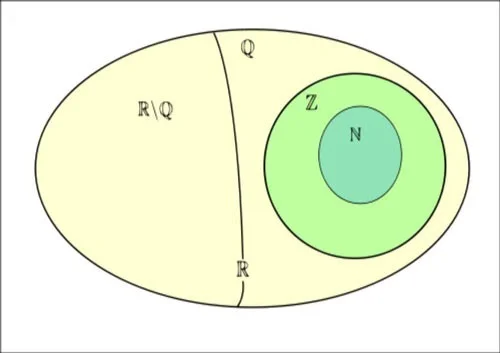
The set of integers is a subset of two larger sets, the set of rational numbers Q and the real numbers R. It is also the parent set of the set of natural numbers N.
Note:
The number 0 is neither a negative integer nor a positive integer.
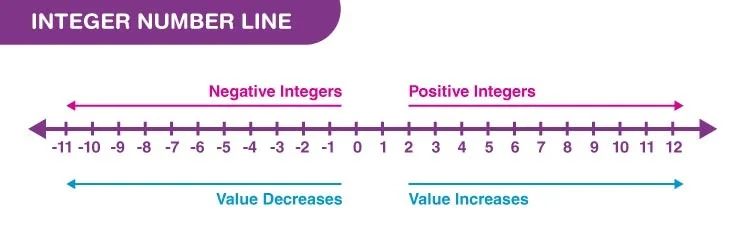
The point representing the integer a on the number line is called point a.
Properties of the set of integers
The integers in set Z will have the following basic properties:
There is no concept of largest integer and smallest integer. The concepts of largest and smallest are only relative and depend on the conditions in each case.
The smallest positive integer is 1. The largest negative integer is -1.
The integer Z consists of infinitely many finite subsets. Those subsets will have definite smallest and largest integers.
There is no integer between two consecutive integers.
Opposite number
On the number line, the points 1 and -1, 2 and -2, 3 and -3,… are equidistant from point 0 and lie on both sides of point 0. We say the numbers 1 and -1, 2 and -2, 3 and -3,… are opposite numbers.
The opposite of 0 is 0.
For example:
The number 10 and the number -10 are opposite numbers.
The number 110 and the number -110 are opposite numbers.
How to represent integers on a number line?
Since we have discussed three types of integers, we can easily represent them on a number line based on positive integers, negative integers, and zero.
Zero is the center of the integers on the number line. Positive integers are to the right of zero and negative integers are to the left. See the figure below.
Hopefully the above article has helped you answer what an integer is and what set of numbers z symbolizes.