Home
» Today
»
What Is Remembrance Day in Canada? History, Poppy Meaning and the Two-Minute Silence — Nov. 11
What Is Remembrance Day in Canada? History, Poppy Meaning and the Two-Minute Silence — Nov. 11
Verified update: November 11, 2026, at 3:18:46 p.m. Eastern Standard Time in Toronto (UTC-05:00; 20:18:46 UTC).
Remembrance Day is Canada’s annual day of reflection for people who served and died in military service. It is observed each November 11. The red poppy is its best-known symbol, and the central public observance is two minutes of silence beginning at 11:00 a.m. in each community’s local time. The quiet pause marks the hour the First World War armistice took effect on November 11, 1918.
In 2026, the custom has a particular Canadian milestone alongside it: the Royal Canadian Legion is marking 100 years since its official incorporation in 1926. The Legion organizes the national ceremony in Ottawa and runs the Poppy Campaign, whose donations support Veterans and their families. Because Canada spans time zones—and British Columbia adopted year-round Pacific Time in 2026—the nationwide silence does not occur at one single UTC moment.
Destaques
Canada’s first Armistice Day observance was held in 1919; Parliament adopted the name Remembrance Day in 1931.
The poppy grew into a remembrance symbol through John McCrae’s 1915 poem and the work of Moina Michael and Anna Guérin; Canada adopted the Poppy Campaign in 1921.
The two-minute silence begins at 11:00 a.m. on November 11 in each location’s time zone, recalling the 1918 armistice.
For November 11, 2026, 11:00 a.m. in Ottawa was 16:00 UTC; in Vancouver, Pacific Time (PCT, UTC-07:00) made it 18:00 UTC.
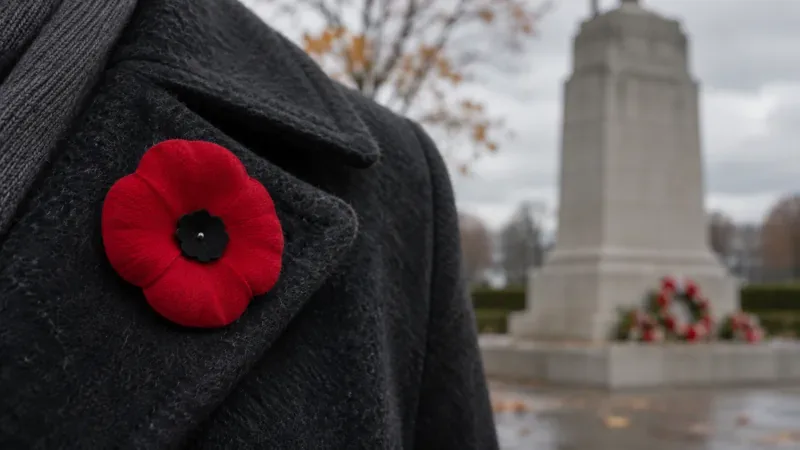
Illustration: A red poppy worn near a memorial. This is not a photograph from a specific Remembrance Day ceremony.
What is Remembrance Day in Canada?
Remembrance Day is observed every November 11 to honor those who died in military service and to recognize the sacrifices of people who served. Ceremonies take place at the National War Memorial in Ottawa, at cenotaphs and memorials in towns and cities, and in schools, workplaces, and community settings. The observance is solemn and civic; ceremonies may include military participation and religious or cultural elements, depending on the organizers.
The date comes from the armistice that ended the fighting of the First World War. The Canadian Department of National Defence’s history records that the armistice agreement was signed in Paris on November 11, 1918, and that the ceasefire took effect at 11:00 that morning. The familiar phrase “the eleventh hour of the eleventh day of the eleventh month” connects the date and time to the pause observed today.
Canada held its first Armistice Day observance in 1919, one year after the armistice. The name changed later: Parliament adopted “Remembrance Day” in 1931. The commemoration has expanded in meaning beyond the First World War to honor Canadian service and sacrifice in later wars, conflicts, and peace-support operations.
Why is the poppy a symbol of Remembrance Day?
Red poppies became associated with remembrance because they grew in parts of France and Belgium where fighting had disturbed the soil during the First World War. Canadian physician and artillery officer John McCrae drew on the flower’s presence in the war landscape in his 1915 poem, In Flanders Fields. The poem helped make the poppy a widely recognized image of loss and remembrance.
The remembrance poppy campaign developed through the efforts of several people. American humanitarian Moina Michael was inspired by McCrae’s poem and chose to wear a poppy in memory of the dead. French humanitarian Anna Guérin promoted artificial poppies as a way to honor the fallen and raise aid for people affected by war. In 1921, the Great War Veterans Association—one of the organizations that preceded the Royal Canadian Legion—adopted the poppy in Canada.
Today, the Royal Canadian Legion’s Poppy Campaign raises donations for programs that assist Veterans and their families. Veterans Affairs Canada says funds support Veterans in financial distress as well as medical equipment, research, home services, and long-term care. Wearing a poppy is a voluntary public expression of remembrance; the Legion recommends placing it on the left side, close to the heart. People commonly wear it during the remembrance period and remove it after the November 11 ceremony, often placing it respectfully at a cenotaph.
The two-minute silence recalls the hour the 1918 ceasefire began and gives people a shared moment to remember, reflect, and honor those who served. In 1919, King George V called for two minutes of stillness at the anniversary of the armistice. Canada’s first Armistice Day observance followed that year, and the pause became a lasting part of the annual ceremony.
At formal services, the Last Post is usually played immediately before the silence. Veterans Affairs Canada explains that the bugle call originally signaled that the last sentry had completed inspection and soldiers could rest for the night. At remembrance ceremonies, it marks a transition into reflection. After the two minutes, the Rouse is played; it traditionally served as a wake-up call and, in this context, signals the return from silence. A lament, wreath laying, readings, and an Act of Remembrance may also form part of the program.
The national observance begins at 11:00 a.m. local time in communities across the country, rather than at one shared instant everywhere. On November 11, 2026, 11:00 a.m. in Ottawa, Ontario, was Eastern Standard Time (UTC-05:00), or 16:00 UTC. In Vancouver, British Columbia, 11:00 a.m. was Pacific Time (PCT, UTC-07:00), or 18:00 UTC. B.C. did not turn clocks back on November 1, 2026, after adopting year-round Pacific Time; its new offset is confirmed by the provincial government.
How is Remembrance Day observed today?
Many communities hold a ceremony around a cenotaph or memorial. A typical service can include a veterans’ march, the national anthem, the Last Post, the two-minute silence, the Rouse, prayers or other traditions, and the laying of wreaths. The precise program is set by the local organizer. People who cannot attend a service may observe the silence wherever they are at 11:00 a.m. in their local time zone.
The Royal Canadian Legion organizes Ottawa’s National Remembrance Day Ceremony and supports local remembrance activities through its branches. The Legion’s official centenary page notes that 2026 marks 100 years since it was incorporated by an Act of Parliament on July 17, 1926. The Poppy Campaign predates the Legion’s incorporation: it was adopted in Canada in 1921 by the Great War Veterans Association.
Frequently asked questions
When is Remembrance Day in Canada?
It is observed each year on November 11.
What does the red poppy represent?
The poppy is a symbol of remembrance for those who served and died. In Canada, the Legion’s Poppy Campaign also raises funds to support Veterans and their families.
When do the two minutes of silence begin?
They begin at 11:00 a.m. on November 11 in each community’s local time zone. The corresponding UTC time differs across Canada.