Home
» Today
»
Why Nvidia Stock Still Drives the AI Hardware Market | Nov. 23, 2026
Why Nvidia Stock Still Drives the AI Hardware Market | Nov. 23, 2026
Checked and updated: November 23, 2026, 9:15 a.m. Pacific Standard Time (UTC−08:00; 5:15 p.m. UTC).
Nvidia remains the clearest single-company signal for the AI hardware market because it sells the accelerators at the center of many large-scale AI systems, along with networking, system designs and software that customers use to deploy them. The market’s latest move shows how closely investors connect that infrastructure story to Nvidia’s leadership: on Monday, November 23, the company said Jensen Huang had returned as president and CEO, and Nvidia shares rose sharply in morning trading.
The leadership news is a catalyst, not the whole investment case. Nvidia’s latest reported quarter showed $115.8 billion in revenue, including $107.6 billion from Data Center, while its next-quarter revenue outlook was $130 billion, plus or minus 3%. Those figures support the view that AI infrastructure demand remains large, but they do not guarantee future growth or make the stock immune to valuation, supply, competition or policy risk.
Destaques
Nvidia reported fiscal Q3 2027 revenue of $115.8 billion, up 103% year over year; Data Center revenue rose 110% to $107.6 billion.
The board reinstated Huang effective immediately on November 23 after his November 12 resignation; the company said its independent investigation will continue.
AP reported Nvidia shares up 34.4% in morning trading on November 23, at about $167 around 11 a.m. Eastern Standard Time (UTC−05:00); that was an intraday snapshot, not a closing price.
Nvidia’s market influence comes from both its earnings and its role across the AI hardware stack, while customer concentration, competition, supply and policy remain important risks.
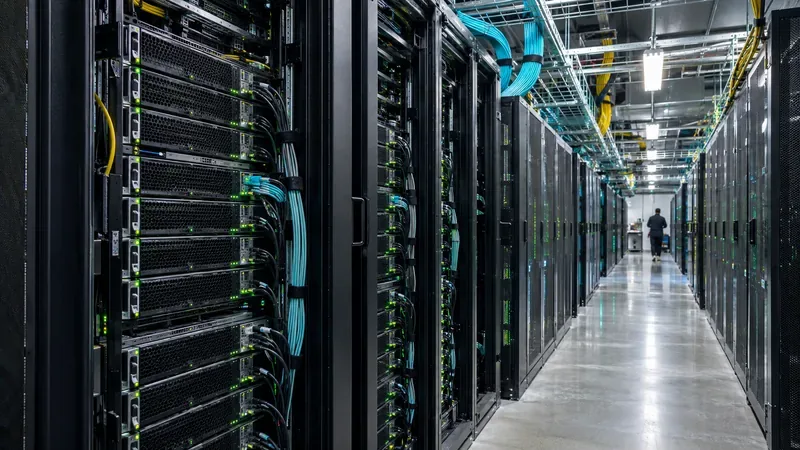
Illustrative image of data-center hardware; it does not depict a specific Nvidia facility or product installation.
Why does Nvidia stock move the AI hardware market?
Nvidia is not simply a chip supplier. Its GPUs are widely used to train and run AI models, and the company sells increasingly integrated platforms that combine processors, high-speed networking and rack-scale systems. For customers building AI data centers, buying compute is a system decision: performance depends on how accelerators, memory, switches, software and power infrastructure work together.
That combination helps explain why Nvidia’s results can influence expectations for server makers, cloud providers, memory suppliers, networking firms and data-center construction. If customers expand deployments, demand can reach beyond the chip itself. Conversely, if spending plans slow, utilization disappoints or deployment is delayed, the impact can spread across the supply chain.
Nvidia’s software ecosystem is another part of the position. Developers and enterprises have built tools and workflows around its platforms, which can make switching technically and operationally costly. That is an advantage, not an unbreakable lock: cloud companies continue to develop their own accelerators, and rival chipmakers compete on price, availability, performance and power efficiency.
What do Nvidia’s latest results say about AI demand?
In results released November 17 for the quarter ended October 25, Nvidia reported $115.8 billion in revenue, 20% above the prior quarter and 103% above the year-earlier period. Data Center generated $107.6 billion, up 21% sequentially and 110% year over year. The company reported a 74.8% GAAP gross margin and $2.70 in GAAP diluted earnings per share.
The company forecast $130 billion in revenue, plus or minus 3%, for fiscal Q4 2027. Nvidia said that outlook assumed no Data Center compute revenue from China. The outlook is management guidance, not a completed result. Investors will need to compare actual shipments and customer spending with that forecast, while watching whether new capacity can be manufactured, packaged, powered and installed on schedule.
Nvidia also said Vera Rubin NVL72 systems had begun shipping and described expanded commitments with supply-chain partners to support infrastructure demand. Those announcements show the company’s attempt to scale beyond individual GPUs into complete systems. They also underline that manufacturing partners and the broader supply chain are essential to converting orders into revenue.
Nvidia announced on November 12 that Huang had resigned and that CFO Colette Kress would serve as interim CEO. On November 23, the company announced that its board had unanimously reinstated Huang as CEO and board member, effective immediately. Kress remains executive vice president and CFO. Nvidia said the board had received input from senior U.S. government officials and was confident the reinstatement posed no national security risk.
The company also said an independent-director committee’s investigation into reports that Huang had been the target of a foreign intelligence effort would continue, with Huang cooperating. The reinstatement resolves who is leading the company now; it does not mean that the investigation is complete. The board’s account and filing are available in Nvidia’s November 23 announcement and its SEC Form 8-K.
The stock reaction should be kept in context. The Associated Press reported that Nvidia was up 34.4% at about $167 around 11 a.m. Eastern Standard Time on November 23, after falling nearly 23% the prior week. The report described that quote as an intraday snapshot; it is not the day’s closing price. AP also noted that Nvidia’s index weight makes its moves influential for the S&P 500. A rally driven by leadership headlines can reverse, and one session does not establish a durable trend.
What could challenge Nvidia’s position?
The main question for the hardware market is whether customer spending produces lasting returns. Cloud providers and AI developers must earn enough from AI services to justify costly data centers. If workloads grow more slowly than expected, financing becomes more expensive or customers delay construction, orders could soften even if the technology remains important.
Competition is another uncertainty. Large buyers are designing custom chips to target their own workloads, while AMD and other suppliers offer alternatives. Nvidia’s advantage can persist if its full platform saves time or performs better at scale, but customers may still diversify to improve bargaining power, reduce dependency or lower costs.
Investors should also follow power availability, advanced packaging capacity, export controls and the pace of new product deployments. Nvidia’s Q4 guidance excluded China Data Center compute revenue, a reminder that policy can affect addressable sales. The company’s substantial margins and rapid growth are evidence of current strength; they are not promises that margins, growth rates or market share will hold.
What should investors watch next?
Rather than treating the NVDA share price as a complete measure of AI demand, track a short list of operating signals: Data Center revenue growth, gross margin, management’s forward guidance, product ramp timing, supply constraints and evidence that customers are using installed systems productively. Also watch whether major cloud and enterprise buyers maintain capital-spending plans and whether competing accelerators gain meaningful workloads.
For the broader market, Nvidia remains a core driver because its results connect chip demand with the buildout of AI infrastructure. That leadership gives the stock unusual influence, but it also raises the stakes when expectations change. Investors can separate the business question—whether demand and execution remain strong—from the valuation question—how much future growth is already reflected in the share price. Neither the November 23 rally nor one quarter’s results answers both.
Frequently asked questions
Why is Nvidia central to the AI hardware market?
Its GPUs, networking, integrated systems and software are used across many AI data-center deployments, so its results can signal demand across a wider hardware supply chain.
Did Nvidia’s stock rise after Jensen Huang returned?
Yes. AP reported a 34.4% intraday gain around 11 a.m. Eastern Standard Time on November 23. That was a morning snapshot, not the closing price.
Does Nvidia’s latest guidance guarantee continued growth?
No. The $130 billion fiscal Q4 revenue outlook was company guidance. Actual results depend on customer demand, supply capacity, competition, power availability and policy conditions.