Home
» Today
»
2026 US Midterm Election Results: What Democratic Control of Congress Means for Trump
2026 US Midterm Election Results: What Democratic Control of Congress Means for Trump
As of 2:12 a.m. Eastern Standard Time (EST, UTC−05:00) on Wednesday, November 4, 2026, in Washington, D.C., the Associated Press had called Democratic control of both the U.S. House and Senate. The calls followed the November 3 midterm elections. That changes who will organize Congress and set its priorities when the new members take office, but it does not remove President Donald Trump or make proposed policies law overnight.
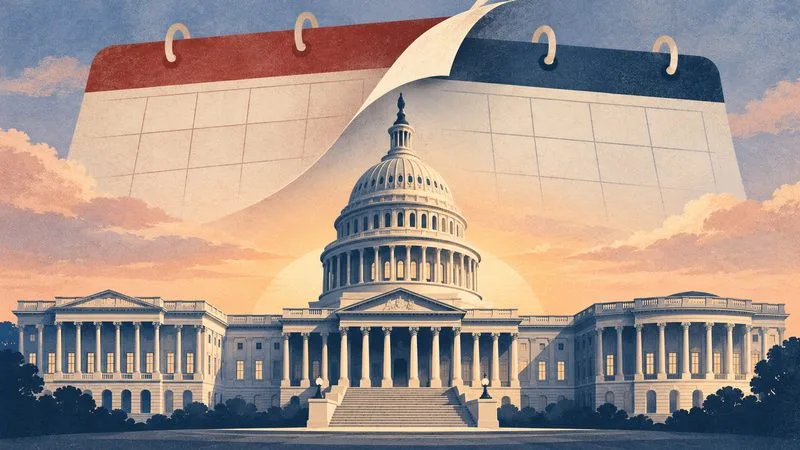
An editorial illustration of the U.S. Capitol and a changing calendar, representing the transition between Congresses.
What has been called, and what is still unresolved?
The AP has called the House for Democrats and separately called Democratic control of the Senate. These are newsroom race calls about which party will hold a majority; they are not final, state-certified vote totals. The AP’s live report still listed Michigan’s open Senate race as uncalled at the time checked for this article. A chamber’s control can be clear before every individual contest has been called.
Election-night returns remain unofficial even when a results page shows every precinct reporting. State and local election officials canvass ballots, reconcile records, complete required checks, and certify results under their state’s procedures. The U.S. Election Assistance Commission’s explanation of canvassing and certification distinguishes those official steps from media calls. For the exact count and certification date in a state, use that state’s election office.
What does Democratic control change in the House?
The House majority organizes the chamber. When the new House convenes, members elect a Speaker, adopt rules, and arrange committee assignments. The majority can shape which bills receive floor time and what committees investigate, hold hearings, or examine in agency oversight. That gives Democrats more power to scrutinize Trump administration decisions and to advance legislation that would otherwise be less likely to reach a vote.
Oversight can produce hearings, document requests, and public findings; it does not itself repeal a law or automatically establish wrongdoing. A bill still has to move through the legislative process and clear the other chamber before it can reach the president.
What does control of the Senate change?
The Senate majority selects its floor leader and has greater influence over the chamber’s schedule and committee leadership. The Senate’s own new-Congress guide explains that party conferences prepare committee rosters and that the Senate approves committee assignments. Committees can review legislation, conduct oversight, and consider nominations. The Senate also votes on many presidential nominations, including federal judges and senior executive-branch officials.
A majority does not mean every bill can pass on party-line votes. Under the Senate’s usual rules, ending debate on many measures requires cloture supported by three-fifths of senators duly chosen and sworn—60 votes when all 100 seats are filled. Different procedures and exceptions can apply, so the threshold depends on the matter. The Senate’s explanation of filibusters and cloture describes the standard rule.
Does this mean Trump’s agenda stops?
No. Trump remains president; a midterm election chooses members of Congress, not a president. The presidential term runs until noon on January 20, 2029, under the 20th Amendment, as summarized by the National Archives. A Democratic majority can investigate, negotiate, block or amend legislation, and put forward its own proposals. It cannot enact a bill alone: both chambers must pass the same text, and the president can sign or veto it. Congress can override a veto only with a two-thirds vote in each chamber, as the House’s historical guide to presidential vetoes explains.
Existing statutes do not disappear because party control changes. They remain in force unless changed through the legal process. Courts also continue to decide cases about federal laws and the limits of government authority; congressional control does not settle a pending case. The federal judiciary describes that role in its guide to court roles and structure.
Voter motivations should be described with care. The AP Voter Poll cited in the AP’s live coverage found that many voters appeared to blame the Trump administration for high costs and wanted Congress to impose more checks on the president. That survey finding offers context; it is not proof that every voter, district, or winning candidate had the same reason for the result.
When does the new Congress take control?
The outgoing Congress remains in office after Election Day. Its members can still meet and act during the post-election “lame-duck” period, the weeks between the election and the next Congress. Newly elected lawmakers do not take over on election night.
The incoming 120th Congress is scheduled to convene at noon Eastern Standard Time (UTC−05:00; 17:00 UTC) on Sunday, January 3, 2027, in Washington, D.C., unless a law sets a different date. The Senate’s official guidance and the House schedule page state the January 3 default. That is when the new members’ terms begin and the outgoing 119th Congress ends. Pending legislation from the previous Congress generally expires and must be introduced again; this does not mean enacted laws expire.
How should readers track the consequences?
Check state election officials for certified results, especially in races that remain uncalled.
Watch for the House Speaker vote, party leaders, and committee assignments; those choices show how the new majority plans to use its control.
Separate a proposal or committee hearing from a bill passed by both chambers and signed into law.
For Senate legislation, check the vote count and procedure as well as the party split; a majority alone may not end debate.
Treat oversight findings as evidence to examine, not as a court judgment or an automatic policy change.
The clearest immediate consequence is a new Democratic Congress facing a Republican president in 2027. Its practical effect will depend on which matters leaders bring forward, how members vote, whether the chambers agree, and how the administration and courts respond. The AP’s chamber calls establish the likely balance of power; certified state results and the new Congress’s recorded actions will show how that balance works in practice.