Home
» Today
»
U.S. Markets After the 2026 Midterms: What to Watch for Stocks, Bonds, and the Dollar
U.S. Markets After the 2026 Midterms: What to Watch for Stocks, Bonds, and the Dollar
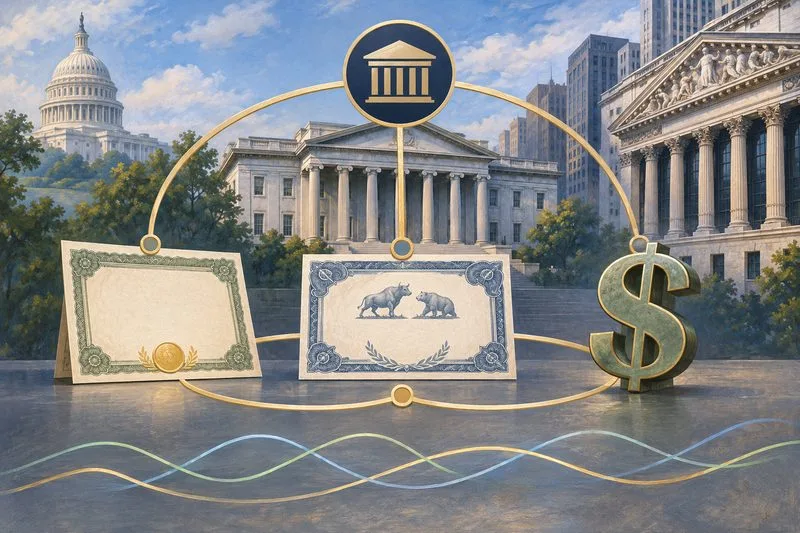
An editorial illustration links stocks, Treasury bonds, and the dollar with the federal policy backdrop.
By Wednesday, Nov. 4, the Associated Press had reported projected Democratic control of both the U.S. House and Senate after the Nov. 3 midterm elections. The AP still listed Michigan’s Senate race as uncalled, and Reuters reported other outstanding Senate contests as vote counting continued. Those calls can establish projected control before every race is resolved, but they are not state certifications. The U.S. Election Assistance Commission explains that election-night media projections are separate from the canvass and certification carried out by election officials.
For investors and business readers, the timing matters. The election did not change tax law, spending statutes, tariffs, or agency rules overnight. Markets can reprice expectations immediately, while a policy change may require a bill, a presidential signature, an agency process, or a court decision—and the new Congress does not take office until January. The president remains in office, and the Federal Reserve’s rate decisions remain a separate market driver.
What had actually moved—and in which session?
The first U.S. cash-market session on Election Day ended before the national results were known. AP reported that on Tuesday, Nov. 3, the S&P 500 rose 0.4%, the Nasdaq Composite gained 0.8%, and the Dow fell 0.4%. That was the regular U.S. session ahead of the election calls, not a post-result trading day.
Snapshot
Reported move
How to read it
Tuesday, Nov. 3 U.S. cash session
S&P 500 +0.4%; Nasdaq +0.8%; Dow −0.4% (AP)
Election Day trading before the projected congressional outcome was known.
Wednesday, Nov. 4 at 01:06 UTC (Tuesday, Nov. 3 at 8:06 p.m. Eastern Standard Time, UTC−05:00), early Asian-hours reporting
Reuters reported S&P 500 futures −0.35%; Nasdaq futures −0.5% after an earlier drop of more than 2%; the 10-year Treasury yield at 4.906%, down 6 basis points; and the dollar index at 101.34, down 0.37%.
An overnight market snapshot after the U.S. cash close—not Wednesday’s U.S. session close, and not proof that the election alone caused every move.
The New York Stock Exchange’s core session starts at 9:30 a.m. Eastern Standard Time on Wednesday, Nov. 4 (UTC−05:00; 14:30 UTC). At the early-morning publication cutoff, that cash session had not opened, so its full-day reaction was still unknown. The timestamp conversion reflects the U.S. switch back to standard time on Nov. 1, 2026. Reuters described the early move as involving concerns about AI regulation and political gridlock; those were investor interpretations, not new rules or enacted policy.
Useful check: Before comparing headlines, note the instrument, venue, timestamp, and session. A futures quote, a daily Treasury par yield, and a stock-market closing price are different measurements.
Stocks: watch earnings alongside taxes and regulation
Congress can change corporate tax rules or pass legislation affecting industries, but a projected majority does not change a company’s tax bill by itself. A bill generally must pass both chambers in identical form and be signed by the president, or overcome a veto with the required two-thirds votes in each chamber. Many Senate bills also face a 60-vote cloture threshold to end debate, although exceptions mean the threshold is not universal. The incoming Congress can investigate companies and agencies, hold hearings, and put proposals on the agenda; those steps may affect expectations, but they are not the same as a new law.
Regulation can also reach companies through executive agencies when existing statutes delegate authority. A proposal may influence forecasts before it is final, but many rulemakings require public notice and an opportunity for comment under the Administrative Procedure Act, subject to statutory exceptions. Courts can review final agency actions that exceed legal authority or fail required procedures. The Reuters report described concerns about AI and data-center regulation as part of the overnight technology-share reaction; no new post-election restriction was enacted by the vote itself.
For stocks, the practical question is whether a political development changes expected revenue, costs, competition, or capital spending for a specific industry—and whether it is a proposal, a final rule, or enacted law. The same company’s shares can also move because of earnings, financing costs, energy prices, or guidance. AP’s Election Day report, for example, discussed corporate earnings and a jobs-related rise in Treasury yields as factors in Tuesday trading.
Useful check: Follow company earnings updates and the legal status of any bill or agency action. Treat a campaign promise or committee hearing as a possible signal, not as an immediate change in business conditions.
Treasuries: separate deficit expectations from the Fed’s rate path
Bond prices and yields move in opposite directions: when buyers bid up an existing bond, its yield falls. A divided government can change expectations for new spending and tax legislation, but it does not automatically reduce the deficit. Continuing laws, previously approved spending, economic conditions, and interest costs still shape federal borrowing. The Congressional Budget Office’s February 2026 baseline projected a $1.9 trillion federal deficit for fiscal 2026; that was a forecast based on assumptions available then, not a final result and not an estimate of the midterm election’s effect.
More expected borrowing can put upward pressure on yields if investors demand compensation for increased Treasury supply or inflation risk. The opposite can happen if uncertainty sends investors toward Treasury securities as a perceived safe haven, or if markets expect slower growth and fewer Federal Reserve rate increases. That helps explain why an overnight bond rally does not settle what yields will do next. The 10-year yield also reflects expectations about future short-term rates, inflation, growth, and the premium investors require to hold longer maturities.
The Federal Open Market Committee—not the incoming Congress—sets the target range for the federal funds rate. Its decisions respond to economic data and its monetary-policy goals. The Fed’s published calendar scheduled minutes from its Oct. 27–28 meeting for Nov. 18 at 2:00 p.m. Eastern Standard Time (UTC−05:00; 19:00 UTC), with the next scheduled FOMC meeting on Dec. 8–9. Jobs, inflation, earnings, energy prices, and geopolitical news can therefore move yields alongside congressional developments.
Useful check: Compare like-for-like Treasury data over time and watch the official daily yield curve, Treasury auction results, inflation and employment releases, and the Fed calendar. Do not read one overnight yield change as a forecast for mortgage rates or a final verdict on federal borrowing.
The dollar: compare U.S. rates and growth with the rest of the world
The dollar index is a basket measure, not a quote against one particular currency. Lower U.S. yields can make dollar assets less attractive relative to assets elsewhere, but the dollar can also strengthen when global investors seek liquidity or safety. Expectations for growth, inflation, Federal Reserve policy, other central banks, trade, and geopolitical risk all matter. Reuters’ reported 0.37% overnight decline in the dollar index was an observed move at one point in one session; it does not establish a lasting trend or a single cause.
Useful check: If a story says “the dollar fell,” check which index or currency pair it means, the timestamp, and whether U.S. yields or foreign-market news changed at the same time.
Trade, taxes, and rules: headlines need a legal pathway
Trade is one area where the president may act under authority Congress has delegated, but the scope depends on the statute and its conditions. In February 2026, the Supreme Court held that the International Emergency Economic Powers Act did not authorize the tariffs at issue in the cases before it. That ruling did not erase every tariff or every trade authority: other statutes provide separate routes, some requiring agency investigations or findings. The Office of the U.S. Trade Representative publishes information on Section 301 investigations and actions. For a market-sensitive tariff headline, the useful questions are which statute is being invoked, what process is required, when a measure takes effect, and whether a court has blocked or narrowed it.
Tax changes have a different path: they require legislation. Regulatory changes may proceed through agencies under authority already in law, but a proposed rule is not a final rule, and a final rule can still face legal review. A new congressional majority can scrutinize, amend, or try to repeal policies; it cannot make existing statutes disappear merely by winning seats. The practical implication is that markets may respond to a credible policy risk before the law changes, while the legal and economic effects remain conditional.
Useful check: Look for enacted legislation, an official USTR or agency notice, a Federal Register publication, an effective date, and any court order. Label proposals and forecasts as such.
The lame duck comes before the new majority
The outgoing 119th Congress remains in office during the lame-duck period after Election Day. Its members can still consider bills, spending measures, nominations, or investigations before the term ends. The incoming 120th Congress is due to begin under the constitutional default at noon on Jan. 3, 2027, in Washington, D.C. (Eastern Standard Time, UTC−05:00; 17:00 UTC), unless a law sets a different date. Jan. 3, 2027, falls on a Sunday, so any later law or official chamber schedule changing the first meeting would control. The Senate’s new-Congress guidance says legislation pending at the end of one Congress generally expires and must be reintroduced, with treaties as an exception.
This calendar means election-night expectations can affect prices before the new majority has legislative power, but any enacted changes must still pass through the constitutional process. The new House majority can set a different oversight agenda once it is seated; a new tax bill or spending measure still needs agreement across the chambers and the president’s response. In the meantime, current laws and valid agency actions remain in effect unless changed through the applicable legal process.
Useful check: Separate what the outgoing Congress does before the transition from what the incoming Congress proposes after it convenes. A media projection, a bill introduction, and an enacted law are three different milestones.
The first overnight reaction to the 2026 midterms is real, but it is only a dated snapshot. Stocks, Treasury yields, and the dollar respond to expected policy as well as earnings, inflation, interest rates, global risk, and geopolitical events. The clearest way to follow the next move is to track the session and timestamp, then ask whether a political headline has become a bill, a final rule, a tariff notice, or an enacted policy.