Home
» Today
»
Auburn Fire Ant Find Prompts New NSW Response | Nov. 23, 2026
Auburn Fire Ant Find Prompts New NSW Response | Nov. 23, 2026
Checked and updated: November 23, 2026, 9:47 a.m. UTC (8:47 p.m. AEDT).
New South Wales authorities have treated a suspected red imported fire ant nest in Auburn, more than six kilometres from the earlier Enfield find and outside Enfield’s existing 2-kilometre control zone. The NSW Government said on November 23 that surveillance is under way at Auburn and a separate biosecurity control order is being developed; it has not yet announced a new Auburn zone or movement restrictions there.
The development raises the possibility of a second source or pathway, but officials say they are investigating how the ants reached Auburn and whether the find is linked to Enfield. Residents and businesses should follow official updates and report suspected ants or nests rather than disturbing them.
Destaques
NSW teams treated a suspected nest site in Auburn over the weekend.
The site is outside the existing Enfield control zone; a distinct Auburn order is still being prepared.
Authorities have begun surveillance and plan to use detection dogs as soon as possible.
NSW asks the public to leave suspicious ants alone, take a safe photo, and call 1800 680 244.
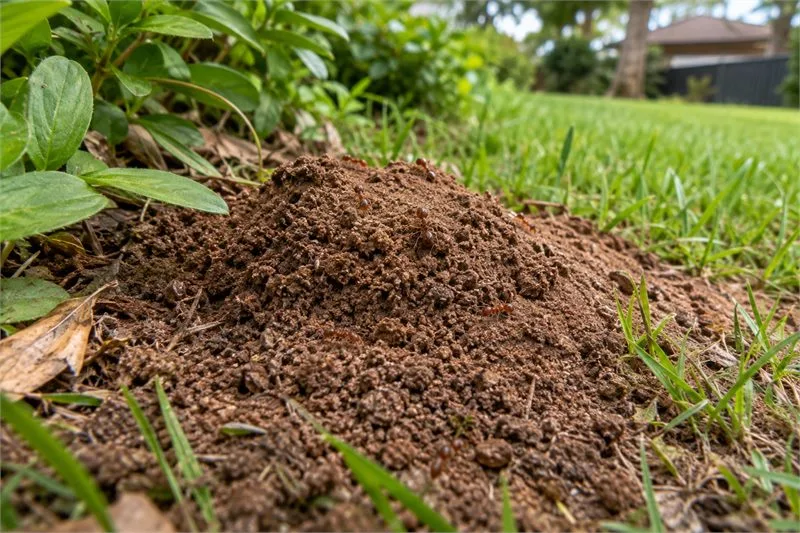
Illustrative image: a soil mound in a suburban garden. It does not depict the Auburn detection site.
What changed in the NSW fire ant response?
The latest update adds Auburn to the locations under investigation. NSW says its biosecurity team inspected and treated the site after a member of the public reported it. Staff destroyed the ants when they were considered suspect red imported fire ants, and collected samples for assessment. Experts cited by the state estimated that the nest could be around 12 months old.
That estimate does not establish when or how the ants arrived. NSW says both possibilities—including whether the ants represent an infestation separate from Enfield—remain under investigation. The state has commenced surveillance in Auburn, expects detector dogs to visit, and is engaging nearby businesses. It says an Auburn control order will follow further information from sample testing and consultation with the local community and businesses. NSW Government’s Auburn update
Does the Enfield fire ant zone cover Auburn?
No. NSW describes the existing Enfield Intermodal control zone as a 2-kilometre radius around the affected premises. The Auburn site is outside that boundary and more than six kilometres from the first Enfield nest, according to the state. The Enfield order sets requirements for moving certain high-risk materials, including soil, turf, mulch, and potted plants. Those Enfield rules should not be mistaken for a new Auburn order: the government says that order is still being developed.
The state’s response around Enfield has included treatment and surveillance within 500 metres, plus targeted surveillance out to 2 kilometres. NSW reported 729 cases inspected, 120 sites visited by detector dogs, and 1,600 people engaged face to face in that zone. Those figures describe Enfield response activity, not Auburn. For the current legal requirements and mapped boundaries, check the latest NSW Department of Primary Industries fire ant page and any published control orders.
Why do authorities focus on soil and equipment?
Fire ants can spread when people move contaminated materials. Australia’s federal outbreak information lists soil, hay, mulch, manure, turf, potted plants, and dirty machinery among potential carriers. In Queensland, the eradication program reviews its biosecurity zones monthly and uses mapped boundaries to guide requirements for moving materials. The program’s current page lists October 2026 changes in areas including Adare, Egypt, Flagstone Creek, and parts of Lake Wivenhoe. These are Queensland changes, separate from the developing Auburn response in NSW. National Fire Ant Eradication Program zone guidance
For businesses shifting soil, landscaping products, machinery, or other potentially contaminated goods, checking the applicable map and rules before transport can help prevent accidental spread. Do not assume that a suburb name alone settles whether a property falls inside a mapped zone; the Queensland program advises checking its interactive map when coverage is partial.
What should people do if they suspect fire ants?
NSW’s public guidance is “Leave it, Snap it, Call it”: do not destroy, treat, collect, or move a suspected nest; take a clear photo or video only if it is safe; then report it to the NSW Biosecurity Helpline on 1800 680 244 or through the state’s fire ant reporting page. Avoid disturbing ants, which can cause stings and potentially spread the infestation.
Authorities have not yet published an Auburn control zone in the update reviewed for this article. Further testing, surveillance, and consultation may change the response. Residents and businesses should rely on the current NSW directions rather than treating a suspected nest themselves or assuming the Enfield boundary applies to Auburn.
Frequently asked questions
Has NSW confirmed a new fire ant zone in Auburn?
No. NSW says an Auburn control order is being developed. The existing Enfield zone does not include the Auburn site.
Were the Auburn ants confirmed as red imported fire ants?
The state describes them as suspected red imported fire ants and says samples were collected. The identification and possible connection to Enfield are under investigation.
How do I report a suspected nest in NSW?
Leave it undisturbed, take a safe photo or video, and call the NSW Biosecurity Helpline at 1800 680 244 or report online through NSW’s fire ant page.