Home
» Today
»
Toyota Diesel Filter Fault Explained: What Caused the A$750 Million Settlement — Nov. 23, 2026
Toyota Diesel Filter Fault Explained: What Caused the A$750 Million Settlement — Nov. 23, 2026
Checked November 23, 2026, at 4:11 p.m. Sydney time (AEDT, UTC+11:00; 05:11 UTC). The A$750 million Toyota diesel particulate filter settlement approved by Australia’s Federal Court on November 20 traces back to a design failure in the exhaust cleaning system of certain HiLux, Prado and Fortuner diesel vehicles. The core fault was that deposits could accumulate on the diesel oxidation catalyst, interfering with the high-temperature process needed to burn soot out of the particulate filter. Court findings identify both physical components and engine-management calibration as part of the defect.
The court approved the overall settlement but did not resolve every financial and administrative detail: its published summary says the litigation funder’s deduction remains reserved and late registrants may participate. The A$750 million figure is the total settlement amount including legal costs and potential funding payments, not an automatic A$750 million payment to drivers or an equal payment per affected vehicle. Federal Court judgment listings describe the November 20 ruling.
Destaques
The underlying problem was a DPF system unable to regenerate reliably in reasonably expected Australian driving conditions.
Deposits on the diesel oxidation catalyst disrupted the temperatures required to burn trapped soot; hardware and software calibration both mattered.
The Federal Court approved a total A$750 million settlement on November 20, 2026, while reserving some distribution-related decisions.
Drivers should check their vehicle identification number, repair records and any current warning lights rather than assuming every diesel Toyota is affected.
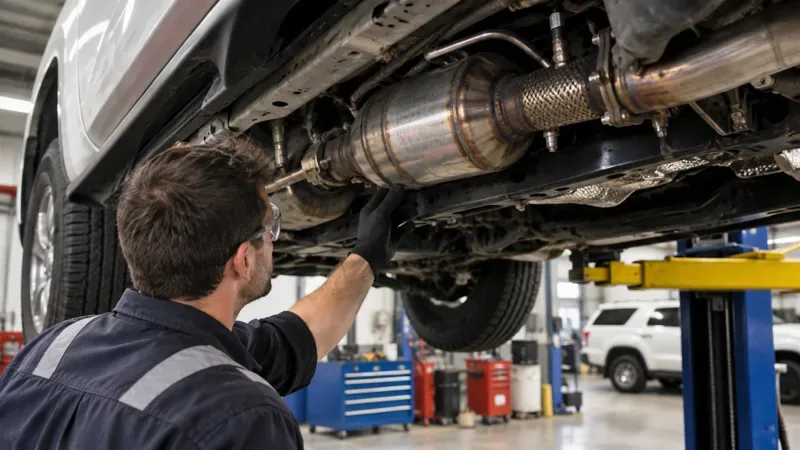
Illustrative workshop image: a mechanic examines an SUV exhaust component. This is not a photograph of an affected Toyota vehicle or evidence from the proceedings.
What exactly went wrong with Toyota’s diesel particulate filter?
A diesel particulate filter, or DPF, traps soot particles that would otherwise leave the exhaust. Once enough soot has collected, the vehicle needs to raise exhaust temperatures and burn the deposits away through a cleaning cycle called regeneration. In the affected system, a diesel oxidation catalyst (DOC) upstream of the filter helps generate the heat needed for that cleaning cycle. When the DOC surface becomes obstructed, regeneration can become ineffective, allowing soot to build up further.
The High Court’s November 6, 2024 reasons describe a “core defect” inherent in the design: under certain reasonably expected operating conditions, the system could not adequately prevent deposits from forming on the catalyst. The court expressly referred to mechanical defects alongside defective control logic and software calibrations. That is a more precise explanation than saying the filter was simply old, poorly maintained or clogged because owners made too many short trips. See the High Court reasons in Williams v Toyota.
How did the DPF defect affect drivers?
A failed or interrupted regeneration process can cause repeated soot accumulation and visible symptoms. In the litigation, consequences associated with the defective system included excessive white exhaust smoke, warnings, unpleasant odors and reduced engine performance. The symptoms did not necessarily occur on every drive or in every vehicle, but a propensity to encounter them under normal conditions was central to the finding that the vehicles did not meet the consumer guarantee of acceptable quality.
The important distinction is between a normal diesel maintenance issue and this established design problem. Any diesel DPF can be affected by operating conditions, yet the Australian courts found the relevant Toyota system was inadequately designed for the range of conditions reasonably expected in its market. Owners should not assume that changing driving habits alone fixes that underlying defect.
Which vehicles and engines were involved?
The original Williams proceedings concerned 264,170 vehicles in the Toyota HiLux, Prado and Fortuner ranges, equipped with 1GD-FTV or 2GD-FTV diesel engines and supplied during the period from October 1, 2015, to April 23, 2020. Acquisition conditions and the related Taylor proceedings can affect who is covered by the settlement; these are not identical to the question of whether a specific vehicle has the defective hardware. The Toyota Australia DPF class-action information page and class-action FAQ give the formal vehicle and membership descriptions.
Model names alone are insufficient for diagnosis. A newer Prado or a petrol-powered HiLux is not automatically implicated merely because it shares a badge with a vehicle in the proceedings. VIN-specific information and Toyota service history are more reliable than broad online lists.
Why did the technical failure lead to a A$750 million settlement?
The dispute developed into a major consumer-law case because the defect was assessed at the point of supply, not solely as a bill for later repairs. Australian courts held that the relevant vehicles were not of acceptable quality when sold. The legal issues included their reduced value at acquisition and other losses attributable to the defect. On appeal, the courts also considered how the existence and timing of an effective, free repair affected the calculation of compensation. The Full Federal Court reasons from March 2023 set out the technical and consumer-law findings.
The settlement resolves the Williams litigation and the related Taylor action. Its scale reflects the reach and duration of the disputes, but the amount is not a published estimate of the mechanical cost of replacing filters. The November 20, 2026 settlement-approval judgment is also important procedurally: the court approved the settlement while declining to approve certain proposed releases and leaving the amount of the litigation funder’s deduction for later determination. Late registrants were permitted to participate, contrary to the provisional limits described in some older notices.
Did Toyota develop a repair for the defect?
Yes. The High Court’s 2024 reasons refer to an effective repair becoming available free of charge in May 2020. Toyota Australia also maintains a DPF class-action page and has communicated with owners about repairs. A proper repair should be assessed by an authorized service technician against the particular vehicle’s VIN and repair history; this article cannot establish which components or software versions any individual vehicle already has.
If a vehicle is displaying DPF warnings, producing abnormal smoke or repeatedly entering a cleaning cycle, arrange diagnosis rather than relying on highway driving as a substitute for inspection. Ask the dealer for a written record of applicable service actions, the work performed and whether subsequent fault codes remain. Keep invoices and photographs of warning messages. Be alert that the legal implications of accepting a remedy or selling a vehicle may differ according to the claim and court orders; seek case-specific guidance from the settlement administrator or legal representative.
What happens next for Toyota owners after the court approval?
The key practical question is now how the approved settlement will be administered and how net compensation will be allocated after court-approved deductions. Official materials published before the hearing described a proposed registration cutoff, but the court’s November ruling specifically states that late registrants are permitted to participate. Because remaining directions and payment calculations may change, owners should consult the official proceeding pages rather than treating older FAQ wording as the final court order.
For maintenance, owners can request a VIN check and review past DPF repair history. For legal eligibility, they should consult the Williams class-action updates or the Taylor class-action updates. No specific individual payment amount or distribution date is confirmed by the court summary cited here. Those figures should not be inferred by dividing A$750 million by the number of vehicles.
FAQ: Toyota DPF fault and settlement
Was the Toyota DPF problem caused by short trips?
Not simply. Driving patterns can affect normal DPF regeneration, but the courts found an inherent system-design defect that could obstruct effective regeneration under reasonably expected Australian operating conditions.
Does every Toyota diesel need a new filter?
No. The proceedings concerned particular HiLux, Prado and Fortuner vehicles and engine types. Whether a vehicle requires any work depends on its VIN, repair history, inspection results and Toyota’s applicable service guidance.
Does the A$750 million settlement mean every owner gets the same payment?
No. The total includes legal and funding-related amounts, and final individual distributions depend on the court-approved scheme and other outstanding determinations.