Home
» Today
»
UK Vehicle Theft: Police Data Show 7% Decline, Keyless Risks Persist | Nov. 23, 2026
UK Vehicle Theft: Police Data Show 7% Decline, Keyless Risks Persist | Nov. 23, 2026
Information checked: November 23, 2026, 5:07 a.m. UTC (London, GMT, UTC+00:00).
Vehicle theft remains a serious concern for UK motorists, but the latest official statistics do not support a new nationwide theft surge. England and Wales police recorded 312,231 vehicle offenses in the year ending June 2026, a 7% decrease from the preceding 12 months, according to the Office for National Statistics. That category includes theft-related vehicle crimes and should not be presented as the number of whole cars stolen. The figures were released on October 22, 2026.
The decline does not mean the threat has disappeared. Police continue to warn about keyless theft, stolen keys and organized criminals targeting particular vehicles. The important change for drivers is to distinguish the national trend from the methods and risks that remain active in individual neighborhoods and vehicle categories.
Destaques
ONS reports 312,231 police-recorded vehicle offenses in England and Wales in the year ending June 2026, down 7% year over year.
The category includes more than theft of a complete motor vehicle; it must not be labeled a car-theft count.
Official government explanatory notes cite a Metropolitan Police estimate that electronic devices feature in approximately 60% of vehicle theft in London, not the entire UK.
Police recommend layered security and immediate reporting to police and insurers when a vehicle is stolen.
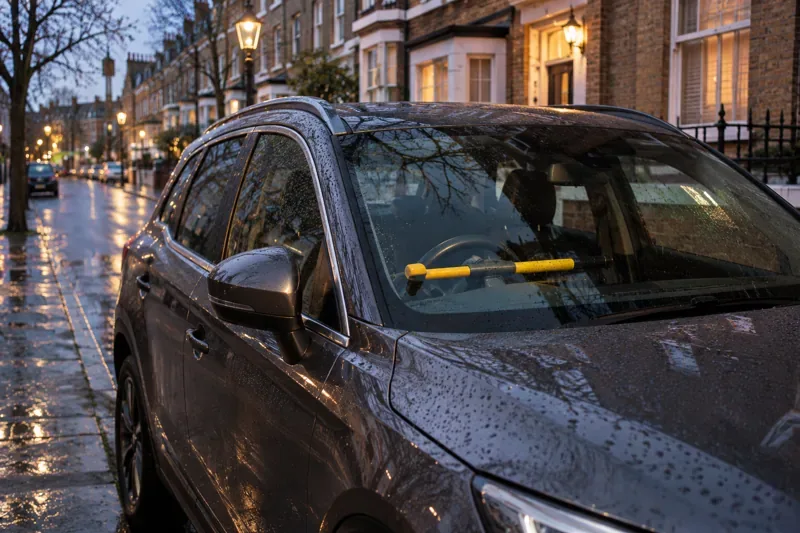
Illustrative image of a parked SUV secured with a steering wheel lock on a British residential street. This is not a photograph of a reported theft or police operation.
Are vehicle thefts increasing in the UK in 2026?
Not according to the most recent comparable police-recorded vehicle-offense total for England and Wales. The Office for National Statistics (ONS), year ending June 2026 reports a 7% year-over-year fall to 312,231 offenses over the 12 months to June 2026. Police-recorded theft offenses of all types also fell 5% to approximately 1.6 million in that period. These are recorded crimes, not an estimate of every incident that occurred.
There is an important geographic limitation: the ONS England-and-Wales series is not a single UK-wide series. Scotland and Northern Ireland have separate police and statistical systems, so England-and-Wales numbers should not be portrayed as a four-nation total. Nor does the existence of concern or increased online searches establish an increase in recorded crime.
Historical numbers also help explain why vehicle crime remains prominent. The UK government reported 132,412 offenses of theft of a motor vehicle in England and Wales in the year ending September 2024, alongside 188,517 thefts from vehicles. Those are older and narrower categories than the latest 312,231 total. They cannot simply be substituted for a June 2026 count of stolen cars.
What do police say about keyless car theft and organized crime?
The official explanatory notes to the Crime and Policing Act 2026 describe organized criminal involvement in vehicle theft, the use of electronic devices to enter and start cars without the original key, and stolen vehicles being moved through criminal networks. The notes cite the Metropolitan Police Service estimate that such devices are used in approximately 60% of vehicle thefts in London. That is an attributed local estimate, not a verified percentage for all UK vehicle thefts in 2026.
The Metropolitan Police vehicle-theft guidance explains relay theft, in which an electronic device makes a keyless vehicle believe its fob is nearby. Police also warn about physical key theft, keys left near front doors, opportunistic theft from unlocked vehicles and devices or valuables visible inside cars. These are different scenarios and require different safeguards.
London-specific estimates and past case patterns cannot tell an individual driver that a particular model will be stolen, or prove that all recent thefts use one technique. Local force notices, manufacturer security updates and an insurer’s vehicle-specific requirements may provide more relevant information for a particular owner.
Why do official vehicle-crime figures differ?
Definitions and coverage matter. “Theft of a motor vehicle” counts a different offense from “theft from a motor vehicle,” where the vehicle itself may remain in place. The broader police-recorded vehicle-offense series includes multiple vehicle-related offense categories. Counts are reported for a defined 12-month period and geography, not a single incident date.
The Crime Survey for England and Wales measures victim experiences and can include incidents not reported to police. Police-recorded crime instead depends on reports, recording practices and administrative rules. Comparisons should use like-for-like definitions and avoid mixing survey incidents with recorded offenses. The ONS notes these methodological limitations in its October 2026 release.
What should car owners do now?
Police guidance is consistent across several UK jurisdictions, although local risks vary. The Police Service of Northern Ireland security advice and Police Scotland car and van theft guidance advise drivers to keep doors locked and keys out of sight, use physical restraints such as steering wheel locks, and protect vehicles where possible with secure parking and tracking systems. The Metropolitan Police also recommends a signal-blocking pouch for keyless fobs and periodic checks that it still blocks signals.
Confirm that the car actually locked, including windows and the trunk, before walking away.
Keep both primary and spare keyless fobs away from the vehicle and exterior doors; use an effective signal-blocking pouch if appropriate.
Consider a visible mechanical lock, an approved immobilizer and a discreet tracker in addition to built-in electronic security.
Park in a locked garage or a well-lit, busier area when practical, and remove items that attract break-ins.
Ask the manufacturer whether security software or key settings have changed, and check insurance conditions before assuming an add-on meets required standards.
What happens if your car is stolen in Britain?
The UK government stolen-vehicle reporting instructions says to contact the police and your insurance company promptly. In a nonemergency, 101 can connect you to police; call 999 when an incident is in progress or there is an immediate danger. Have the registration, make, model and color ready, and keep the crime reference number for the insurer. Police notify the DVLA when the vehicle is reported stolen or recovered. If an insurance payout transfers the vehicle to the insurer, the registered keeper must complete the relevant DVLA notification.
If a tracker indicates a possible location, pass that information to police rather than attempting to confront anyone. Preserve relevant camera footage and other records. The practical consequences of theft—loss of transport, insurance excesses, claims delays and potential recovery costs—depend on individual policies and circumstances; the national offense count cannot predict an individual claim.
What should drivers watch for next?
The next scheduled ONS crime bulletin is due January 28, 2027. It may show whether the latest decline continues in England and Wales, but a future increase or decrease cannot be assumed. Police alerts about particular theft methods or local clusters may arrive independently of the quarterly national statistics. Drivers should treat both as useful but different kinds of evidence: national data describe measured patterns, while police notices help identify immediate local prevention priorities.
Frequently asked questions
Did UK car theft surge in the latest figures?
No nationwide surge is established by the latest ONS data. Police-recorded vehicle offenses in England and Wales fell 7% in the year ending June 2026. This is not a complete four-nation UK total.
Are all 312,231 offenses stolen cars?
No. That is a broader police-recorded vehicle-offense category, not a count of complete vehicles stolen.
What is the first step after discovering a stolen vehicle?
Report it to police and your insurer as soon as possible, and retain the police crime reference number for the claim.