Home
» Today
»
Chicago Transport Disruptions in October 2026: CTA Changes, Road Closures and Marathon Weekend
Chicago Transport Disruptions in October 2026: CTA Changes, Road Closures and Marathon Weekend
You leave home on a Saturday expecting a normal CTA trip, only to discover your train is bypassing a station, your bus is on a construction detour, or the street where you planned to park has been posted for a race closure. October 2026 has several disruptions that can create exactly that problem in Chicago, especially during the October 10–11 marathon weekend.
As of September 29, 2026, the most important confirmed items are: a temporary Blue Line schedule through October 9, a Green Line 43rd-station bypass through October 16, the continuing State/Lake station reconstruction closure, several long-running and recurring CTA bus reroutes, downtown closures for the Abbott Chicago 5K on October 10, and extensive street and parking restrictions for the Bank of America Chicago Marathon on October 11. Some additional CTA weekend work, Metra engineering activity and event-related bus reroutes may still be announced later in the month, so this guide clearly marks what is confirmed and what must be rechecked.
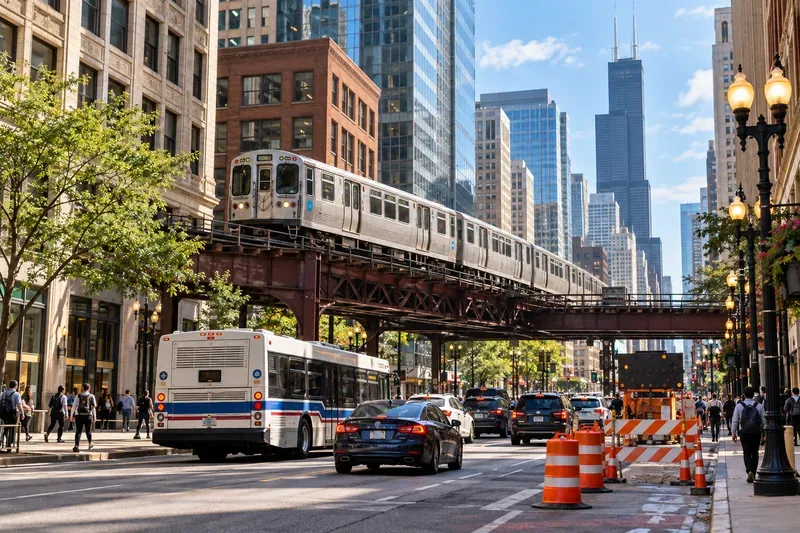
A downtown Chicago transit scene with elevated rail, buses, traffic and temporary work-zone barriers, illustrating the mix of rail, bus and street impacts travelers may encounter during construction and major events.
What should you check first before traveling in October?
Start with the mode you actually plan to use. CTA riders should open the CTA system alerts page on the day of travel because planned work can be supplemented by short-notice operational changes. Drivers should check the City of Chicago's ChiStreetWork map, which includes construction, road closures and special events. The City itself notes that map information is subject to change, so posted curb signs and police traffic control still take priority.
Metra passengers should check the operator's official schedules and service alerts before departure. In the official material reviewed for this article on September 29, I did not find a Metra-issued, systemwide October 2026 weekend engineering calendar comparable to the specific CTA notices below. That does not mean every Metra weekend will be disruption-free; line-specific work can be published closer to the date.
Confirmed CTA rail changes in October 2026
Service
Confirmed period
What changes
Practical alternative
Blue Line O'Hare branch
Through Friday, October 9
CTA says a slightly modified schedule is in effect during non-rush periods and weekends because of construction.
Allow extra time, especially for O'Hare trips, and verify the trip shortly before leaving.
Green Line at 43rd
Through Friday, October 16 at 4 a.m.
Ashland/63rd- and Cottage Grove-bound trains bypass 43rd during planned work.
Use a nearby Green Line station or connect by bus; confirm the best accessible option in CTA's trip planner.
State/Lake elevated station
Ongoing into 2029
The station remains closed for reconstruction. The closure affects the Brown, Green, Orange, Pink and Purple lines that normally serve it.
CTA directs riders to Clark/Lake or Washington/Wabash.
These rail notices come from CTA's current and upcoming service alerts. The CTA rail status page should be treated as the final pre-trip check because construction windows can move.
Does October have confirmed full-weekend CTA rail shutdowns?
Not for every weekend at the time of writing. CTA's currently published October information confirms construction effects such as the Blue Line temporary schedule and the Green Line station bypass, but the agency also publishes weekly upcoming planned changes. Therefore, a traveler planning for October 17–18, October 24–25 or October 31 should not assume today's list is complete. Check again during the week before travel.
Which CTA bus routes already have October reroutes?
Several planned reroutes extend into October. The most broadly useful ones to know are below; this is not a complete inventory of every temporary stop relocation in the system.
#J14 Jeffery Jump, #15 Jeffery Local and #N5 South Shore Night Bus: CTA lists construction-related reroutes in the Jeffery corridor through 8 p.m. Monday, October 26. Routing varies by notice, so riders should check the exact direction and stop before boarding.
#75 74th-75th: rerouted through 8 p.m. October 26 via 75th, Stony Island, 76th, Yates and 75th.
#47 47th: a planned reroute continues through November 11, with buses operating via 47th, Ashland, 51st and Damen.
#56 Milwaukee: CTA lists a southbound reroute from 7 a.m. to 6 p.m. on Sundays October 4, 11, 18 and 25, using Milwaukee, Kedzie and Logan before returning to the regular route. On October 25, CTA also lists a separate 7 a.m.–8 p.m. reroute in both directions via Milwaukee, Damen, Division and Milwaukee.
#70 Division: CTA lists recurring Saturday reroutes from 7:30 a.m. to 5 p.m. on October 3, 10, 17 and 24. Eastbound buses use Division, Wells, Oak and Dearborn; westbound buses use Clark, Oak, Wells and Division.
#8 Halsted: a longer-running reroute remains listed through December 25, using Halsted, Division, Elston, Milwaukee and Halsted.
The Abbott Chicago 5K will close a group of Loop streets on Saturday morning. The official event closure notice says the main race streets are scheduled to close from 6:30 a.m. to 9:30 a.m., including sections of Ida B. Wells Drive, Congress Plaza Drive, Michigan Avenue, Harrison Street, State Street, Franklin Street, Van Buren Street and Wacker Drive.
Two areas have longer planned closures: Jackson Boulevard between Wacker Drive and Franklin Street and Wacker Drive between Adams Street and Van Buren Street are scheduled to close from 5 a.m. to 11 a.m.. No parking is allowed on the listed race streets starting at 1 a.m. Saturday, October 10; vehicles left there can be ticketed and towed.
The official Abbott Chicago 5K street-closure notice says closures are intended to roll open after runners pass. It also says Lower Wacker Drive remains available to bypass much of the Loop, although some ramps are closed. Michigan Avenue north of Ida B. Wells is scheduled to remain open.
May still change: the event explicitly notes that additional streets may be closed if Chicago Police Department or event officials consider it necessary. Treat the published times as the planned framework, not a guarantee that every intersection will reopen at the exact minute listed.
How disruptive will the Chicago Marathon be on Sunday, October 11?
This is the date that requires the most planning. The official 2026 marathon traffic plan says course streets begin closing to traffic at 6 a.m., with reopening occurring progressively as the final runners pass. Different segments reopen at different times, generally moving from the north and west portions of the route toward the later south-side miles and finish area.
The event's official closure schedule includes major sections of Columbus Drive, Grand Avenue, Dearborn Street, Jackson Boulevard, LaSalle Street, Stockton Drive, Fullerton Drive, Cannon Drive, Sheridan Road, Broadway, Clark Street, North Avenue, Wells Street, Wacker Drive, Adams Street, Damen Avenue, Halsted Street, Taylor Street, Loomis Street, 18th Street, 21st Street, Canalport Avenue, Cermak Road, Wentworth Avenue, 26th Street, Michigan Avenue, 35th Street, Indiana Avenue, 31st Street and Roosevelt Road.
Grant Park setup begins well before October 11. The published plan includes these notable restrictions:
Balbo Drive, Columbus Drive to DuSable Lake Shore Drive: closed from September 24 at 6 a.m. until October 16 at 3 p.m.
Balbo Drive, Michigan Avenue to Columbus Drive: October 8 at 4 a.m. to October 12 at 3 p.m.
Jackson Drive, Columbus Drive to DuSable Lake Shore Drive: October 8 at 4 a.m. to October 12 at 6 a.m.
Columbus Drive, Ida B. Wells Drive to Roosevelt Road: October 8 at 4 a.m. to October 12 at 3 p.m.
Columbus Drive, Randolph Street to Monroe Street: October 10 at 4 a.m. to October 11 at 5 p.m.
Roosevelt Road, Columbus Drive to DuSable Lake Shore Drive: October 10 at 11 a.m. to October 11 at 6 p.m.
Michigan Avenue, Madison Street to Balbo Drive: October 11 at 4 a.m. to 4 p.m.
Those restrictions matter even if you are not attending the race. A trip to a downtown garage, hotel, hospital, museum or lakefront destination can be affected by blocks that close earlier than the race course itself.
What are the marathon parking restrictions?
The race plan says No Parking zones along the marathon course will be enforced beginning at 1 a.m. Sunday, October 11. Vehicles not removed can be ticketed and towed to a city auto pound. The safest approach is not to rely on a space anywhere on or immediately adjacent to the course the night before.
If your vehicle is missing, use the City of Chicago's official towed and relocated vehicle search. The city system is updated in real time for vehicles towed or relocated by the City.
What driving alternatives are scheduled to remain available on marathon day?
The race organizer's current plan says DuSable Lake Shore Drive remains open northbound and southbound. The Kennedy, Eisenhower and Stevenson expressways are also listed as available, although local exits can be affected; the marathon plan specifically notes the Kennedy's Adams Street exit ramp closure.
For neighborhood travel, published through-routes include Milwaukee Avenue west of the Loop, Ashland Avenue north or south of the relevant course segments, and portions of Halsted, Damen, Archer and Michigan outside the course. But do not build a tight appointment around a single crossing point: police may hold traffic temporarily even on roads that remain generally open.
Should you drive or take transit during marathon weekend?
For destinations inside or near the course, rail is generally the simpler option because trains are not trapped by street crossings. However, the State/Lake elevated station is closed for reconstruction, and the Green Line's 43rd stop is being bypassed by southbound trains during the first half of the month. That means “take the L” still requires a station-level check.
Buses are more exposed to the event because their streets can be closed. CTA had not yet posted a complete 2026 marathon-day bus reroute bulletin in the official service material checked on September 29. Expect additional temporary reroutes and delays to appear closer to October 10–11, and check the CTA bus alert page on race weekend.
What about Metra during the month?
Metra is useful for reaching downtown without driving through road closures, particularly for suburban trips. However, this guide does not list a specific October 2026 Metra engineering shutdown because I could not verify one from a current Metra-issued October notice as of September 29. Riders should use the official Metra schedule and service-alert tools before traveling, especially on weekends.
For marathon weekend, remember that arriving at Union Station, Ogilvie Transportation Center or Millennium Station gets you downtown but does not eliminate the last-mile problem. Street crossings, CTA bus reroutes and pedestrian crowd controls can still add time after you leave the train.
A simple way to plan from easiest to most cautious
Check your exact CTA or Metra route. Do not rely on a general citywide summary when a station bypass or stop relocation can affect only one direction.
If driving, check the destination block. Use ChiStreetWork and then read temporary curb signs when you arrive.
On October 10–11, avoid crossing the race route by car if possible. Choose rail, walk from a station on the same side of the course as your destination, or use an expressway/major through-route identified by the event plan.
Leave margin around published reopening times. Rolling openings depend on runners clearing the course and on police operations.
Recheck the morning of travel. Late construction updates, weather, incidents or safety decisions can produce changes that were not available when this article was prepared.
What information is still subject to change?
Potentially all operational details. The City of Chicago states that ChiStreetWork materials are subject to change without notice. CTA can add planned work or temporary reroutes after this article's September 29 research cutoff. The marathon organizer also states that street and park closures may change if the City considers it necessary, and its event schedule marks times as subject to change.
The most uncertain part of the month is the later-weekend engineering schedule. A missing alert today should not be interpreted as a promise of normal service three or four weeks from now. For that reason, this article does not invent Red Line, Metra or bus shutdowns that have not been officially posted.
Final self-check before you leave
Five minutes before heading out, verify four things: your train station is open, your bus is using its normal street, your destination block is accessible, and your parked car is not inside a temporary No Parking zone. On October 10 and 11, add a fifth check: make sure your route does not require crossing the 5K or marathon course at a blocked intersection.
If all five checks are clear, your plan is reasonably current. If one has changed, switch early rather than trying to improvise at the closure. That is especially important in Chicago during marathon weekend, when a detour of only a few blocks can involve thousands of runners, heavy pedestrian traffic and multiple simultaneous bus reroutes.