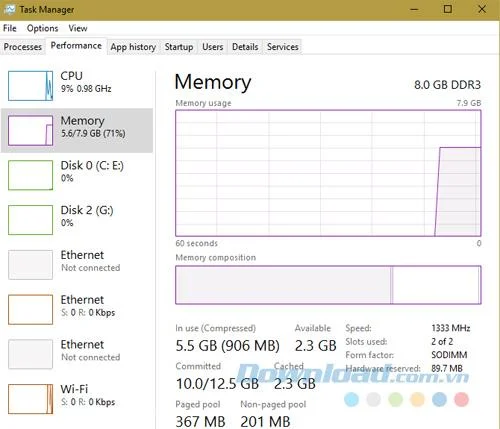
Computer users often prefer one-click solutions to solve their problems. However, while some issues are fairly easily overcome, others require more time and effort. Perhaps, the most common problem is computer speed. Using heavy software or running too many programs at once or a long-used computer puts the system under a lot of stress and sluggish performance. People always want to make their computers run faster without having to pay for upgrades or remove some software.
Download Memory Cleaner Download CleanMem
On the market, there are also many software to help optimize the system. One of the most popular names is Memory Cleaner - a free solution to optimize RAM effectively, helping your computer run smoother. But in today's article, Download.com.vn wants to mention another free software called CleanMem. Like Memory Cleaner, this tool has a good impact on RAM usage, but does it really help speed up your computer? Let's find the answer through the following article.
See also: Instructions for installing and using Memory Cleaner on the computer
What is the mission of CleanMem?
CleanMem is a free tool that helps manage memory on Windows. To help reduce the amount of RAM used by software, CleanMem summons the Windows Memory Management API every 15 minutes to reclaim the used RAM. According to the manufacturer, this is better than allowing Windows to manage the memory itself.
The program works silently by scheduling a task in the Windows Task Scheduler . To see its status and know how the system memory is doing, you can open the included CleanMem Mini Monitor tool . It places an icon in the System Tray, allowing you to see the amount of RAM being used in your system. You can also create shortcuts to run CleanMem at any time.
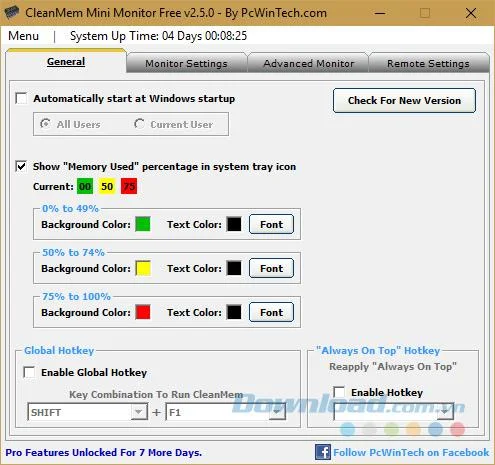
On the plus side, CleanMem does not attempt to fight the standard Windows memory manager. It simply requires Windows to perform within an established schedule, rather than allowing it to execute itself. However, we need to discuss why this tool should not be used on your system.
Note that Panda Antivirus disables downloading of CleanMem as a threat in this test, so you should consider before deciding to use CleanMem.
How does memory work?
RAM or random access memory is a component that a computer uses to temporarily store running processes. RAM is not saved when the computer is turned off. When you open the Microsoft Word window, the windows put that process in RAM. If the computer is powered off after five minutes, your document will be lost, unless you have saved it to your hard drive.
Obviously, the more programs running simultaneously, the more RAM the computer uses. To overcome this limit, your computer uses a file called a page file. This is a small amount of your hard drive for pretending to be RAM. When your computer starts running out of RAM, it uses a page file to manage older processes.
In general, the larger (and cheaper) computer storage media are, the longer the access time will be. Your Dropbox cloud storage may have a terabyte of space, but downloading files from it will take quite a long time. In contrast, loading a process from RAM only takes a fraction of a second, but most people don't have more than 8 or 16 GB of RAM installed.
As you can imagine, juggling a hard drive is much slower than juggling around RAM. You will see a decrease in performance when this usually happens. CleanMem exists to keep Windows from relying on page files. However, this is a "poor" solution to the problem.
Why is CleanMem not effective?
- First, CleanMem will not make your computer run faster.
- Second, while CleanMem does not conflict with Windows memory management, it does one thing that needs attention.
Windows has done a good job of managing memory well. It does not need a reminder of when to collect rubbish. Perhaps this is more important in older versions of Windows, but the modern versions are completely solid.

While cleaning memory has no effect, it is not useful (register cleaning is worse). CleanMem can get memory from a program, such as Photoshop when it's not working in the background. Photoshop will need that memory back when you return to using the program. So, why take time to take and return RAM to a program?
What should be used instead?
There are many ways to improve RAM if you need it. The best option is to install more RAM on the system. Investing in upgrading RAM will significantly improve computer performance.
Even if you don't have the money to upgrade, you can still use alternative software to reduce RAM usage. Consider removing software that starts with the system and uninstalling programs you no longer use so they don't run in the background.
In a nutshell, CleanMem is an unnecessary solution to a problem that few PC users encounter. If you have less memory in your system that makes Windows use page files, the best solution you can do is to add more RAM. CleanMem's solution is to constantly take RAM from the processes you are using to make the overall utilization rate look better.
See also: Summary of tips to help your computer run faster - Part 1