A trapezoid is a convex quadrilateral with two parallel sides, called the bases, and the remaining sides are called the lateral sides. The formula for calculating the perimeter of a trapezoid and the area of a trapezoid is one of the basic mathematical knowledge that is often applied in both study and life. The following article will introduce to you the formula for calculating the area of a trapezoid and the length of the base of a trapezoid, please refer to it.
Table of Contents
Formula for calculating the area of a trapezoid
There is a trapezoid ABCD with base AB length a, base CD length b and height h.
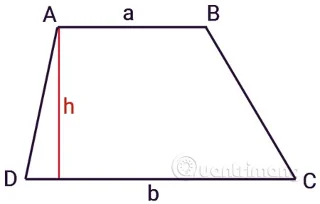
The area of a trapezoid is equal to the average of the two bases multiplied by the height between the two bases.
In there:
- S is the area of the trapezoid.
- a and b are the lengths of the two base edges.
- h is the height from base edge a to b or vice versa (distance between 2 base edges).
There is also a poem about calculating the area of a trapezoid that is quite easy to remember as follows:
Want to calculate the area of a trapezoid
We add the big bottom and the small bottom together.
Add and multiply by height
Divide in half and take in half, it will come out anyway.
Formula for calculating the area of a trapezoid when knowing 4 sides (advanced problem)

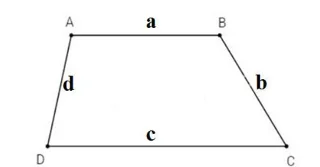
In case the problem gives data on the length of 4 sides, clearly stating the base side a, c with base side c being larger than base side a, the side sides are b and d, then you can calculate the area of the trapezoid using the following formula.

In there:
- S: Area
- a: small base
- c: large base edge
- b, d: sides of trapezoid
How to calculate the area of a square trapezoid
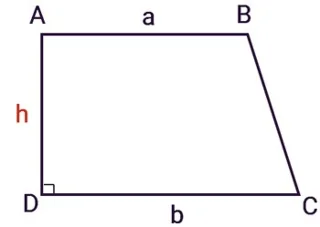
A right trapezoid is a trapezoid with one right angle. The side perpendicular to the two bases is also the height h of the trapezoid.

The general formula for calculating the area of a right trapezoid is similar to that of a regular trapezoid: the average of the two base sides multiplied by the height between the two bases , however the height here is the side perpendicular to both bases.
In there:
- S is the area of the trapezoid.
- a and b are the lengths of the two base edges.
- h is the length of the side perpendicular to the two bases.
How to calculate the area of an isosceles trapezoid
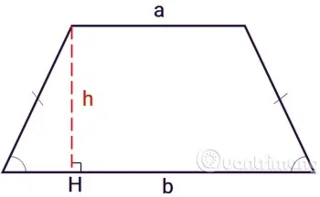
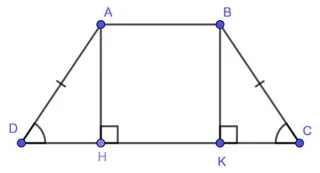
An isosceles trapezoid is a trapezoid whose two adjacent angles are equal. The two sides of an isosceles trapezoid are equal and not parallel.

In addition to applying the formula as usual to calculate a trapezoid, you can also divide the isosceles trapezoid into smaller parts to calculate the area of each part and then add them together.

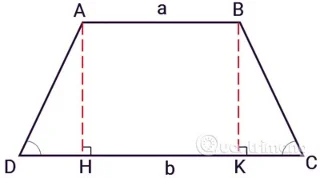
For example, the isosceles trapezoid ABCD has 2 equal sides AD and BC. With heights AH and BK, the trapezoid will be divided into 1 rectangle ABKH and 2 triangles ADH and BCK. Apply the formula for calculating the area of a rectangle for ABHK and the area of a triangle for ADH and BCK then add all the areas to find the area of trapezoid ABCD.
Specifically like this:
And SADH = SBCK (easy to prove), we get:
Calculate the length of the base of the trapezoid
Knowing the area, height and length of one side of the base, you can calculate the length of the remaining side as follows:
Types of math to calculate the area of a trapezoid
Example 1: Calculate the area of a trapezoid
Calculate the area of a trapezoid knowing that the length of the two bases are 18cm and 14cm respectively; the height is 9cm
Prize:
Applying the formula for calculating the area of a trapezoid we have:
So the area of the trapezoid is 144cm2
Example 2:
There is a trapezoidal piece of land with a small base of 24m and a large base of 30m. Extend the two bases to the right of the land with the large base added by 7m and the small base added by 5m to obtain a new trapezoidal piece of land with an area 36m2 larger than the original area. Calculate the area of the original trapezoidal piece of land.
Prize:
According to the problem, the increased area is the area of a trapezoid with a large base of 7m and a small base of 5m. Therefore, the height of the trapezoidal plot of land is: h = (36 x 2) : (7 + 5) = 6m
The initial area of the land is: S = 6 . (24 + 30) : 2 = 162m²
Lesson 3:
Given a square trapezoid with a distance of 2 bases of 16cm, the small base is ¾ of the large base. Calculate the length of the 2 bases when knowing the area of the square trapezoid is 112cm².
Prize:
The distance between the two bases in a right trapezoid is the height of the trapezoid, so:
The total length of the two bases is (112 x 2) : 16 = 14cm
We call the length of the small base a, the length of the large base b, we have:
a + b = 14 and a = ¾ b
So a = 14 x 4: 7 = 8cm
Therefore, small base = 34/7 cm, large base 64/7 cm
Example 4: Isosceles trapezoid ABCD (AB//CD) has AB = 5cm, CD = 13cm, AD = 5cm. Calculate the area of trapezoid ABCD?
Prize:

Let AH and BK be the two heights of the trapezoid. Then, ABKH is a rectangle, we have:
Applying the Pythagorean theorem to right triangle AHD we have:
So: AH = 3cm
So the area of trapezoid ABCD is:
Above is an article by Quantrimang.com about the most standard formula and method to calculate the area of a trapezoid. Hope the article will be useful to you!