Home
» Share
»
Goal Setting for the Rest of 2026: Reset, Refocus, and Finish Strong
Goal Setting for the Rest of 2026: Reset, Refocus, and Finish Strong
There is one useful update to bring into goal setting for the rest of 2026: persistence is not always the smartest response to a difficult goal. A major meta-analytic review published in the February 2026 issue of Nature Human Behaviour synthesized 1,421 effect sizes from 235 studies on goal disengagement, reengagement, and flexibility. The authors found that different forms of goal adjustment have distinct antecedents and outcomes, while also cautioning that the overall evidence base is still only low to moderate in quality because many studies are cross-sectional and heterogeneous. The practical message is not “quit when a goal gets hard.” It is that effective self-regulation includes deciding when to persist, when to change the route, and when a goal no longer deserves your limited time and energy. See the 2026 Nature Human Behaviour meta-analysis on goal adjustment.
That is especially relevant in mid-September 2026. There are just over 15 weeks left before December 31. That is enough time to make meaningful progress, but not enough time to treat every unfinished January resolution as equally important. The best plan for the rest of the year is a reset: keep the goals that still matter, revise the ones that need a different route, deliberately shelve some, and turn the remaining priorities into actions you can repeat every week.
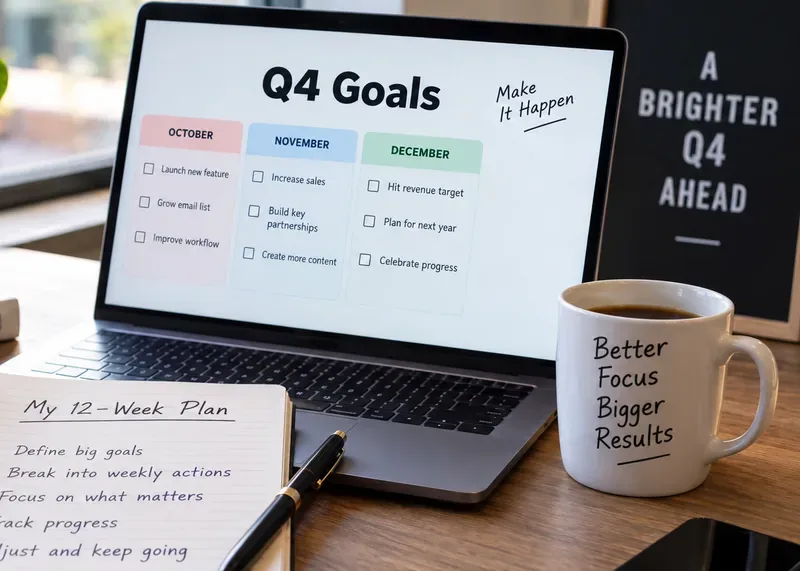
A practical year-end reset starts by looking at the actual time left, choosing a small number of priorities, and turning them into actions that fit your weekly calendar.
Start by deciding what deserves the rest of your year
Do not begin by adding new goals. Begin with the goals already competing for attention. Write each meaningful goal from 2026 on one page and classify it into one of four categories:
Keep: the outcome still matters, the deadline is realistic, and you have enough control or resources to pursue it.
Revise: the direction is still right, but the scope, deadline, strategy, or success measure needs to change.
Shelve: the goal matters, but another season would be better. Shelving is a deliberate pause, not a hidden failure.
Stop: the goal no longer fits your values, circumstances, opportunity cost, or available resources.
This is where the 2026 goal-adjustment research is most useful. A mature plan does not judge every change as lack of discipline. If you started the year planning to change careers but a family responsibility now requires stability, “apply to 40 jobs by December” may be a poor goal even if career growth still matters. A revised goal such as “complete two portfolio projects and have five exploratory conversations by December 15” may preserve the direction while matching reality.
Choose one to three outcomes, not a dozen priorities
Goal-setting research has long found benefits from clear, challenging goals under the right conditions. Locke and Latham's influential review of decades of research describes how goals can direct attention, mobilize effort, increase persistence, and motivate strategy development. But difficult goals are useful only when people are committed, have adequate ability and resources, and receive feedback. The original review is available through PubMed's record of Locke and Latham's goal-setting theory review.
For the final months of a year, fewer goals usually make the tradeoffs visible. A useful filter is:
Question
Why it matters
Would completing this meaningfully improve my life, work, health, or finances?
Importance protects you from filling the list with easy but low-value wins.
Can I influence the result before year-end?
Goals dominated by external decisions create poor feedback loops.
What will this goal displace?
Every serious goal consumes time, attention, money, or recovery.
Can I name the weekly behaviors that make progress more likely?
If you cannot identify actions, the “goal” may still be only a wish.
A goal such as “get promoted before December 31” is partly controlled by your employer. A better structure is to keep the promotion as an outcome while focusing weekly effort on controllable inputs: finish a high-impact project, document business results, ask for a role-calibration meeting, close identified skill gaps, and build relationships with relevant decision-makers.
Separate outcomes from lead actions
One of the simplest ways to make year-end goals more actionable is to track two levels at once.
Outcome measures tell you whether you are moving toward the result. Examples include revenue, body weight, savings balance, applications submitted, or a project milestone.
Lead actions are the repeatable behaviors you can directly control. Examples include making five sales calls, strength training three times, transferring a fixed amount on payday, studying for four focused hours, or completing one portfolio artifact each week.
Outcomes matter because they tell you whether the strategy works. Lead actions matter because they tell you what to do today. If you track only outcomes, you may spend weeks staring at a number you cannot directly change. If you track only activity, you may stay busy with actions that are not producing results.
Turn intentions into if-then plans
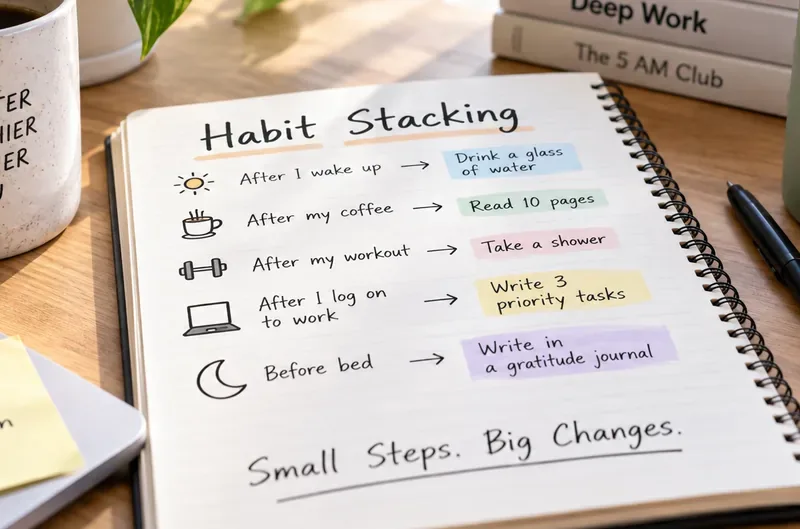
A goal such as “work on my certification more consistently” leaves a decision to be made every day: when, where, and under what conditions will you actually study? Implementation intentions solve part of that problem by linking a situation to a behavior: If situation X occurs, then I will do behavior Y.
Research led by Peter Gollwitzer and colleagues has examined implementation intentions for decades, and a meta-analysis of the approach found benefits for translating intentions into action. You can review the publication record on the NYU Motivation Lab's publication page for Peter Gollwitzer.
For the rest of 2026, useful if-then plans might look like this:
If I finish breakfast on Monday, Wednesday, and Friday, then I will walk for 30 minutes before opening work messages.
If I receive my paycheck, then I will transfer $300 to savings before discretionary spending.
If it is 7:30 p.m. Tuesday or Thursday, then I will study for 45 minutes at my desk with my phone in another room.
If a meeting is canceled, then I will use the first 30 minutes of that block on my highest-priority project instead of checking social media.
The plan should remove ambiguity, not create an elaborate productivity ritual. The more predictable the cue and the more specific the response, the easier it is to act without renegotiating the goal every time.
Build a weekly scorecard you will actually review
A goal that disappears between planning sessions is unlikely to improve. A 2016 meta-analysis of 138 studies involving 19,951 participants found that interventions designed to increase progress monitoring improved both monitoring frequency and goal attainment. Effects on attainment were larger when progress was physically recorded or reported publicly. Read the progress-monitoring meta-analysis on PubMed.
You do not need a complex dashboard. Use one page with four columns:
Goal: the outcome you want by a specific date.
This week's actions: the few behaviors that should move it forward.
Actual: what you completed.
Adjustment: what you will change next week based on the evidence.
A five-minute Friday review is better than a perfect tracker you abandon after two weeks. Make the review recurring on your calendar, and keep the scorecard somewhere visible enough that it cannot quietly disappear.
Use difficult goals carefully
A 2017 systematic review and meta-analysis of randomized trials found a small positive unique effect of goal setting on behavior change across many contexts. The analysis also suggested larger effects for difficult goals and for goals that were public or group-based, although those findings do not mean “harder is always better.” See the 2017 goal-setting meta-analysis.
For a short year-end window, challenge should come from focus and meaningful effort, not from impossible volume. “Publish one excellent research report by November 30” can be demanding and useful. “Write three books, launch two businesses, lose 40 pounds, learn a language, and rebuild every relationship before New Year's Eve” is not ambitious goal setting; it is a planning failure.
Make sure the goals are actually yours
Goals tend to be easier to sustain when they fit personal values and interests rather than being driven entirely by guilt, comparison, or external pressure. Research on self-concordance found that personally endorsed goals were associated with stronger progress, and that self-concordance could work together with implementation planning. See the study on self-concordance and implementation intentions.
Ask one uncomfortable question: If nobody could see the result, would I still want this? If the answer is no, investigate why the goal is on your list. Some externally motivated goals still matter—paying debt or meeting a professional requirement may not be exciting—but knowing the real reason helps you design a plan that does not depend on borrowed enthusiasm.
A realistic example for the final 15 weeks
Suppose your broad goal is “get healthier before 2027.” That is too vague to guide a Tuesday afternoon. A stronger plan might be:
Outcome: complete 45 strength-training sessions between September 15 and December 31 while improving consistency with sleep.
Lead actions: train Monday, Wednesday, and Saturday; prepare clothes the night before; shut down work by 9:30 p.m. on weeknights; record each session immediately after finishing.
If-then plan: if the planned gym session becomes impossible, then do a 25-minute home session before dinner rather than skipping the week entirely.
Weekly review: count completed sessions, note why any were missed, and change the environment before changing the goal. If repeated pain, illness, or medical concerns emerge, the plan should be reconsidered with appropriate professional advice rather than pushed through blindly.
The same structure works for career, finance, study, creative work, or relationships. The exact metric changes; the logic does not.
Do not let a bad week become a new identity
Progress is rarely linear. Missing a week is information, not a verdict. Before abandoning a goal, diagnose the cause:
Was the goal too large for the available time?
Was the action poorly scheduled?
Did an external event temporarily disrupt the plan?
Is the strategy ineffective even though effort is consistent?
Has the goal become less important than another responsibility?
Then choose the smallest appropriate adjustment. Change the schedule before changing the objective. Change the strategy before questioning your ability. Reduce scope if the deadline is fixed. And when a goal has truly become unattainable or no longer worth its cost, use the 2026 evidence as permission to disengage deliberately and redirect effort rather than continuing only because you once wrote it down.
Your rest-of-2026 weekly review
Use these questions once a week until year-end:
What did I say mattered this week?
Which lead actions did I actually complete?
What measurable progress occurred?
What got in the way: skill, time, energy, environment, or strategy?
What will I keep, change, delegate, postpone, or stop next week?
What is the single most important action I can schedule now?
That final question matters because planning should end in a calendar, not in inspiration.
The bottom line
The rest of 2026 does not need a dramatic reinvention. It needs a smaller set of meaningful targets, realistic tradeoffs, clear lead actions, reliable cues, visible progress tracking, and permission to adjust when evidence says the plan is wrong.
Choose one to three outcomes that would genuinely matter by December 31. Decide what you will do each week. Schedule those actions before the calendar fills itself. Review the evidence every seven days. Persist when the goal still makes sense—and adjust without guilt when it does not. That is a stronger year-end strategy than trying to rescue every resolution you made in January.