Home
» Share
»
The 12-Week Year for Q4: A Practical Plan to Finish the Year Strong
The 12-Week Year for Q4: A Practical Plan to Finish the Year Strong
The most useful way to apply the 12-Week Year to Q4 is simple: stop treating the quarter like a three-month catch-up sprint. Choose a very small number of measurable outcomes, translate them into actions you can complete every week, protect time for those actions, and review execution before the next week begins. If a goal cannot be connected to weekly behavior you can actually control, it is not ready for a 12-week plan.
That is the core advantage of the framework popularized by Brian P. Moran and Michael Lennington: it shortens the planning horizon so that distant annual intentions become near-term commitments. Wiley describes the method as replacing the traditional 12-month execution cycle with a 12-week one, supported by planning, scorekeeping, process control, time use, accountability, and a review period. The current Wiley listing identifies a 2025 edition of the book, while the original Wiley edition dates to 2013. Review Wiley's current description of The 12 Week Year.
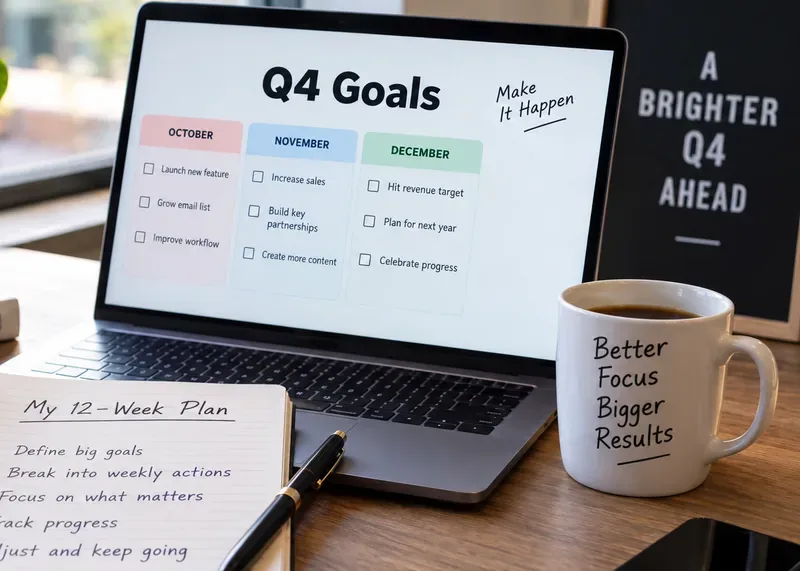
A focused Q4 setup works best when quarter-level outcomes are translated into visible weekly actions and reviewed regularly.
The key idea: Q4 needs fewer goals, not more pressure
A common Q4 mistake is to collect every unfinished annual objective and label the pile a priority list. That usually creates competing commitments, not focus. A 12-week cycle works better when you deliberately limit the number of outcomes that deserve concentrated effort.
For an individual professional, one to three major outcomes is often a workable range. This is a practical recommendation rather than a universal rule from the book. A sales leader might choose “create $500,000 in qualified pipeline,” while a product manager might choose “ship the onboarding redesign and raise activation from the current baseline to an agreed target.” The exact number of goals should shrink as each goal becomes more complex or more dependent on other teams.
This emphasis is consistent with decades of goal-setting research. Locke and Latham's review of goal-setting theory describes how goals influence attention, effort, persistence, and strategy, while also noting that the effect of goals depends on factors such as task complexity, ability, commitment, and feedback. Read the PubMed record for Locke and Latham's goal-setting review.
Use this when: you can define a meaningful result, you have enough control to influence it, and you can identify actions that should move it. Use a different approach when: the work is primarily exploratory, depends on an uncertain external decision, or requires discovery before a credible outcome can be set.
Fit the 12 weeks inside Q4 instead of forcing the calendar
Q4 is roughly 13 weeks, which is convenient because the 12-Week Year also includes a concept of a 13th week for reflection and reset. For Q4 2026, one clean Monday-to-Sunday cycle runs from October 5 through December 27, leaving the final days of December for review, cleanup, celebration, and planning the next cycle. You do not have to use those exact dates; the point is to give the execution cycle a clear beginning and end.
If your company operates strictly by calendar month, start October 1 and define the first or last week as a shortened week. If your industry enters a holiday slowdown in late November or December, reduce planned capacity before the cycle starts instead of pretending every week will be equally productive.
Example: a consulting team expecting client availability to drop during Thanksgiving and the final two weeks of December might build its most important client interviews and workshops into Weeks 1–7, then reserve later weeks for analysis, delivery, follow-up, and work that does not require synchronous client participation.
Turn each outcome into weekly lead actions
An outcome such as “close $150,000 in new business” is measurable, but it is not a task. The weekly plan needs lead actions: behaviors that are closer to your control and plausibly connected to the result.
Complete scheduled design reviews, user tests, engineering checkpoints
Launch date and activation rate
Build a consistent exercise routine
Three scheduled training sessions and one weekly meal-prep block
Sessions completed, fitness or health metric chosen with appropriate professional guidance
The lead actions should be specific enough to schedule. Research on “implementation intentions” is relevant here: a 2006 meta-analysis by Peter Gollwitzer and Paschal Sheeran found that plans specifying when, where, and how to act improved goal attainment across the studies they reviewed. That evidence does not prove the branded 12-Week Year system itself, but it supports the broader idea that intentions become more actionable when behavior is tied to concrete situations. Read the original implementation-intentions meta-analysis.
Instead of writing “work on portfolio,” write “Tuesday and Thursday, 7:30–9:00 a.m.: complete one case-study section before opening email.” The second version gives the goal a trigger, a place in the calendar, and a defined action.
Score execution separately from results
One of the most useful features of the system is separating what you did from what happened. The official 12 Week Year weekly scorecard tracks completed tactics against tactics due. Its basic execution score is completed planned tactics divided by total planned tactics, expressed as a percentage. See the official Weekly Plan & Scorecard.
Suppose you planned eight meaningful actions and completed six. Your execution score is 75%. That number does not tell you whether the strategy is good; it tells you whether you executed the strategy you said you would execute. You still need a separate outcome measure to learn whether the plan is working.
This distinction prevents two bad conclusions. First, a disappointing result does not automatically mean you failed to execute. Market conditions, customer timing, injuries, technical issues, or other external factors may affect the outcome. Second, a high execution score does not prove the tactics are effective. If you repeatedly execute well but the lag measure does not move, the strategy may need to change.
Protect the work on your calendar
The official system emphasizes intentional time use, including time blocks for strategic work and handling lower-value or reactive tasks. The current Achieve system page describes time use as a discipline for protecting what matters most and scorekeeping as a way to make execution visible. Review the official 12 Week Year system overview.
In practice, your Q4 plan should claim calendar space before the week fills with meetings. A founder might protect three 90-minute product blocks each week. A job seeker might reserve two mornings for applications and networking. A manager might protect a Friday review block to update metrics and decide next week's priorities.
The trade-off is real: protected focus means saying no, delaying lower-value work, or negotiating expectations. If your role is highly reactive—customer support, incident response, emergency care, operations—use shorter focus blocks and larger buffers instead of copying a schedule designed for uninterrupted knowledge work.
Build a weekly operating rhythm you can maintain
A sustainable cycle needs a repeated review, not constant replanning. At the end of each week, compare planned actions with completed actions, update the outcome metric, identify one or two causes of slippage, and set the next week's commitments. Keep the review short enough that you will still do it during a difficult week.
A useful weekly review can answer five questions:
What did I commit to?
What did I actually complete?
What moved in the outcome measure?
What blocked execution or made a tactic ineffective?
What will I keep, change, remove, or reschedule next week?
If you lead a team, the review can be shared, but avoid turning it into a status theater meeting. The score is most useful when it helps the team detect execution problems early rather than punish people for a bad week.
A concrete Q4 example
Imagine a freelance designer whose Q4 objective is to generate $30,000 in signed projects while avoiding the usual December scramble. The designer starts with three weekly lead actions: contact 15 well-matched prospects, ask three past clients for referrals, and publish one portfolio case study or educational post. Two 90-minute prospecting blocks are placed on the calendar before client meetings are accepted.
After three weeks, execution is high but qualified conversations are low. That is useful information. Instead of simply “working harder,” the designer changes the target list and outreach message while keeping the weekly measurement structure. By Week 6, conversations increase. In Week 9, holiday schedules reduce response rates, so the designer shifts more time toward follow-ups, January bookings, and collecting deposits for work that will begin after New Year's Day.
The point is not that this exact plan guarantees $30,000. It does not. The value is that the designer can see whether the problem is execution, tactic quality, timing, or the original target—and can adapt while there is still time left in the quarter.
When the 12-Week Year is a strong fit
This approach is especially useful when you have a clear outcome, a meaningful but limited horizon, measurable weekly behavior, and enough autonomy to schedule the work. It can work well for sales, product launches, writing projects, job searches, learning goals, operational improvements, and many personal projects.
It is less suitable as a rigid system when success depends mostly on discoveries you have not made yet. Early-stage research, complex investigations, medical treatment outcomes, legal proceedings, and initiatives waiting on regulatory or executive approval may need milestone-based planning rather than a fixed output target. In those situations, define the 12-week goal around controllable progress—experiments run, evidence gathered, decisions resolved, or milestones reached—rather than promising an outcome you cannot responsibly control.
Common ways Q4 plans fail
Too many “top priorities”
If everything matters, the weekly plan becomes a task dump. Remove or defer goals until the most important work fits your actual capacity.
Measuring only the final outcome
Revenue, weight, launch dates, and promotion decisions are lag measures. Pair them with weekly actions so you can diagnose the process before the quarter ends.
Planning for an imaginary perfect week
Q4 often includes holidays, year-end reviews, budget work, school breaks, travel, and family commitments. Put known constraints into the calendar before assigning tactics.
Changing the plan every time a week goes badly
One weak week may be noise. Change tactics when evidence suggests the strategy is failing or circumstances have materially changed, not simply because execution felt uncomfortable.
Using the framework as a reason to overwork
The method is about shortening the execution horizon, not compressing 12 months of labor into 12 weeks. A plan that requires sustained sleep loss, chronic overtime, or impossible daily capacity is not focused; it is overloaded.
Your Q4 starting point
Before Q4 begins, write one sentence for each result that genuinely matters. Add a measurable finish line, list the few recurring actions most likely to move it, and put those actions into real calendar space. Then decide when you will score and review the week.
For Q4 2026, you could begin the cycle on Monday, October 5, run it through Sunday, December 27, and use the remaining days of December for review and transition. If another schedule fits your work better, use it. The calendar is a container; the important part is maintaining a short, visible execution cycle.
The 12-Week Year is most useful when it changes what you do this week. A compelling annual vision can provide direction, but Q4 results are created by the meetings you decline, the focus blocks you protect, the actions you complete, and the adjustments you make while there is still time to recover. Finish the year by making fewer promises—and executing the right ones consistently.