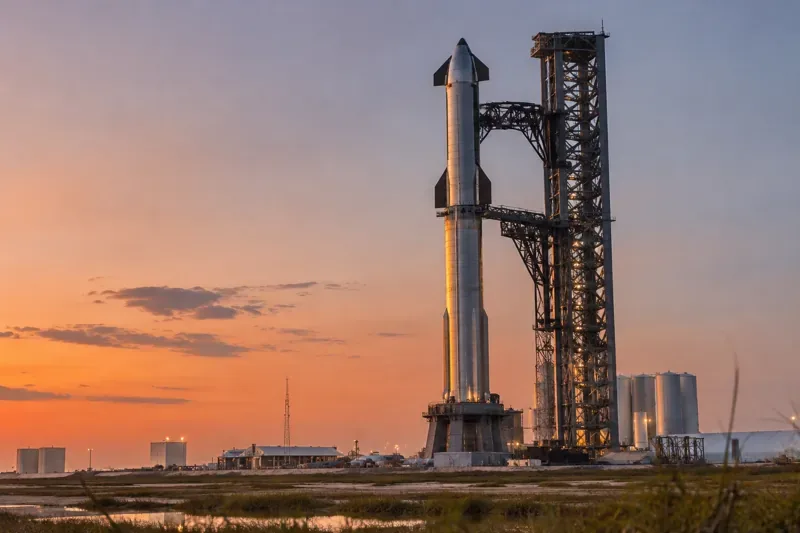
Starship Flight 15: What SpaceX Tested and What Comes Next — Updated Nov. 14, 2026
Starship Flight 15 reached orbit and deployed 26 Starlink satellites, but its booster catch was aborted. Here are the test’s goals and what remains unconfirmed.
Updated November 14, 2026, 8:00 p.m. UTC
Canada’s robotics story in 2026 is moving along two connected tracks: researchers and manufacturers are combining robots with AI, sensors and real-time data, while the federal government is building new pathways to develop and test autonomous systems. The National Research Council’s active Advanced Manufacturing Initiative includes collaborative robots, vision systems and embedded sensors; in July, National Defence launched the Defence Drone Initiative to accelerate development, testing and production of Canadian uncrewed and autonomous systems. Together, these efforts show where robotics is heading: machines that can interpret changing surroundings and adjust their actions, with people still setting goals and managing safety.
That shift matters because a modern robot is not simply a mechanical arm following a fixed sequence. AI can help a system recognize objects, interpret sensor data or choose among permitted actions. The practical result is more flexibility in structured settings such as factories, and new potential for work in environments where conditions are harder to predict. It does not mean every robot can safely perform any task on its own.
Robotics brings together a body that can move or manipulate objects, sensors that measure its surroundings, and software that turns those measurements into action. A robot may use cameras, depth sensors, force sensors, wheel encoders or satellite navigation, depending on the task. Its control system compares what it senses with the task it has been assigned, then commands motors or other actuators.
Autonomy comes in degrees. A conventional industrial arm might repeat a tightly defined motion inside a safeguarded cell. A mobile robot can map a facility and route around obstacles. A more adaptive system may use machine-learning models to classify an unfamiliar object or estimate how to grasp it. Even then, the system operates within limits designed by people. Autonomy describes how much of the task the machine can handle without continuous input; it is not a guarantee of general intelligence or independent judgement.
AI is useful when a robot must make sense of varied information rather than repeat a single exact movement. Computer vision can help identify parts despite changes in orientation. Machine learning can help detect patterns in equipment data. A robot can combine those signals with conventional control rules to adjust its motion. The physical robot still needs reliable actuators, calibration, power, and a safe way to stop when conditions fall outside its operating limits.
Canada’s National Research Council Advanced Manufacturing Initiative describes work on collaborative robots, vision systems and embedded sensors, alongside modelling and advanced sensing and control for manufacturing. This points to an important practical trend: AI is often one part of a wider production system, connected to machinery, quality checks and operational data. A factory’s gains depend on the whole workflow working together, not on a robot arm alone.
On July 23, 2026, the Government of Canada announced the Defence Drone Initiative. The initiative is intended to connect Canadian capabilities in areas including robotics, AI, aerospace, sensors and advanced manufacturing with operational requirements from the Canadian Armed Forces and Canadian Coast Guard. The government says the pathway will support activities such as research, prototyping, testing, demonstrations and potential production. Qualification is not a guarantee of a contract.
The initiative is defence-focused, but it illustrates challenges shared across autonomous robotics: systems must perceive their environment, navigate when conditions are difficult, communicate reliably and fail safely. The National Research Council’s 2026–27 plan also identifies responsible AI, data provenance and security risks in autonomous systems among areas of work. These are signs of active priorities, not proof that a particular capability has already been deployed at scale.
Manufacturing is a natural fit when tasks are repetitive, physically demanding or require consistent handling. Collaborative robots can work near people when the task, equipment and safety measures are designed for that arrangement. Mobile robots may move materials through facilities. Outside factories, autonomous systems could support inspection, agriculture, environmental monitoring, logistics or operations in remote areas. Each use case has different demands for weather tolerance, connectivity, maintenance and human supervision.
For Canadian organizations, the next step is often less dramatic than buying a humanoid robot: identify a task with a clear bottleneck, measure its current cost and error rate, and check whether automation can fit existing equipment and processes. A pilot should track not just speed, but also stoppages, quality, maintenance, safety incidents and the amount of human intervention required. These measures help distinguish a successful demonstration from a system that works reliably in daily operations.
Near-term progress is likely to come through targeted deployments and continued testing. Government initiatives and research programmes can help connect expertise and requirements, but broad adoption depends on proven performance, affordability, skilled staff and clear responsibility when a system makes a mistake. AI can widen the range of tasks a robot attempts; it also raises the importance of testing edge cases, protecting data and defining when a person must take control.
For workers, robotics can shift tasks toward setup, monitoring, maintenance and exception handling, while reducing some manual or repetitive work. The exact effect depends on the workplace and how automation is introduced. Training and consultation matter because successful implementation involves people, processes and equipment together.
Robots are used in specific industrial and service settings, but the level of autonomy varies. Many systems work in bounded environments and still rely on people for oversight, maintenance or unusual situations.
No. AI can help a robot interpret data or choose actions within a task, but its abilities remain limited by its training, sensors, software, operating conditions and safety controls.
Announced in July 2026, it is a federal effort to accelerate development, testing, adaptation and production of uncrewed and autonomous systems for the Canadian Armed Forces and Canadian Coast Guard.
Sources checked November 14, 2026: National Research Council Canada, “Advanced manufacturing initiative” and “2026–27 Departmental Plan”; Department of National Defence, “Government of Canada launches Defence Drone Initiative,” July 23, 2026.
Starship Flight 15 reached orbit and deployed 26 Starlink satellites, but its booster catch was aborted. Here are the test’s goals and what remains unconfirmed.
Starship Flight 15 reached orbit and deployed 26 Starlink satellites, but its Super Heavy booster missed the planned catch. Here are the latest confirmed milestones.
Starship Flight 15 reached orbit and deployed 26 Starlink V3 satellites, but its Super Heavy booster diverted from a planned tower catch. Here is what the milestone could mean for future missions.
Learn how to set a British Gas thermostat while away, when 7°C frost protection helps, and how to reduce heating costs without leaving vulnerable pipes exposed.
British Gas advises using frost protection when freezing weather is possible. Learn when to use 7°C or 5°C, how away mode works, and how to reduce pipe risks.
Flight grounded or canceled? Learn when U.S. travelers qualify for cash refunds, how to rebook, and when hotels, meals or vouchers may be available.
The FAA lifted its nationwide ground stop, but U.S. flight delays and cancellations continue. Check the latest verified status and what travelers should do.
The FAA lifted its Nov. 13 nationwide ground stop after communications issues at air traffic control centers. Learn why flights were halted and why delays continued.
New mobile security robots point to a shift from warehouse automation to home robotics. Here’s what Canadian consumers and workers should know about availability, privacy, and jobs.
A practical guide to modern robotics in Canada, from AI-powered perception and collaborative robots to new federal autonomous-systems initiatives.