Starship Flight 15: What SpaceX Tested and What Comes Next — Updated Nov. 14, 2026
Starship Flight 15 reached orbit and deployed 26 Starlink satellites, but its booster catch was aborted. Here are the test’s goals and what remains unconfirmed.
Updated: November 14, 2026, 9:27 p.m. UTC
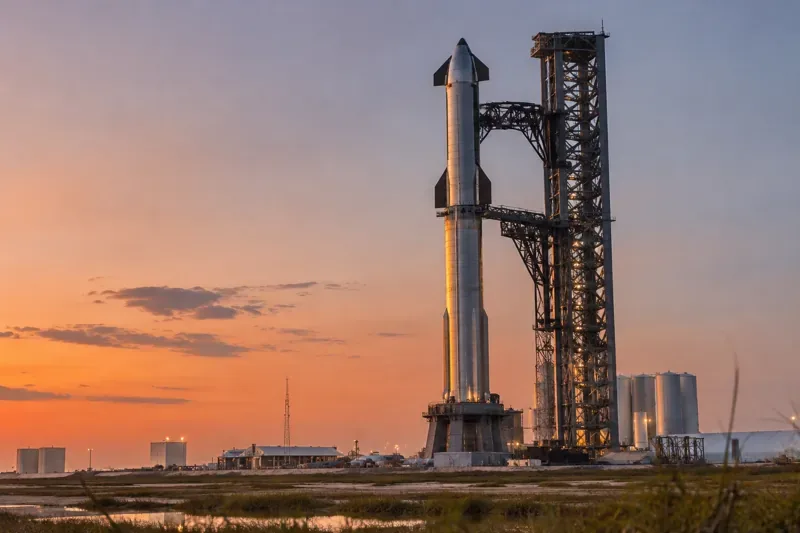
SpaceX’s Starship Flight 15 reached orbit on November 13 and deployed 26 next-generation Starlink V3 satellites, a concrete step toward using the giant rocket for operational satellite deliveries. Its Super Heavy booster, however, did not return for the planned tower catch: an automatic abort sent it to an offshore contingency area, where it was destroyed. SpaceX was still investigating why it was out of position, while the upper stage’s planned return remained pending in the latest report.
The mixed result matters because Starship’s potential impact depends on two separate capabilities: carrying large payloads and reusing both stages. The satellite deployment advances the first; the missed booster recovery shows the second still needs work. Neither result by itself proves that Starship will reduce launch costs or change satellite services on a particular schedule.
Destaques
Flight 15 tested an ambitious recovery profile after Starship’s previous flight reached orbit without an attempt to recover either stage. In the latest available account, the ship deployed 26 Starlink V3 satellites. The booster began its return sequence, but its guidance, navigation and control system triggered an abort because the vehicle was not in the expected position for a safe catch. SpaceX later clarified that the system performed correctly; the cause of the positioning problem remained under investigation. The booster then diverted offshore and was destroyed by its flight termination system. The Associated Press’s Flight 15 report describes the satellite deployment and aborted booster recovery.
This distinction is important: an aborted catch is not evidence that the safety system failed. It is also not a successful recovery. Reusing the booster requires SpaceX to understand why it missed the acceptable return conditions, make any needed changes, and demonstrate repeatable performance on later flights.
A large launcher with substantial payload capacity could give satellite operators more options for deploying spacecraft, especially if it can fly often and recover both stages. SpaceX has described Starship as a future vehicle for Starlink V3 deployments; Flight 15’s delivery demonstrates that the rocket can carry and release this class of payload during a test mission. It does not yet establish a dependable commercial schedule or show that Starship has replaced Falcon 9 for routine satellite launches.
If full reuse and high flight rates become reliable, operators might be able to deploy larger batches, replenish constellations more quickly, or place spacecraft in coordinated groups. Those are conditional possibilities, not confirmed outcomes. Actual effects will depend on demonstrated payload performance, turnaround time, launch-site capacity, licensing, mission reliability, and the economics of operating the vehicle. Satellite customers should continue to plan around available launch services and confirmed contracts rather than assume Starship capacity is already routine.
Recovering a booster and ship could reduce the amount of hardware discarded after each mission and support a faster launch cadence. That could be valuable for missions that need many launches, including a lunar landing architecture requiring propellant to be moved and accumulated in Earth orbit. But reuse only improves mission planning if vehicles can be inspected, refurbished, and relaunched safely and predictably. Flight 15’s booster diversion is a reminder that recovery systems and operational reliability remain central engineering challenges.
NASA’s revised Artemis planning makes those challenges practical. The agency describes SpaceX’s Starship Human Landing System (HLS) approach as launching tanker vehicles to low Earth orbit to transfer cryogenic propellant to a depot before the lunar lander departs. NASA says the updated plan also calls for Starship HLS to rendezvous with Orion in Earth orbit and travel with the crew toward lunar orbit. NASA has not assigned a specific provider to the next lunar landing under its realigned plan; selection depends on lander readiness. NASA’s October 2026 architecture update lays out the revised operations and milestones.
The next useful indicators are SpaceX’s explanation of the booster’s return-position issue, the outcome of the ship’s planned return attempt, and whether a later flight can demonstrate recovery under comparable conditions. For satellite customers, watch for verified payload and launch cadence data, not projected capacity alone. For lunar missions, watch NASA’s HLS milestones, especially propellant-transfer demonstrations and crew-cabin testing. These steps will show whether Starship’s growing flight record can translate into dependable transport for satellites and deep-space missions.
Yes. The flight deployed 26 Starlink V3 satellites, according to reporting on the mission.
No. Its system automatically aborted the planned tower catch and diverted to an offshore contingency area.
That is not established. Starship has demonstrated a satellite deployment, but a reliable operating cadence and routine replacement of Falcon 9 have not been confirmed.
Sources: Associated Press reporting on Flight 15; Space.com’s updated account of SpaceX’s booster-abort clarification; NASA’s Artemis lander architecture update.
Starship Flight 15 reached orbit and deployed 26 Starlink satellites, but its booster catch was aborted. Here are the test’s goals and what remains unconfirmed.
Starship Flight 15 reached orbit and deployed 26 Starlink satellites, but its Super Heavy booster missed the planned catch. Here are the latest confirmed milestones.
Starship Flight 15 reached orbit and deployed 26 Starlink V3 satellites, but its Super Heavy booster diverted from a planned tower catch. Here is what the milestone could mean for future missions.
Learn how to set a British Gas thermostat while away, when 7°C frost protection helps, and how to reduce heating costs without leaving vulnerable pipes exposed.
British Gas advises using frost protection when freezing weather is possible. Learn when to use 7°C or 5°C, how away mode works, and how to reduce pipe risks.
Flight grounded or canceled? Learn when U.S. travelers qualify for cash refunds, how to rebook, and when hotels, meals or vouchers may be available.
The FAA lifted its nationwide ground stop, but U.S. flight delays and cancellations continue. Check the latest verified status and what travelers should do.
The FAA lifted its Nov. 13 nationwide ground stop after communications issues at air traffic control centers. Learn why flights were halted and why delays continued.
New mobile security robots point to a shift from warehouse automation to home robotics. Here’s what Canadian consumers and workers should know about availability, privacy, and jobs.
A practical guide to modern robotics in Canada, from AI-powered perception and collaborative robots to new federal autonomous-systems initiatives.