Starship Flight 15: What SpaceX Tested and What Comes Next — Updated Nov. 14, 2026
Starship Flight 15 reached orbit and deployed 26 Starlink satellites, but its booster catch was aborted. Here are the test’s goals and what remains unconfirmed.
Updated: Nov. 14, 2026, 9:27 p.m. UTC (4:27 p.m. CST at Starbase, Texas). The latest information checked confirms that SpaceX’s Starship Flight 15 reached orbit and deployed 26 Starlink V3 satellites, while the Super Heavy booster’s planned catch at the launch tower was aborted. A return attempt for Ship 42, the upper stage, was planned for later on Nov. 14; its result was not confirmed by the sources reviewed at this timestamp.
Destaques
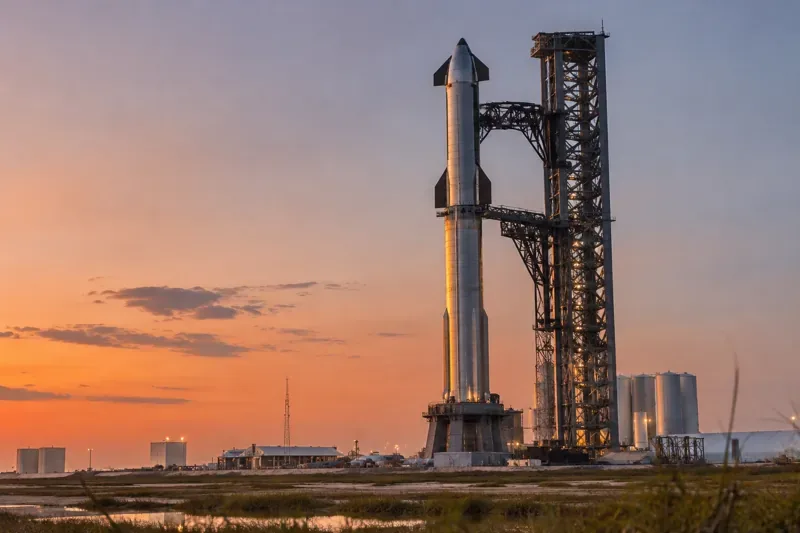
Flight 15 is a test of whether Starship can do more than reach orbit: SpaceX is working toward a system that can return both stages to the launch site for inspection and reuse. The two parts have different jobs. Super Heavy is the first-stage booster that powers liftoff; Ship is the upper stage that continues toward orbit, carries payloads and is intended to return from space.
For this flight, the company aimed to catch Super Heavy shortly after launch and bring Ship back to Starbase after an extended orbital flight. The catch uses large mechanical arms on the launch tower, often nicknamed “chopsticks.” Recovering hardware could reduce refurbishment and replacement needs between flights, but a single test cannot establish a reliable, fast turnaround system.
SpaceX launched Flight 15 from Starbase, Texas, on Nov. 13. The launch and stage separation proceeded, and Ship continued upward while Super Heavy turned back toward the site. SpaceX called off the booster’s planned tower catch; the booster instead came down in the Gulf of Mexico. The Associated Press reported that the booster’s loss prevented the intended “double catch.”
Ship’s orbital phase still achieved important objectives. It reached low Earth orbit and deployed 26 Starlink V3 satellites. Space.com’s Flight 15 mission coverage reported that cameras were used to gather information about the vehicle and heat shield. SpaceX had said the return to Starbase would proceed only if vehicle systems were judged healthy.
A catch attempt tests several systems working together: guidance and navigation, engine performance, vehicle control, communications and the tower’s ability to receive the returning stage. For Ship, the challenge also includes surviving atmospheric reentry and lining up with the launch site for a controlled approach. A successful flight to orbit is valuable data, but it does not by itself prove that the spacecraft can safely return or be caught.
Flight 15’s planned Ship return was listed in an FAA operations advisory for a reentry window beginning Nov. 14 at 20:56 UTC and extending past midnight UTC. That window is a planning notice, not confirmation that a catch occurred. At the update time above, the sources checked did not establish the result of the Ship return attempt. See the FAA operations plan advisory and SpaceX’s Flight 15 mission page.
Full and repeatable reuse could support more frequent launches and make it easier to carry large payloads, including future Starlink spacecraft. Starship is also part of NASA’s plans for lunar exploration. Those are longer-term implications, not outcomes proven by this flight. The system must demonstrate dependable launches, safe returns, successful recovery and eventual reuse across multiple missions.
The immediate lesson is narrower: Flight 15 demonstrated another orbital flight and satellite deployment while revealing that the booster recovery sequence still needs work. The upper-stage return attempt, if confirmed successful, would answer a different question. Until SpaceX reports the result and publishes more flight data, readers should distinguish what the mission accomplished from what it set out to test.
Yes. Ship 42 reached low Earth orbit and deployed 26 Starlink V3 satellites.
The catch was called off and the booster came down in the Gulf of Mexico. The exact cause was not confirmed in the sources reviewed for this update.
The return attempt was planned for Nov. 14, but its outcome was not confirmed by the sources reviewed at 9:27 p.m. UTC.
Starship Flight 15 reached orbit and deployed 26 Starlink satellites, but its booster catch was aborted. Here are the test’s goals and what remains unconfirmed.
Starship Flight 15 reached orbit and deployed 26 Starlink satellites, but its Super Heavy booster missed the planned catch. Here are the latest confirmed milestones.
Starship Flight 15 reached orbit and deployed 26 Starlink V3 satellites, but its Super Heavy booster diverted from a planned tower catch. Here is what the milestone could mean for future missions.
Learn how to set a British Gas thermostat while away, when 7°C frost protection helps, and how to reduce heating costs without leaving vulnerable pipes exposed.
British Gas advises using frost protection when freezing weather is possible. Learn when to use 7°C or 5°C, how away mode works, and how to reduce pipe risks.
Flight grounded or canceled? Learn when U.S. travelers qualify for cash refunds, how to rebook, and when hotels, meals or vouchers may be available.
The FAA lifted its nationwide ground stop, but U.S. flight delays and cancellations continue. Check the latest verified status and what travelers should do.
The FAA lifted its Nov. 13 nationwide ground stop after communications issues at air traffic control centers. Learn why flights were halted and why delays continued.
New mobile security robots point to a shift from warehouse automation to home robotics. Here’s what Canadian consumers and workers should know about availability, privacy, and jobs.
A practical guide to modern robotics in Canada, from AI-powered perception and collaborative robots to new federal autonomous-systems initiatives.