Home
» Today
»
How AI Is Changing UK STEM Jobs and the Skills to Build
How AI Is Changing UK STEM Jobs and the Skills to Build
AI is increasingly part of UK work, but the latest national business data do not show widespread headcount changes tied to adoption. That makes task-level change a more useful focus for STEM workers than treating every AI-exposed role as a job on the way out. Researchers, engineers, software developers, and technical analysts can use AI for first-pass coding, data analysis, image review, literature searches, simulation, or documentation. The valuable skill is knowing when the output is useful, how to check it, and where professional judgment must take over. This is a broad cross-sector reading of current data, not a finding about every STEM occupation. Most STEM workers do not need to become machine-learning researchers; they do need AI and data literacy, strong domain knowledge, verification skills, and safe handling of information.
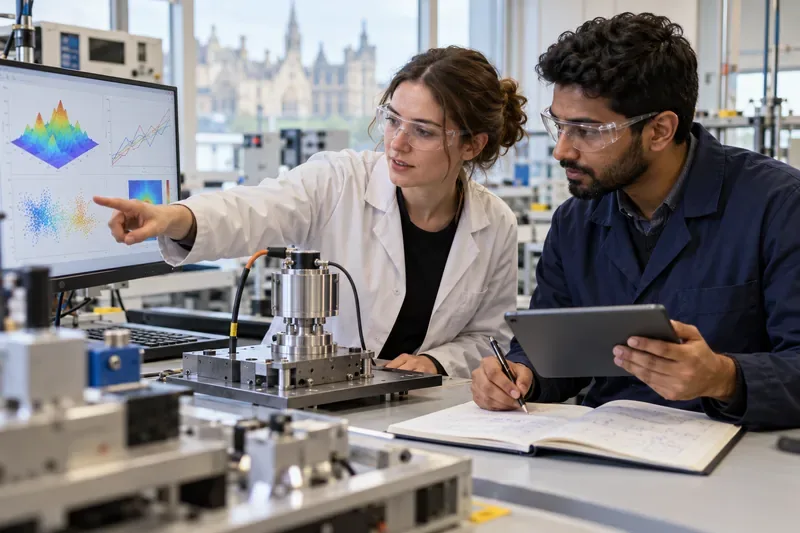
Two STEM colleagues compare a data display with a physical sensor assembly.
What is changing in UK STEM work?
AI tends to affect parts of a workflow before it changes the job title. In software, it can draft code or tests. In a lab, it can help classify images or find patterns in large datasets. In engineering, models can flag unusual sensor readings or help compare design options. These outputs can save time, but someone still needs to define the question, judge whether the data are suitable, and verify results against measurements, technical standards, or a known baseline.
The Royal Society’s report on science in the age of AI describes AI as changing scientific methods and research practice, while emphasizing research integrity, ethics, and the need for scientific communities to oversee AI systems. That points to a shift in the mix of work: less time on some repetitive processing, and more value in experimental design, interpretation, validation, and explaining uncertainty.
What the UK evidence says about adoption and jobs
The Office for National Statistics’ July 2026 analysis found that self-reported AI use among UK businesses with 10 or more employees rose from around 12% in late 2023 to around 35% by June 2026. Adoption differed by industry: 58% of information and communication businesses reported using AI, compared with 13% in construction. The ONS also described adoption as relatively shallow so far: only 10% of AI-using businesses reported extensive use, and AI use had not yet produced widespread changes in overall workforce headcount. These figures are a business survey, not a forecast of job losses or a measure of every worker’s experience.
A 2026 UK AI Skills for Life and Work study projects that jobs involving core AI activities could reach 3.9 million by 2035, with another 9.7 million in roles where AI is adjacent to the work. The study says much of that change is expected to come from AI responsibilities being added to existing jobs, rather than from an equivalent number of brand-new AI jobs. Treat the figures as skills projections, not a promise of new vacancies or a count of roles that AI will replace.
Skills worth building
AI and data literacy. Learn what a tool can and cannot do, what data it uses, and how to give it a well-defined task. Practice checking an answer against source documents, calculations, or a known result instead of treating fluent output as proof.
Statistics, experimental design, and validation. STEM professionals need to spot weak samples, data leakage, false correlations, and misleading benchmarks. Be able to compare an AI-assisted result with a baseline and explain its error rate or uncertainty.
Domain expertise. A model cannot replace knowing whether a result makes sense in the relevant science or engineering context. A biomedical researcher must consider patient-data controls and study design; a civil engineer must check AI-generated recommendations against measurements, safety requirements, and engineering codes.
Technical depth matched to the role. If you build AI systems, prioritize programming, data science, machine learning, model evaluation, and deployment. If you apply AI in another STEM role, build enough Python, SQL, spreadsheets, or data-pipeline skill to inspect and reproduce the analysis you rely on. The government study’s job-posting analysis for 2021–23 found Python, data science, and machine learning among the most-requested skills for AI expert roles; it is a dated snapshot, so check current vacancies before choosing a course.
Privacy, security, and responsible use. Know which data your employer permits in an AI service, how sensitive research or personal information is protected, and how to document decisions. The UK study identifies judging output reliability and keeping information safe as skills that matter across different kinds of AI users.
Communication and collaboration. Explain what the AI contributed, what you checked yourself, and what remains uncertain. These skills help teams combine technical tools with scientific, regulatory, operational, and customer knowledge.
Choose a learning path that fits your work
If you mainly use AI tools, start with a low-risk task such as summarizing public technical documents or drafting a non-sensitive script. Record the time saved, errors found, and checks required. Do not upload confidential data unless your organization has approved the tool and workflow. If the output cannot be checked independently, do not make it the final basis for a safety, clinical, or financial decision.
If your goal is an AI specialist or research role, build deeper foundations in mathematics, statistics, Python, machine learning, data engineering, and model evaluation. The UK study found that only a small share of job postings in its analysis were for AI experts or specialists; most people were expected to use or implement AI within existing jobs. That means a STEM professional can benefit from AI skills without retraining as a full-time data scientist.
Early-career workers should also protect opportunities to learn fundamentals. The government’s Digital and Technologies Jobs Plan says employers should redesign entry-level roles so people can work alongside AI while gaining practical experience, judgment, and oversight skills. For students and career changers, a project portfolio that shows the question, data, AI contribution, validation, and limitations can demonstrate more than a prompt-writing certificate.
A practical self-check
Before relying on AI for a STEM task, ask: Can I explain the problem and data? Can I verify the output against an independent source or test? Have I protected sensitive information? Do I know who is accountable for the final decision? If you can answer those questions and show your work, you are building the skills most likely to travel across UK STEM roles as AI tools change.