Home
» Today
»
How Prediction Markets Work: A Beginner’s Guide to Reading Digital Forecasts
How Prediction Markets Work: A Beginner’s Guide to Reading Digital Forecasts
Prediction markets turn questions about future events into tradable contracts. A typical market asks something that can later be resolved as “Yes” or “No” — for example, whether an economic indicator will exceed a threshold, whether a policy decision will happen by a deadline, or whether a particular event will occur. Traders buy and sell contracts, and the resulting price is often interpreted as the market’s current implied probability.
For beginners, the most useful goal is not to memorize a platform interface. It is to learn how to judge whether a quoted probability is actually informative. A good prediction-market reading comes from four things: a clearly defined question, a credible resolution source, enough liquidity to support a meaningful price, and an understanding that the price is a market estimate rather than a guarantee.
There is also a current regulatory reason to pay attention to contract design. In the United States, the Commodity Futures Trading Commission (CFTC) has been actively revisiting the rules that apply to prediction markets and event contracts during 2026. In March 2026 it opened a new rulemaking process focused on prediction markets, and in September 2026 CFTC staff issued additional guidance warning that certain “mention markets” can present heightened manipulation risk when settlement depends on a person’s discrete conduct. The regulatory framework is still evolving, so users should check current rules and platform eligibility rather than assuming that every digital forecasting market is treated the same way. See the CFTC’s prediction-market explainer, the CFTC’s 2026 prediction-markets rulemaking notice, and the September 2026 CFTC staff advisory.
What is a prediction market?
A prediction market is a marketplace where participants trade contracts whose value depends on the outcome of a future event. The CFTC describes event contracts as derivatives whose value comes from an underlying event. Many are binary: one side pays if the stated event occurs, and the other side pays if it does not.
On an exchange-style platform, the platform does not need to “decide” what probability to display by itself. Buyers and sellers submit orders at prices they are willing to accept, and trades occur when those prices meet. That process creates the market price.
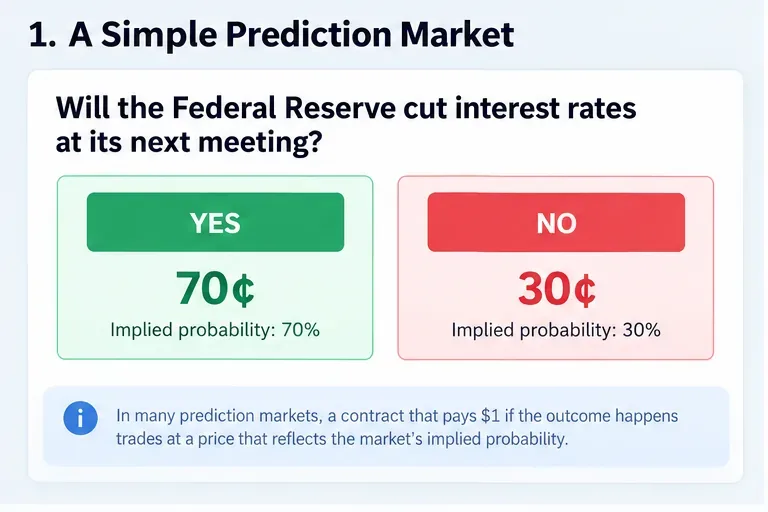
A binary market can express a forecast as two complementary contract prices. A 70-cent Yes price is commonly read as roughly a 70% market-implied probability, not a guarantee.
How does a Yes-or-No contract work?
Imagine a hypothetical contract asking: “Will the Federal Reserve cut interest rates at its next meeting?” Suppose a Yes contract trades at $0.70 and a No contract at $0.30. In a simple binary structure where the correct side settles at $1 and the incorrect side at $0, a Yes buyer paying $0.70 would receive $1 if the market resolves Yes, for a gross gain of $0.30 per contract before fees. If it resolves No, that contract would settle at $0 and the buyer would lose the $0.70 paid.
This $0-to-$1 payoff structure is common, but beginners should not assume every platform or every contract follows exactly the same settlement mechanics. Some markets can include special provisions, cancellation rules, partial outcomes, or platform-specific fee structures. The governing market rules matter more than the headline price.
Does a 70-cent price really mean a 70% chance?
It is reasonable to read a 70-cent Yes price as an implied probability of about 70% in a standard binary market. Both Kalshi and Polymarket describe prices this way in their official educational materials. Kalshi explains that Yes and No prices reflect what participants are willing to trade at, while Polymarket describes market prices as probabilities generated by supply and demand. See Kalshi’s explanation of price formation and Polymarket’s official FAQ.
However, “70%” should be treated as a market-implied estimate, not a measured physical probability. The price can be distorted by thin trading, large individual positions, transaction costs, sudden news, unclear rules, or an unrepresentative group of traders. A market can also be wrong. The practical question is not “Is 70% true?” but “How much evidence is behind this 70% price?”
How the order book creates a market price
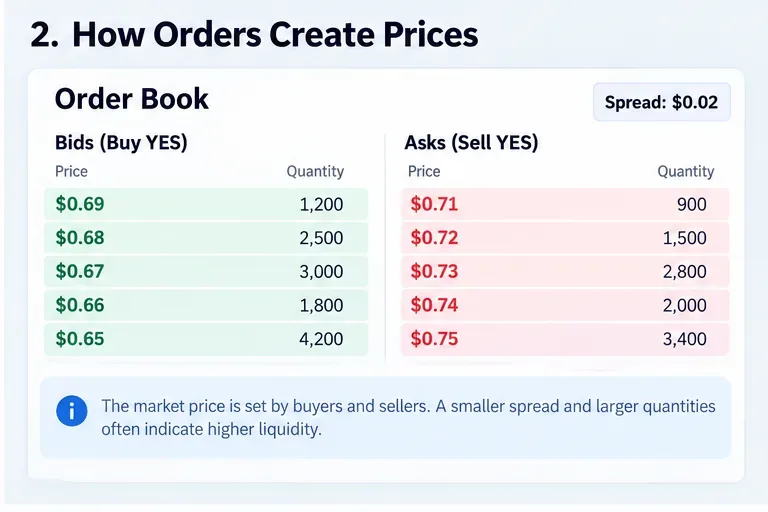
Many prediction platforms use an order book. A bid is the highest price a buyer is currently willing to pay. An ask is the lowest price a seller is willing to accept. The gap between them is the bid-ask spread.
The order book shows the prices and quantities available on each side. A narrow spread and meaningful depth are generally better signs of a usable market price than a lone last-traded number.
For example, if the best Yes bid is $0.69 and the best Yes ask is $0.71, the spread is $0.02. A trade may occur near that range, but a large order can move through several price levels if there is not enough quantity available at the best quote. Kalshi’s official help center explains that larger orders can fill across multiple prices, which means the average execution price can differ from the first price a user sees. See Kalshi’s order-book documentation and its quick-order explanation.
What should a beginner look for?
Narrow spread: a small gap between the best bid and ask suggests buyers and sellers broadly agree on the current range.
Visible depth: meaningful quantities at several nearby prices make the quote less dependent on one small order.
Recent trading: a stale price may not reflect new information.
Reasonable size: if a modest trade would move the price sharply, treat the displayed probability cautiously.
Market rules matter more than the headline question
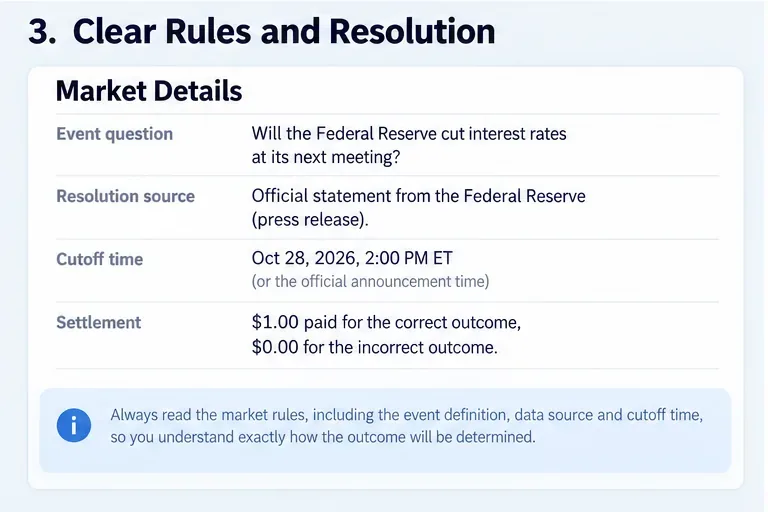
A market cannot be evaluated from its title alone. You need to know exactly what counts as Yes, what counts as No, the cutoff time, the source used to verify the outcome, and what happens if the source is delayed or the event is ambiguous.
Before treating a prediction-market price as meaningful, check the exact event definition, official resolution source, cutoff time, and settlement language.
Kalshi states that each market has its own rules and identifies the source used to determine the outcome. It also notes that settlement can be delayed while the platform waits for official data. That is a useful general lesson even if you use another platform: the resolution source should be authoritative, available, and specific enough to answer the contract question. See Kalshi’s market-rules guide and its settlement FAQ.
A simple quality test for a prediction-market forecast
Before using a market price as an input to a decision, score it informally against five questions:
Question
Stronger signal
Warning sign
Is the event precisely defined?
Clear threshold, date, and terminology
Words such as “major,” “significant,” or “announce” are undefined
Is the resolution source authoritative?
Named government release, court filing, official result, or other primary source
Vague reference to “reports” or social media
Is the market liquid?
Narrow spread with meaningful orders near the current price
Wide spread, sparse depth, little recent trading
Can the outcome be manipulated?
Outcome occurs independently of traders
A person can deliberately trigger the outcome with a small action
Is the information current?
Price has reacted to the latest relevant news
Last trade predates a major development
If several warning signs appear at once, the market price may still be interesting, but it should carry less weight. This is especially important for markets whose settlement depends on wording, appearances, mentions, or other behavior that can be deliberately influenced — precisely the type of concern highlighted in the CFTC’s September 2026 advisory.
Common risks beginners underestimate
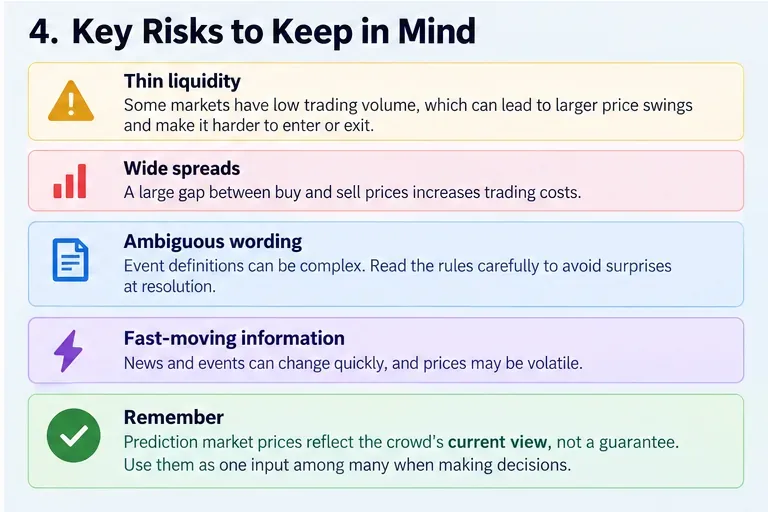
The biggest beginner mistakes often come from market quality rather than the forecast itself: thin liquidity, wide spreads, ambiguous rules, and rapidly changing information can all weaken the signal.
Thin liquidity
A quoted 62% probability is less persuasive if only a few contracts have traded. One participant can move a thin market much more easily than a deep one.
Wide spreads
If buyers are willing to pay 55 cents but sellers want 65 cents, the market does not really have one precise 60% consensus. It has a broad disagreement zone.
Ambiguous wording
Two people can agree on what “probably happens” yet disagree on whether the contract’s exact legal wording resolves Yes. Read the contract, not just the headline.
News shocks
Prediction markets can move quickly. A probability seen in the morning may be obsolete after a policy announcement, injury report, court ruling, economic release, or other new information.
Fees and execution costs
The displayed probability is not the same as your realized return. Platform fees, spread, and slippage can reduce the economics of a trade. Fee schedules vary, so check the platform’s current official pricing before placing an order.
When should you stop trusting the market price?
You do not need to reject a prediction market entirely when conditions deteriorate. Instead, downgrade how much weight you give it. Consider switching from “use the price as a probability estimate” to “use the market only as one noisy signal” when any of the following occurs:
the spread widens sharply;
trading activity falls and the last trade becomes stale;
the market rules become disputed or difficult to interpret;
a new event changes the information set but the market has not repriced;
the resolution source is delayed or contradictory;
the outcome can be intentionally influenced by a participant or subject.
At that point, compare the market with primary data, official releases, polling averages where appropriate, or other independent forecasts. A prediction market is most useful as an information-aggregation tool when participants have diverse information, incentives to correct mispricing, and enough liquidity to express those views.
How to use prediction markets as a beginner
Read the rules first. Confirm the exact event definition, cutoff, and resolution source.
Translate the price carefully. A 70-cent Yes contract is roughly a 70% implied probability in a standard binary structure, not a promise.
Inspect liquidity. Look at the bid, ask, spread, recent trades, and available quantity.
Check what changed. Determine whether important new information has already been reflected in the price.
Know the payoff and costs. Understand settlement, fees, slippage, and the maximum amount at risk before trading.
Use the forecast proportionally. Give more weight to clear, liquid, independently resolvable markets and less weight to thin or ambiguous ones.
Are prediction markets legal everywhere?
No single answer applies to every platform or jurisdiction. In the United States, the CFTC oversees federally regulated commodity-derivatives markets, including event contracts traded on registered markets. The agency’s 2026 materials show that prediction-market regulation is an active area of rulemaking and enforcement policy. Separately, platform access can depend on residence, product type, and current terms of service. Before creating an account or trading, check the regulator’s current information and the platform’s official eligibility rules for your location.
Bottom line
Prediction markets are easiest to understand as markets for event outcomes. Prices emerge because participants disagree, submit orders, and trade. In a simple binary contract, a 70-cent Yes price can be read as roughly a 70% implied probability, but that number is only as useful as the market behind it.
The best beginner habit is to judge the quality of the forecast before judging the forecast itself. Clear rules, authoritative resolution sources, narrow spreads, meaningful depth, and fresh information are positive signs. Thin liquidity, vague wording, manipulable outcomes, stale prices, and rapidly changing news are reasons to lower your confidence. Used that way, prediction markets can be a valuable forecasting input without being mistaken for certainty.