Home
» Today
»
Why MU Stock Is Trending After Micron Earnings—and What It Means for the AI Memory Market
Why MU Stock Is Trending After Micron Earnings—and What It Means for the AI Memory Market
If you opened a market app after Micron’s September 30, 2026 earnings report, you may have seen “MU stock” and “AI memory” searches rising together. It is understandable to ask whether a strong quarter proves the AI boom will keep lifting semiconductor shares. The report gives investors concrete evidence of powerful current demand, but one company’s results cannot guarantee future prices or tell you whether MU is fairly valued.
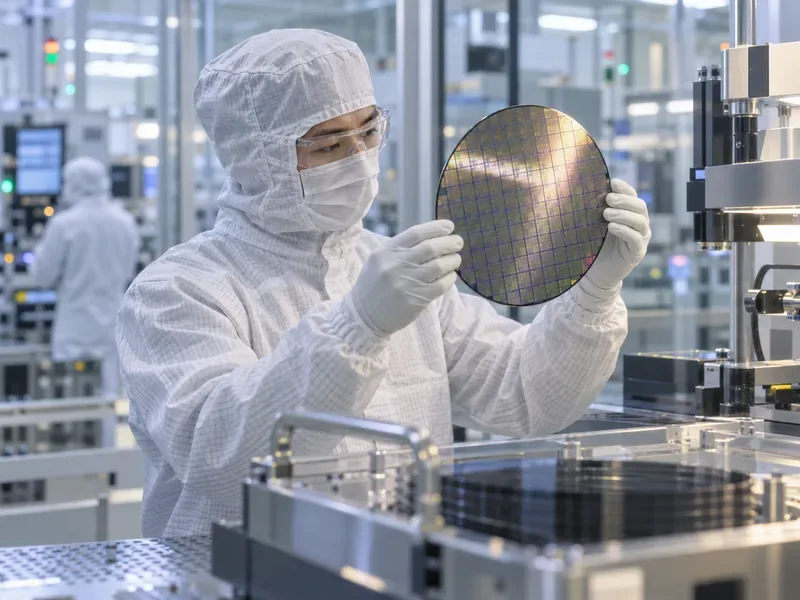
A cleanroom technician examines a patterned silicon wafer, representing the manufacturing capacity behind memory-chip supply.
Micron Technology (Nasdaq: MU) makes memory and storage products, including DRAM, NAND flash and high-bandwidth memory (HBM). Its latest release reported record fiscal fourth-quarter and full-year 2026 results, then forecast another step up for fiscal Q1 2027. The headline figures are striking; the useful next step is to separate reported results, management’s forecast and market risks.
Why is MU stock trending after Micron’s earnings?
The immediate catalyst is the earnings report published September 30. Micron said fiscal Q4 revenue was $54.23 billion, compared with $41.46 billion in the previous quarter and $11.32 billion a year earlier. Non-GAAP diluted earnings per share were $33.42; GAAP diluted earnings per share were $32.87. Those accounting measures are different, so comparisons should use the same basis.
Micron had previously forecast Q4 revenue of $50 billion, plus or minus $1 billion, and non-GAAP diluted earnings per share of $31, plus or minus $1. The final figures came in above the high end of that earlier company outlook. Full-year fiscal 2026 revenue reached $133.19 billion, versus $37.38 billion in fiscal 2025. These comparisons help explain why the report drew attention without relying on a stock-price target or assuming the share price must rise.
The company also projected fiscal Q1 2027 revenue of $61.5 billion, plus or minus $1.5 billion, and non-GAAP diluted EPS of $38.15, plus or minus $1. That is a forecast, not a reported result. It signals management expects momentum to continue into the next quarter, while the actual outcome will depend on demand, production, pricing and other factors.
What do the results say about AI memory demand?
AI systems need more than processors. They also need memory close to those processors so they can access model weights, active data and intermediate calculations quickly. HBM is a specialized form of DRAM that stacks memory dies and uses a very wide interface to move large amounts of data near GPUs and other accelerators. Conventional server DRAM and solid-state storage serve other jobs in the same infrastructure.
Micron’s earnings materials show the strength was broader than one product line. In fiscal Q4, the company reported $18.00 billion in its Core Data Center business unit, $16.28 billion in Cloud Memory, $13.11 billion in Mobile and Client, and $6.82 billion in Automotive and Embedded. These are business-unit figures, not a direct breakdown of AI sales; it would be inaccurate to label all data-center or memory revenue as AI revenue.
Management said HBM revenue grew faster than Micron’s total revenue in the quarter and that agreements were completed for most of its calendar 2027 HBM bit supply. It also said the agreements included significant year-over-year price increases. In prepared remarks, Micron forecast tight industry supply-demand conditions for DRAM and NAND in calendar 2027 and 2028, and HBM shipment growth faster than conventional DRAM through 2028. That is a company forecast based on its view of customers, capacity and the industry; it is not an independently guaranteed outcome.
How should you read the earnings without overreacting?
Start with the evidence that is easiest to verify, then add interpretation:
Check what was reported. Compare actual revenue, GAAP earnings and non-GAAP earnings with the prior quarter, year-ago quarter and Micron’s own previous forecast. Note whether a quoted EPS figure is adjusted or GAAP.
Separate the outlook from the results. The $61.5 billion revenue midpoint and $38.15 non-GAAP EPS midpoint are management’s fiscal Q1 2027 guidance. They are not booked revenue or a promise.
Look beneath the total. Track what the company says about HBM, ordinary server DRAM, NAND storage, customer agreements, pricing and production capacity. AI demand can support several products, but the products do not have identical economics.
Compare with the market’s response over time. Search interest, an after-hours quote and the next regular-session close are different signals. A strong report can be followed by a flat or falling share price if investors expected even more, focus on risks, or change their view of valuation. Check a time-stamped quote rather than treating “trending” as a direction-of-price indicator.
What could weaken the AI memory story?
Memory is a competitive, capital-intensive business. Demand and selling prices can shift as customers adjust inventories and manufacturers add capacity. Micron’s own SEC filing describes intense competition in memory and storage and the risk that industry investment could contribute to DRAM or NAND oversupply. New factories and advanced packaging capacity take time to build, but if supply later grows faster than demand, pricing and margins could come under pressure.
Other uncertainties include whether AI infrastructure spending continues at the pace customers currently indicate, whether customers use memory more efficiently, whether rival suppliers win designs, and whether manufacturing ramps meet schedule and yield targets. HBM is also a component in a larger system: strong demand for accelerators does not automatically mean every chip supplier captures the same revenue or profit.
There is a valuation question too. An excellent business can still be a risky purchase at a price that already assumes unusually strong future growth. The earnings release does not establish that MU is cheap, expensive, or suitable for a particular investor. It reports company performance and management expectations; those are inputs to a decision, not a recommendation.
What should you check next?
For a quick reality check, write down four items before drawing a conclusion: the fiscal Q4 results, the fiscal Q1 guidance, the company’s specific comments about HBM and supply, and the risks it lists in its SEC filing. Then check whether later reports confirm or weaken each point. If you are evaluating the stock, add your own time horizon, risk tolerance and valuation assumptions; do not use search popularity alone as a buy signal.