Jim Farley, Ford, Skilled Trades and AI: Why the Debate Is Trending
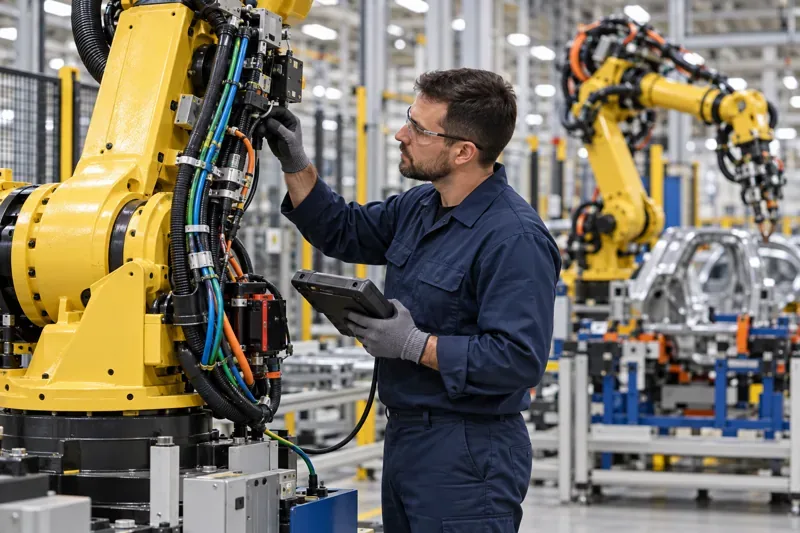
A maintenance technician inspects the cables on an industrial robot in an automotive plant, showing the hands-on work behind automated production.
Jim Farley, Ford’s president and CEO, has put skilled trades in the middle of a timely question: as artificial intelligence (AI) changes office work, who will install, maintain, and repair the physical systems that keep factories, power networks, vehicles, and data centers running? The discussion is trending because it links two worries people are already weighing: whether AI will reduce job opportunities and whether the United States can train enough skilled workers for expanding infrastructure and manufacturing needs.
The answer is not that trades are “AI-proof.” It is that AI and automation affect tasks differently. A person considering a career should compare the actual work, training, local openings, pay structure, safety demands, and schedule of a specific occupation—not decide from a broad claim that one kind of job is safe.
Why are Jim Farley and Ford part of the AI-and-trades debate?
Ford convened the second annual ACCELERATE the Essential Economy gathering in Detroit on September 30, 2026. Ford describes the event as a forum for business and policy leaders, educators, small businesses, and workers to address the skilled-trades pipeline. In a pre-event essay, Farley argued that the country needs stronger routes into work that builds, wires, welds, and repairs essential infrastructure. Ford’s post-event summary said the national report presented there estimates 1.7 million skilled-trades openings per year through 2035 and that training pathways produce 55 people for every 100 workers needed.
Those figures come from a report commissioned by the Alliance for America’s Skilled Trades, a coalition that includes Ford and other employers. They are useful as a signal of the group’s stated workforce concern, but readers should treat them as estimates from an industry-led initiative, not as a guarantee that every listed opening will be available in a particular city or occupation. The report covers 124 occupations across all 50 states, and its own regional detail matters more to a job seeker than one national ratio.
AI enters the debate because factories and service businesses are adding software, sensors, and automated equipment at the same time that employers are asking for technicians who can work with those systems. A robot may repeat a programmed motion reliably; the plant still needs people to install it, notice when it behaves unusually, determine whether a fault is electrical or mechanical, make a safe repair, and verify the line before restarting it. That is a description of work tasks, not proof that every maintenance job will grow or stay unchanged.
What does the employment data say—and what does it not say?
The U.S. Bureau of Labor Statistics (BLS) projects that installation, maintenance, and repair occupations overall will grow 4.6% from 2024 to 2034, adding about 301,400 jobs. In a newer occupation-specific outlook, BLS projects 14% growth from 2025 to 2035 for industrial machinery mechanics, machinery maintenance workers, and millwrights, with about 51,900 openings a year on average. BLS says continued adoption of automated manufacturing machinery is expected to create demand for workers who keep the equipment in working order.
That is a more precise point than saying “AI creates trade jobs.” The BLS projection concerns a defined occupation group and a decade-long model; it does not predict the fate of each Ford facility or measure every AI deployment. BLS also projects declines for some occupational groups: its 2024–34 table shows office and administrative support down 3.9%, while production occupations are projected down 1.1%. These figures reflect many forces, including technology, business demand, and replacement needs. They do not mean that every office worker will lose a job or that all production work is disappearing.
BLS explicitly cautions that projections are not promises about the future. AI’s labor-market effect remains uncertain, and actual employment can differ from the assumptions. So Farley’s argument is best understood as a case for investing in skills and training—not a reliable forecast that one career category will be untouched by automation.
How should someone compare a trade career with college or another technical path?
| Path | What to compare | Potential advantage | Tradeoff to check |
|---|
| Registered apprenticeship | Employer, sponsor, wage progression, mentor, classroom hours, credential, and completion record | Paid work-based learning combined with technical instruction | Openings and program quality vary; work can be physical, shift-based, and tied to a location |
| Community or technical college | Total tuition and fees, lab access, equipment, placement support, transfer credit, and local employer links | Structured foundations in electricity, mechanics, controls, or diagnostics | Some programs require tuition and time before full-time earnings; confirm which credentials employers recognize |
| Four-year degree | Target role, prerequisites, debt, internships, and whether the work is engineering, operations, or research | May fit design, engineering, software, or management roles that require deeper theory | More time and cost may not be necessary for every technician role |
| Employer training or entry-level role | Written training plan, safety instruction, mentorship, advancement, and whether skills transfer to other employers | Can connect learning directly to equipment and a real workplace | Training depth and portability can vary substantially by employer |
The U.S. Department of Labor describes Registered Apprenticeship as paid work experience with mentorship, progressive wage increases, classroom instruction, and a portable credential. BLS says industrial machinery mechanics typically need a high school diploma plus substantial on-the-job training; some workers complete a two-year associate degree, while millwrights commonly train through a multi-year apprenticeship. The right path depends on the occupation and the specific local program, so compare actual offers and curricula rather than relying on the label “trade school” or “college.”
Which option fits different priorities?
- If you want to earn while learning: look first at registered apprenticeships and employer-sponsored programs. Confirm the starting wage, raises, instructional hours, benefits, safety training, and what credential you receive.
- If you want a foundation before choosing an employer: compare community-college programs with local employers’ job requirements. Ask whether labs use current controls, sensors, electrical systems, and diagnostic tools—and whether credits can transfer.
- If you like software and hands-on problem solving: explore industrial maintenance, mechatronics, automation, or service technician roles. Ask how much time is spent troubleshooting, documenting work, and collaborating with engineers, not only operating equipment.
- If you prefer predictable hours or less physical work: inspect the schedule and demands of each opening. BLS notes that industrial machinery mechanics may work nights or weekends, be on call, and face overtime. A projected growth rate does not tell you whether a particular workplace suits you.
- If your priority is long-term flexibility: favor training that builds fundamentals—electrical safety, mechanical systems, measurement, controls, and systematic troubleshooting—alongside familiarity with digital diagnostic tools. Specific software can change; these underlying skills transfer more readily.
What should job seekers and families verify before acting?
Start with local evidence. Search state workforce data and BLS state or metro employment profiles for the occupation you actually want. Review current job postings for required credentials, shifts, travel, physical demands, and experience. Contact program graduates or employers to ask how often apprentices complete, what equipment they train on, and what happens after the credential. For a job offer, compare total compensation and benefits with tuition, tools, commuting, and unpaid training time.
Then ask what AI changes in that specific role. Does it mainly help technicians find service information, summarize fault codes, or organize work orders? Does a machine perform a repetitive operation under controlled conditions? Who checks the output, handles exceptions, and accepts responsibility when the system is wrong? Answers to those questions are more useful than headlines declaring that AI will either erase or protect a whole category of work.
The near-term lesson from Farley’s Ford campaign is that factories may become more automated while still depending on people who understand machines and can respond when conditions change. That can create opportunity, but the tradeoffs remain real: training takes time, some roles involve physical risk or irregular shifts, and demand varies by place. Compare the work and the training before choosing a route—and keep updating that comparison as employers adopt new tools.
Sources