How to change page orientation on Google Docs to landscape

How to rotate document page orientation in Google Docs? Let's learn with WebTech360 how to rotate pages in Google Docs if you don't know how!
How to change page orientation on Google Docs to landscape

  • Google Docs for iOS
  • Google Docs - Google Docs
  • Google Docs for Android

Microsoft Word is no longer the only quality word processing software available today. Thanks to the evolution of technology, you've got plenty of equally great alternatives. Prominent among them is Google Docs.

As the name suggests, this is a Google text editing, editing and editing product. It provides almost all the basic features of Microsoft Word. If you need a completely free, cross-platform text editor, then Google Docs is the perfect choice.

How to change page orientation on Google Docs to landscape

Google Docs gives you a lot of useful features. In addition to aligning, changing fonts, checking spelling, Google Docs also allows you to rotate the text page to landscape whenever needed. Rotating documents horizontally is great when you want to see charts and tables at a clearer size.

Note, if the rest of the document page is vertical, you cannot rotate the page horizontally in the center of the document.

How to change page orientation in Google Docs

Sign in to Google Drive and open the current document in Google Docs.

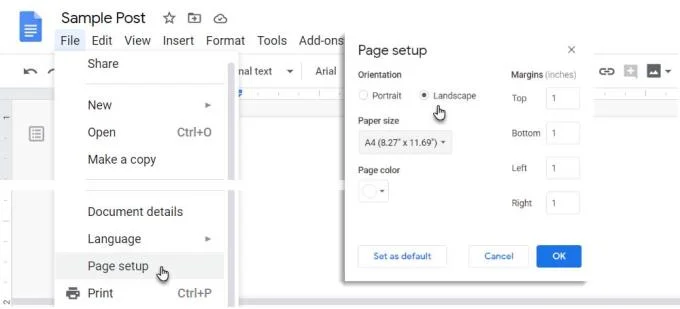
1. Go to File > Page setup in this menu.

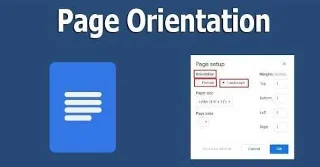
2. In the Page setup box , select the orientation you want to use Portrait or Landscape for .

How to change page orientation on Google Docs to landscape

4. Click OK and exit.

If you want to open the next document in landscape mode, select Landscape as the default layout. Click the Set as default button before you click OK and exit.

You should be a little careful with the current document because redirecting the page can affect the layout of the original text and media files inside. So please review it before saving or sharing.

How to change page orientation to landscape in Google Docs for mobile

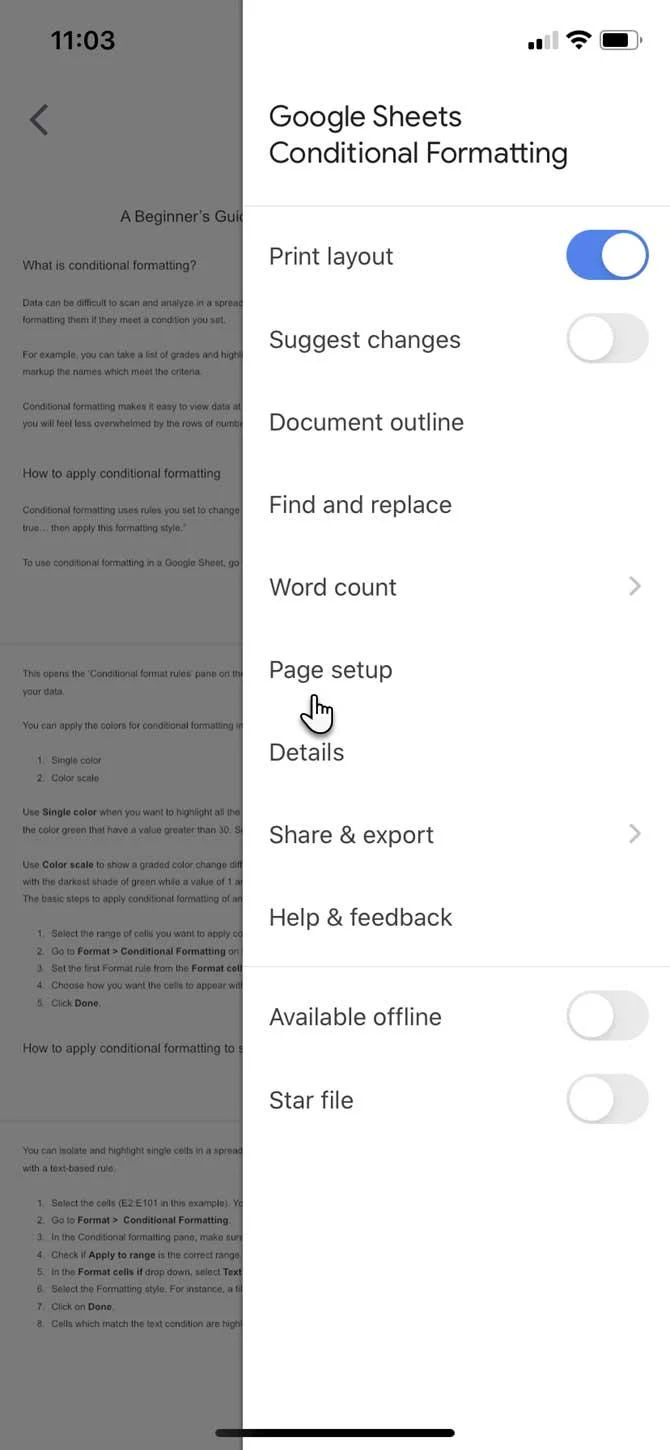
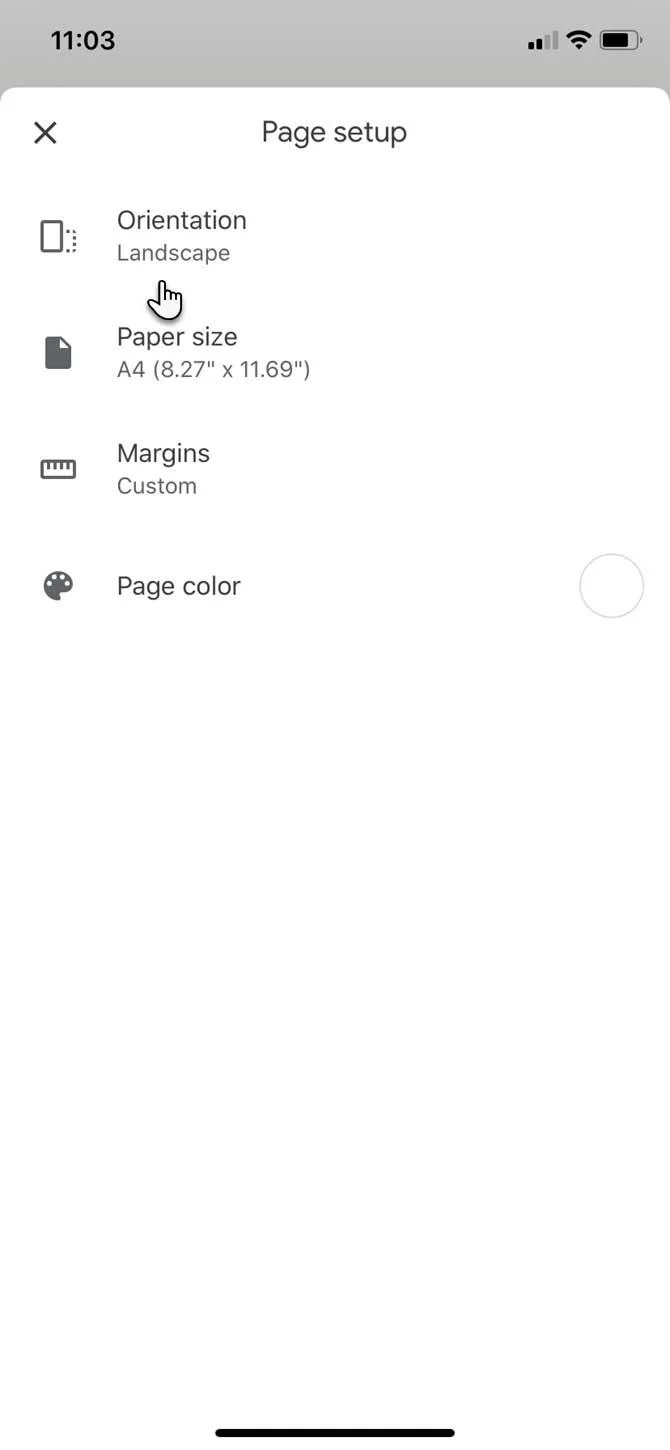
The process of redirecting documents from portrait to landscape (or vice versa) is a little different on Android and iOS. You can find the page setup controls in the 3-dot menu on the Google Docs mobile app. The screenshot below is on an iOS device.

How to change page orientation on Google Docs to landscape

How to change page orientation on Google Docs to landscape

Open a document in the Google Docs app .

Tap the 3-dot menu in the upper right corner of the screen.

Go down to the side menu and select Page setup .

Tap Orientation .

Select the page orientation you want to use, and then tap the arrow in the upper right to return to the document.

Google Docs will prompt you to view the changes in the Print Layout window . Return to the menu via the 3-dot icon and turn the Print layout button to blue.

Above is how to rotate the document page horizontally on Google Docs for desktop and mobile . It's simple and easy, isn't it? It is recommended to use landscape layout when viewing invoices, forms or documents that contain graphs or compare multiple columns to better capture and evaluate all the information.
Leave a Comment

Side Hustles That Actually Pay in 2026: 7 Realistic Options and the Tradeoffs to Know

Side Hustles That Actually Pay in 2026: 7 Realistic Options and the Tradeoffs to Know

Compare realistic side hustles for 2026 by startup cost, fees, flexibility, and income control, with current tax and scam guidance from official sources.

Remote Work Ergonomics in 2026: Upgrade Your Home Office Without Overbuying

Remote Work Ergonomics in 2026: Upgrade Your Home Office Without Overbuying

Upgrade your home office ergonomics with current OSHA and NIOSH guidance on chair fit, monitor height, laptop setup, lighting, and movement.

Why Emotional Intelligence Matters in Leadership—and How to Build It

Why Emotional Intelligence Matters in Leadership—and How to Build It

Learn why emotional intelligence matters in leadership, where it helps most, how to strengthen it, and how to tell whether your approach is working.

How to Transition to a Tech Career Without a Degree: A Results-First Roadmap for 2026

How to Transition to a Tech Career Without a Degree: A Results-First Roadmap for 2026

A practical roadmap for moving into tech without a degree: choose an accessible role, build job-ready skills, prove them with projects, and use hiring feedback to improve.

Building a Personal Brand on LinkedIn in 2026: What Still Works, What Changed, and What to Ignore

Building a Personal Brand on LinkedIn in 2026: What Still Works, What Changed, and What to Ignore

Build a credible LinkedIn personal brand in 2026 with current profile, content, newsletter, analytics, verification, and visibility guidance from LinkedIn.

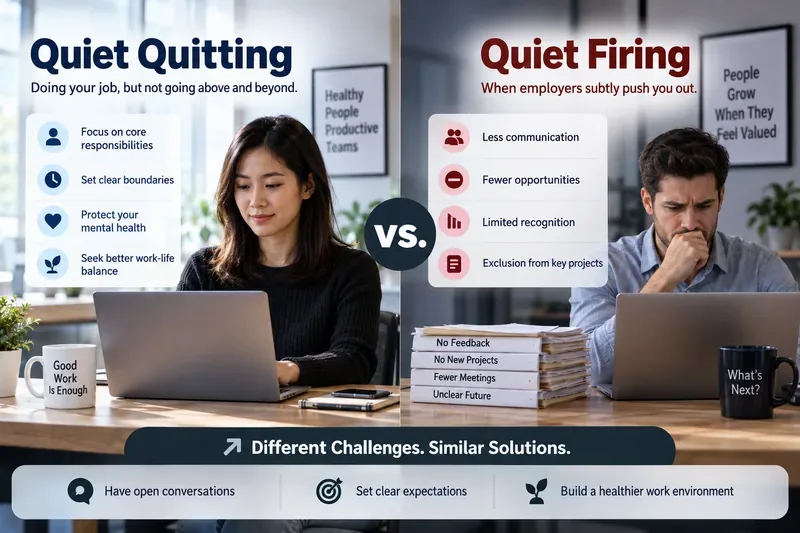
Quiet Quitting vs. Quiet Firing in 2026: What’s Really Changing at Work

Quiet Quitting vs. Quiet Firing in 2026: What’s Really Changing at Work

Quiet quitting and quiet firing are catchy labels, not diagnoses. Learn what is verified, what depends on context, and what employees and managers can do next.

The Rise of the Fractional Executive: When Part-Time C-Suite Leadership Makes Sense

The Rise of the Fractional Executive: When Part-Time C-Suite Leadership Makes Sense

Fractional executives offer senior leadership without a full-time hire. Learn when the model works, what to ask, and the risks to manage.

How to Negotiate a Raise During Q4 Performance Reviews: A Practical 2026 Decision Guide

How to Negotiate a Raise During Q4 Performance Reviews: A Practical 2026 Decision Guide

Prepare a stronger Q4 raise request with current wage data, timing options, compensation tradeoffs, and scripts for yes, partial, or no outcomes.

6 High-Income Skills You Can Start Learning Before 2026 Ends

6 High-Income Skills You Can Start Learning Before 2026 Ends

Choose a high-income skill you can realistically start before 2026 ends, with current pay data, learning priorities, and a practical self-check.

Mastering the Hybrid Work Schedule: A Practical Framework That Actually Holds Up

Mastering the Hybrid Work Schedule: A Practical Framework That Actually Holds Up

Build a hybrid work schedule around tasks, team overlap, and measurable outcomes. See sample patterns, warning signs, and when to adjust your plan.