Would Europe Be Drawn into a Hypothetical U.S.-Israel-Iran Nuclear War? NATO Rules Explained

A guide to NATO Articles 4 and 5, UN self-defense rules, and why consultation does not mean automatic European entry into war.
Transformer is one of the important power transmission devices with the main task of adjusting the voltage level to meet human needs. The following article will outline the structure, symbols and operating principles of transformers in detail for everyone to refer to.
Article content
The structure of a transformer consists of 3 main parts: Steel core, windings, and casing.

Steel core: Consists of a column and a yoke. The column is used to place the winding wire, and the yoke is responsible for connecting the columns together to create a closed magnetic circuit. The steel core of the transformer is usually made of good magnetic conductive materials, manufactured by joining thin insulating iron sheets together. The main function of the steel core is to conduct magnetism and at the same time create a frame to place the winding wire.
Winding: Transformers often use copper or aluminum windings, with an insulated outer layer. The function of the winding is to charge and transmit energy. Usually, transformers wound with copper wire will have better electrical conductivity, avoiding oxidation after a period of use, increasing the durability and lifespan of the transformer.
Windings are divided into two types: primary coil and secondary coil. The primary coil has the task of receiving energy to connect to the AC circuit. The secondary coil has the task of transmitting energy to connect to the consuming load. Depending on the task of each type of transformer, the number of turns of the two coils will be different. The number of turns of the primary coil can be larger than the number of turns of the secondary coil and vice versa.
Casing: The transformer casing will be made of different materials depending on the type of machine such as wood, plastic, wood, steel, thin sheet metal, cast iron... The job of the casing is to protect the internal components of the transformer. The casing consists of the cover and the barrel.
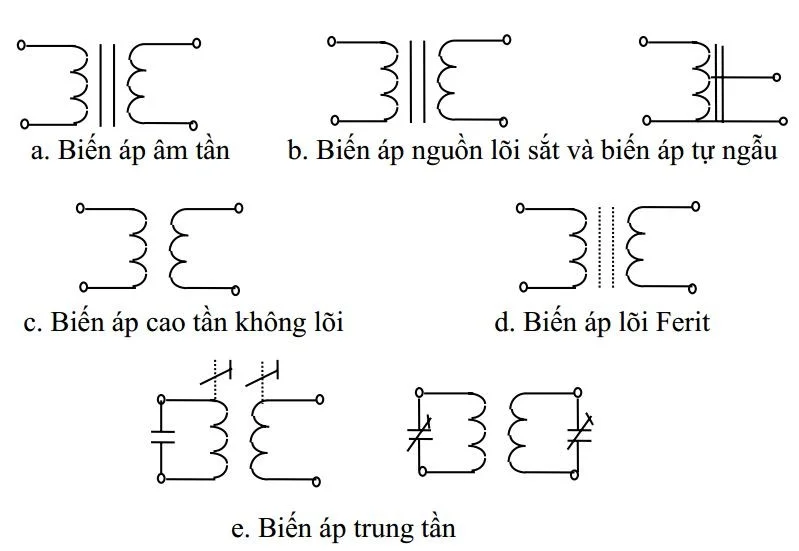
Based on structure and function, transformers are divided into 7 main types and symbolized as shown below:
The operating principle of the transformer is based on the phenomenon of electromagnetic induction. When we apply alternating voltage at the two ends of the primary coil, it will create a change in magnetic flux inside the two coils. This magnetic flux passes through the primary and secondary coils. Then the secondary coil will have an induced electromotive force and change the initial voltage level.
Transformers are classified in many different ways:
The main function of a transformer is to convert voltage values from high to low or from low to high to suit the needs of the user. Transformers are widely used in households, factories, large civil works such as high-rise buildings, hospitals, commercial centers... In particular, it is also one of the most important parts of transformer stations as well as power transmission systems.
Thus, we have presented the structure, symbols, operating principles, applications and classification of transformers in the most detailed and easy-to-understand way. Hopefully, you will have more interesting insights about this device.
>>> You may be interested in: [Experience] Which is the best voltage stabilizer to buy today?
A guide to NATO Articles 4 and 5, UN self-defense rules, and why consultation does not mean automatic European entry into war.
Assess claims about Iran in six steps, distinguishing uranium enrichment, weapons development and verified possession.
Understand nuclear decision authority in six steps, including US civilian control and the limits of public information about Israel.
A guide to official 2026 evidence on Hormuz shipping disruption, Iran-related claims, confirmed incidents, and what remains uncertain.
A source-based guide to nuclear escalation risks, UN Charter rules and NATO Article 5 in a strictly hypothetical Iran scenario.
Use five steps to prepare for an outage; nuclear and EMP scenarios are hypothetical, and official shelter instructions come first.
Use 5 defensive steps to verify a cyber disruption, protect household accounts, and avoid mistaking an outage for war.
Use these 5 steps to assess climate effects from a hypothetical Iran strike, compare model assumptions, and avoid unsupported predictions.
Explore six steps for reading research on climate, food and ecosystem recovery after a hypothetical nuclear conflict.
Build a practical fallout preparedness kit in six steps, with sealed food and water, a radio, medical supplies and shelter guidance.