How to Prepare for a Hypothetical EMP-Related Power Outage: 5 Civilian Steps
Use five steps to prepare for an outage; nuclear and EMP scenarios are hypothetical, and official shelter instructions come first.
Updated: November 6, 2026. This guide covers a hypothetical scenario: an extended power outage after a nuclear emergency in which an electromagnetic pulse (EMP) may also disrupt electronics. It does not claim that a nuclear detonation or EMP event has occurred. A blackout alone is not evidence of a nuclear strike. An EMP-related electronics disruption and radioactive fallout are different hazards, and power-outage preparation does not replace radiation safety instructions.
For an actual radiation emergency, follow local emergency instructions first. FEMA’s guidance is “Get Inside, Stay Inside, Stay Tuned”: enter the nearest substantial building, move to its basement or center away from windows, and remain sheltered unless officials direct otherwise. This five-step plan helps households prepare for common outage needs while keeping that life-safety priority clear.
| Preparation | Details |
|---|---|
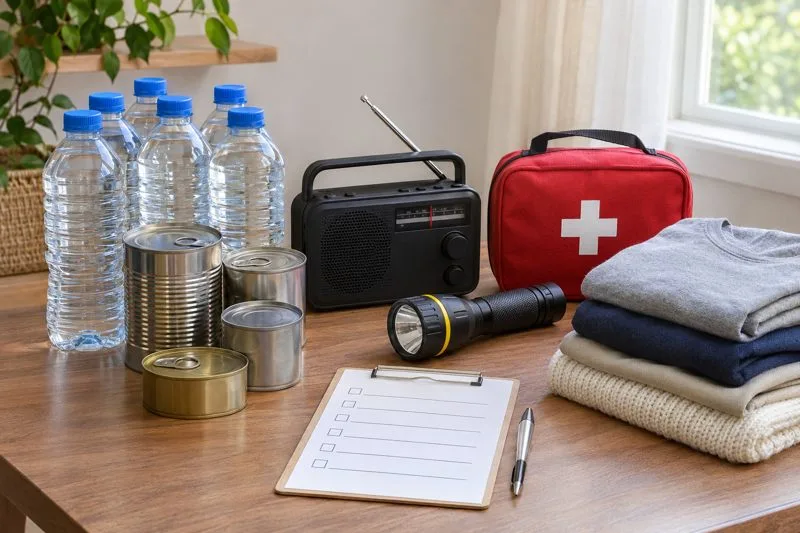
| Basic supplies | Water, nonperishable food, flashlight, extra batteries, a battery-powered or hand-crank radio, first aid items, necessary medicines, and sanitation supplies. |
| Time | About 30–60 minutes to identify shelter and communication plans and check existing supplies. |
| Difficulty | Easy. Use ordinary household items and official emergency instructions; specialized equipment is not required. |
| Household notes | List medical devices, prescriptions, children, older adults, disability-related needs, pets, and who may need assistance. |
Start with a basic kit that can support your household for at least several days. Ready.gov’s emergency kit checklist recommends one gallon of water per person per day for at least three days, plus at least a three-day supply of nonperishable food. Adjust the quantities for your household, climate, medical needs, and pets. Store supplies where you can reach them safely.
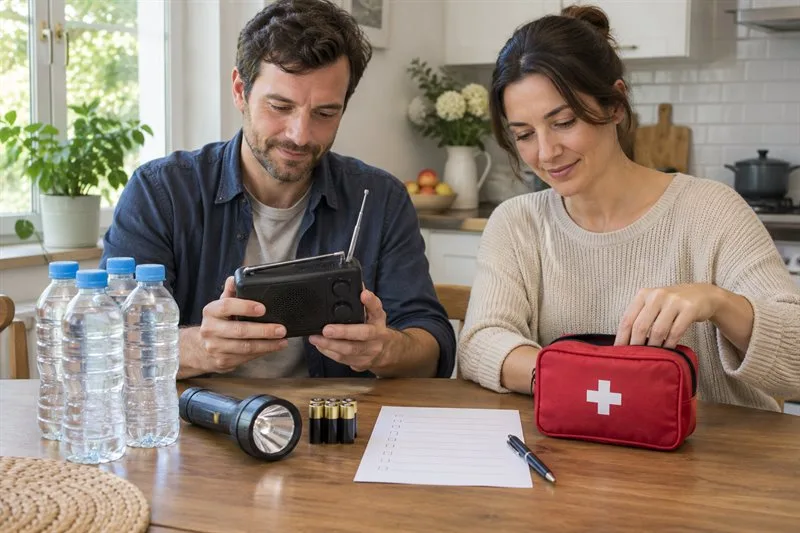
Include a flashlight and spare batteries, a battery-powered or hand-crank radio, a first aid kit, a manual can opener, hygiene items, and copies of important contact information. Keep essential medicines in their original packaging and check expiration dates. If a household member depends on powered medical equipment, talk with their clinician and equipment provider about a safe backup plan before an outage; do not improvise a medical power setup during an emergency.
A kit is a starting point, not a guarantee that a household can manage every length or type of outage. Build it around ordinary needs and official recommendations. You do not need special EMP devices or improvised electronics to follow the safety steps in this guide.
Before any emergency, identify the best shelter location in the places where your household spends time. For a nuclear detonation warning or fallout emergency, FEMA advises getting inside the nearest building, then going to a basement or the middle of a larger building and staying away from the roof and outer walls. A brick or concrete building may provide more shielding than a vehicle or a lightweight structure, but the closest substantial building is usually the practical first choice. Do not drive across town to reach a preferred shelter if doing so would delay getting indoors.
Agree on where family members should shelter if they are at home, school, or work. If a real radiation emergency occurs, separated family members should generally stay inside where they are rather than travel through potentially contaminated areas to reunite. Choose an out-of-area contact and keep the number written on paper. Plan how you will check in if mobile service or internet access is unavailable.
Keep pets indoors during a radiation emergency and follow official instructions about caring for them. If someone in the household has mobility, hearing, vision, or medical needs, plan ahead for assistance and accessible shelter options.
If authorities issue a nuclear detonation warning or radiation emergency instruction, get inside immediately and move away from windows. Use a basement or central area of a substantial building if available. FEMA says to remain inside for 24 hours unless local authorities provide other instructions. That is a baseline public instruction for this scenario, not a substitute for later evacuation or safety directions from local officials.
Use a battery-powered or hand-crank radio to receive official updates. Cell phones, television, and internet services may be disrupted or unavailable in a serious emergency; do not assume that a working screen means a message is authentic. Check the source and follow local emergency management or public health instructions when communications are available.
Do not leave shelter to search for a battery, KI tablets, or relatives. CDC says potassium iodide (KI) should be taken only when public health or emergency officials or a healthcare provider instruct you to take it. KI protects the thyroid from radioactive iodine only; it does not protect against other radioactive materials, external radiation, or an EMP. Leaving shelter to obtain it can create additional exposure.
If you may have been outside when fallout arrived, follow official directions and decontaminate when you are safely inside. CDC advises carefully removing the outer layer of clothing; this can remove up to 90% of radioactive material. Avoid shaking clothing, because dust can become airborne. Put the clothing in a sealable bag or container and place it away from people and pets.
Then gently wash exposed skin and hair with soap and water if available. Do not scrub, scratch, or scald the skin. Cover cuts while washing. CDC notes that tap water may be safe for washing even when officials advise people to drink bottled water; follow local public health guidance about drinking water. Change into clean clothes if available. Seek medical help for serious injuries and follow emergency responders’ advice.
Do not eat food or drink liquids that were left outside uncovered after fallout may have arrived. Use stored food and water, and follow any local food or water advisories. These are radiation-safety steps, separate from the question of whether electrical devices still work.
During an ordinary or extended outage, keep refrigerator and freezer doors closed. FEMA’s power-outage guidance says a refrigerator stays cold for about four hours and a full freezer for about 48 hours when doors remain closed. Use a thermometer if available and follow food-safety instructions; discard food that authorities say is unsafe. Keep phones and power banks charged before a forecast outage when possible, but conserve battery and use official alerts for important updates.
Never run a generator, camp stove, charcoal grill, or fuel-burning heater inside a home, garage, or enclosed space. FEMA advises using generators, camp stoves, and charcoal grills outdoors, at least 20 feet from building openings such as windows, doors, and garages, to reduce carbon-monoxide poisoning risk. Follow the equipment maker’s instructions and local fire-safety guidance. Use flashlights or battery lanterns instead of candles where possible.
Pay attention to water advisories, heat or cold warnings, and instructions for people who rely on powered medical equipment. If officials recommend evacuation or a public shelter, follow the route and instructions they provide. An EMP scenario is hypothetical here; no one can use this article to predict how long any particular outage would last or which devices would work.
No. A power outage can have many causes, including weather, equipment failure, maintenance, or other technical problems. Check your utility and local authorities through official channels. The outage itself does not establish a nuclear detonation, EMP, or attack.
Get inside the nearest substantial building and move to its center, away from windows, the roof, and outer walls. Follow local instructions. Do not delay sheltering to travel to a distant building if you can safely enter a more substantial one nearby.
Do not take KI unless a public health or emergency official or healthcare provider instructs you to. KI only protects the thyroid from radioactive iodine and does not replace shelter. Stay inside and use available stored supplies while waiting for official directions.
No event is being reported in this article. The nuclear detonation and possible EMP-related outage are hypothetical preparedness scenarios. A routine power failure is not proof that either occurred.
They are different effects. FEMA lists EMP and radioactive fallout separately among possible effects of a nuclear explosion. Fallout is radioactive material that can contaminate people, food, or water; an electronics disruption is not proof of radioactive contamination. Follow radiation-emergency instructions if authorities issue them.
Get inside a substantial building, move to its basement or center away from windows, stay inside unless officials direct otherwise, and tune in to official updates. If you may have been outside after fallout arrived, follow public-health guidance for decontamination.
This is a general preparedness guide, not a prediction or an emergency alert. In a real incident, follow current directions from local emergency management and public health authorities.
Use five steps to prepare for an outage; nuclear and EMP scenarios are hypothetical, and official shelter instructions come first.
Use 5 defensive steps to verify a cyber disruption, protect household accounts, and avoid mistaking an outage for war.
Use these 5 steps to assess climate effects from a hypothetical Iran strike, compare model assumptions, and avoid unsupported predictions.
Explore six steps for reading research on climate, food and ecosystem recovery after a hypothetical nuclear conflict.
Build a practical fallout preparedness kit in six steps, with sealed food and water, a radio, medical supplies and shelter guidance.
Use six steps to assess Middle East power shifts, test evidence, compare scenarios, and avoid mistaking short-term crisis moves for lasting alliances.
Use five steps to check claims about a hypothetical strike on Iran’s nuclear program, civilian risks, nuclear safety, and diplomacy.
Use 5 steps to assess missile-defense limits in a hypothetical Iranian nuclear counterstrike without treating defense as a guarantee.
Use this 5-step guide to assess AI target-prediction claims, check uncertainty, and keep human judgment central.
Use these 5 steps to choose a safer home shelter, prepare supplies, and respond to radiation alerts; no DIY shield replaces a solid building.