Home
» Today
»
Inside Jet2’s Kestrel Cabin: More Knee Room Without Reclining — November 2026
Inside Jet2’s Kestrel Cabin: More Knee Room Without Reclining — November 2026
Information checked: November 21, 2026, 9:12 p.m. London time (GMT, UTC+00:00).
Jet2 has begun flying its new British-made Mirus Kestrel economy seats, with the first equipped service operating from Manchester to Tenerife on November 19, 2026. The airline confirmed the launch on November 20, highlighting up to two inches of additional legroom and in-seat power. But the defining feature for passengers is less obvious: the standard Kestrel seat is designed with a fixed, already-angled backrest rather than a mechanism that reclines on demand.
That approach changes how space is distributed inside a crowded narrow-body cabin. Instead of promising more distance between rows, designers slim down and reshape the seat structure to free up room around the knees and shins. The result may feel more spacious without giving the traveler in front the ability to tip their seat into that space.
Destaques
Jet2's first Kestrel-equipped Airbus A321neo service flew from Manchester to Tenerife on November 19, 2026.
Jet2 advertises up to two inches of additional legroom; this does not establish a two-inch increase in seat pitch.
Mirus lists Kestrel as a fixed, pre-reclined seat, with a standard backrest angle of 22 degrees.
The rollout covers Jet2's A321neo program, ultimately encompassing 155 aircraft through 2035, rather than every Jet2 flight immediately.
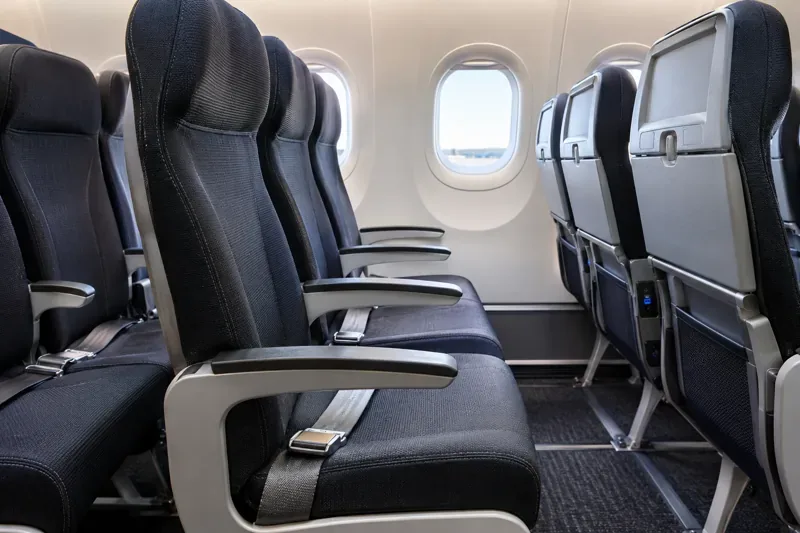
Illustrative cabin image generated for this article; it does not depict or verify the actual Jet2 Kestrel installation.
What has changed inside Jet2's Airbus A321neo cabin?
Jet2 says its new seats use sculpted, slimline seatbacks engineered to improve support while taking up less usable space. In-seat device charging is also part of the installation, marking the airline's first introduction of this amenity. The airline identifies itself as the first UK carrier to operate the Kestrel seat in passenger service.
The first flight was an operational milestone, not a declaration that the whole fleet changed overnight. The company plans to fit the seats across its Airbus A321neo fleet, including aircraft delivered in the coming years. Its announced program ultimately covers 155 A321neos through 2035. The company has not provided a flight-by-flight installation schedule or confirmed that any particular future departure will use the new seat.
How can a fixed-back seat create more legroom without increasing seat pitch?
Seat pitch measures the distance from a reference point on one seat to the same point on the next row. It is not the same thing as the usable clearance between a passenger's legs and the structure directly ahead. Two cabins can have identical pitch but noticeably different knee space if their seatbacks and support frames occupy different amounts of that distance.
The Kestrel design concentrates on that distinction. Its thinner backrest and carefully shaped contours reduce the physical intrusion of the seat ahead, while its integrated, pre-reclined geometry avoids a bulky moving recline mechanism. Mirus's published Kestrel specifications describe a fixed reclined backrest with a 22-degree pre-recline setting. In a separate announcement about the same Kestrel seat family, easyJet explicitly said improved knee and shin clearance could be achieved without changing seat pitch.
Jet2 has not published a newly measured, Kestrel-specific seat pitch in its November 20 announcement. Therefore, the claimed maximum two-inch improvement should be read as a statement about available passenger space, not proof that the airline physically moved every row two inches farther apart. Nor does the maximum guarantee an identical benefit for passengers of every height or in every seating position.
Can you recline a Jet2 Kestrel seat?
The standard Kestrel product described by manufacturer Mirus uses a fixed, pre-reclined backrest, meaning it does not offer conventional passenger-controlled reclining. The resting angle is built into the seat rather than selected with a button. Jet2 has named the Kestrel model for its installation, but its airline announcement does not independently specify whether every detail of its configured seats matches the standard brochure. Travelers should not assume an adjustable recline feature unless Jet2 confirms one for their particular cabin.
There is a trade-off: travelers who like to lean farther back for sleep will not have the same flexibility as on a reclining seat. On the other hand, a passenger in the row ahead cannot unexpectedly use a normal reclining mechanism to consume the space around your laptop, knees, or meal tray. A constant backrest position may be especially valuable on busy holiday flights, although personal comfort still depends on body size, posture, and flight length.
What do the seat dimensions and charging features actually tell us?
Mirus's Kestrel product sheet specifies an available pitch range of 28 to 38 inches, a starting seat weight of 6.9 kilograms per passenger position in the listed configuration, and an economy-class design for single-aisle aircraft. The 28-to-38-inch range describes the seat product's compatibility, not Jet2's verified row spacing. The manufacturer lists USB-A and USB-C as available options, but Jet2's statement confirms in-seat charging without identifying the exact ports, charging wattage, or availability at each position.
The distinction matters when planning a flight. A traveler who needs to charge a specific laptop should not assume the port can supply laptop-grade power; bringing a fully charged device and the correct cable remains prudent. Similarly, extra knee clearance does not establish wider seats, greater under-seat baggage allowance, or more space to stretch feet into the aisle.
Why is Jet2 choosing a lighter seat design?
Space efficiency is only one part of the engineering rationale. Jet2 estimates that the Kestrel installation removes 420 kilograms of cabin weight per flight. It projects roughly 40 metric tons of annual fuel savings and approximately 125 metric tons of carbon-dioxide-equivalent emissions savings per aircraft. These are airline estimates associated with reduced aircraft weight, not independently measured results from a full year of Kestrel-equipped flights.
Lighter seats can lower the energy required to operate a flight, while fewer moving components may simplify maintenance. The seats are manufactured in Norfolk, England, by Mirus Aircraft Seating. Neither the environmental estimate nor the product's engineering credentials guarantees a measurable passenger comfort improvement on every flight, but the development illustrates why airlines value designs that simultaneously improve space efficiency and operational weight.
Will your next Jet2 flight have the new cabin?
The key filter is aircraft type. Jet2's announced Kestrel program applies to the Airbus A321neo fleet, not to all aircraft operated by the airline. Even an A321neo booking is not a guarantee during a multiyear phased rollout, because aircraft assignments and configurations may vary. Check your booking's aircraft details and any updated seat information provided directly by Jet2 nearer departure; the airline has not announced a complete public list of equipped routes or tail numbers.
The most meaningful change for holidaymakers is therefore conditional but concrete: on a Kestrel-equipped flight, the thin, fixed-angle structure is intended to provide more usable room directly in front of the passenger, alongside the convenience of charging devices in the seat. Whether travelers prefer that arrangement over adjustable reclining will remain a matter of personal preference and real-world experience, not something established by the manufacturer's design claims alone.
Frequently asked questions
Does Jet2's Kestrel seat recline?
Mirus specifies a fixed, pre-reclined backrest for its standard Kestrel seat. Jet2 has not separately detailed any custom recline variation in its public launch notice.
Does two inches more legroom mean the rows are farther apart?
No. The claim refers to up to two inches of additional usable space from the slimmer seat design. Jet2 has not confirmed a two-inch seat-pitch increase.
Are the new seats on every Jet2 plane?
No. The announced program concerns Jet2's Airbus A321neo aircraft and is being rolled out gradually through the delivery program ending in 2035.