Verified and updated: November 21, 2026, 21:10 UTC.
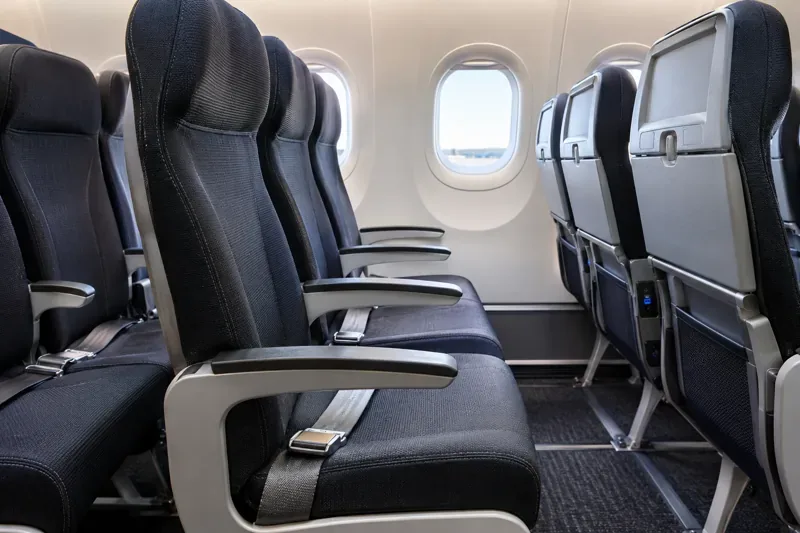
Jet2’s new Mirus Kestrel seats have entered service: the first equipped flight operated from Manchester to Tenerife on November 19. The airline says the slimline design offers up to two inches of additional legroom and in-seat power, a first for Jet2, and will be fitted across its Airbus A321neo fleet as those aircraft are delivered through 2035.
For UK holidaymakers, the immediate change is practical: some passengers on an A321neo may be able to charge a device at their seat and gain a little more knee room. The change is not yet fleetwide, however. Jet2 has not published a list of equipped aircraft or routes, nor specified the exact charging connections.
Destaques
- The first Kestrel-equipped Jet2 flight ran Manchester–Tenerife on November 19.
- Jet2 says the new seat design can add up to two inches of legroom and includes in-seat power.
- The rollout is planned for 155 Airbus A321neo aircraft as they arrive through 2035.
- The airline estimates a 420-kilogram weight reduction per flight and around 40 tonnes less fuel use per aircraft each year.
What changed on Jet2’s first Kestrel flight?
Jet2 announced on November 20 that the seats had entered operation, following the previous day’s Manchester–Tenerife service. The airline identifies the seat as Mirus Aircraft Seating’s Kestrel and says it is manufactured in Norfolk, England. Jet2 describes itself as the first UK airline to operate flights with the model.
The announcement marks a passenger-facing upgrade as well as an efficiency change. In-seat power means travelers can charge compatible devices during the flight, while the seat’s slimline back is intended to create more usable space. Jet2’s stated figure is “up to” two additional inches of legroom; it should not be read as a guarantee that every passenger or row gains the same amount.
Which Jet2 planes will have the new seats?
The announced rollout covers Jet2’s Airbus A321neo fleet, with the program ultimately extending to 155 aircraft as they are delivered through 2035. That long delivery horizon means the new cabin will appear gradually. The first flight confirms that at least one A321neo is operating with the seats, but the airline has not published a schedule identifying which aircraft will receive them next.
Passengers should therefore avoid assuming that every Jet2 flight—or every A321neo flight—already has Kestrel seats. The aircraft type on a booking can help narrow down the possibility, but it does not confirm that a particular plane has the new interior. Jet2 has not announced an aircraft-by-aircraft checker or a route list. For a specific trip, look for updates in the booking details and check with the airline if the seat feature is important to your plans.
How much legroom and charging does Kestrel offer?
Jet2 says its configured seats provide up to two inches of additional legroom and add in-seat power. Its announcement does not identify whether the power connection is USB-A, USB-C, or another format, nor does it provide charging speeds. Mirus lists USB-A and USB-C among optional Kestrel features, but that product information does not establish which options Jet2 selected. Travelers should bring a charged device and a suitable cable rather than assume a particular port is available.
Mirus describes Kestrel as an economy seat with a fixed recline. Its published product specifications list a 22-degree pre-recline and a pitch range of 28 to 38 inches, but those are product-level specifications, not a published layout for Jet2’s aircraft. Jet2’s announcement does not state the seat pitch or separately explain how its cabin configuration compares with earlier A321neo interiors.
What do the seats mean for fuel use and emissions?
Jet2 says the new seats reduce aircraft weight by 420 kilograms per flight. It estimates that the lower weight will save about 40 tonnes of fuel per aircraft annually and cut emissions by around 125 tonnes of carbon-dioxide equivalent per aircraft each year. Those figures are the airline’s estimates; they are not passenger-level measurements or a guarantee of the result on every flight, since actual fuel use varies with operations.
The seat upgrade connects cabin design with operating efficiency: lighter equipment can reduce the weight carried, while the new layout is intended to improve passenger space. The first effect is an airline-reported efficiency projection, and the second is a passenger benefit described by Jet2. Neither changes the basic travel decision today as much as whether the assigned aircraft has been fitted.
What should Jet2 passengers expect next?
The confirmed development is the start of service and the plan to fit the A321neo fleet as aircraft are delivered through 2035. Jet2 has not confirmed the rollout pace, the number of equipped aircraft by a particular holiday season, or whether any existing aircraft will be retrofitted. Those details matter to travelers booking well ahead: a fleetwide target spanning years should not be mistaken for an immediate fleetwide cabin change.
For now, the useful takeaway is straightforward: the new Kestrel cabin is in service on at least one Jet2 route, and the program will grow with its A321neo fleet. Passengers may gain extra legroom and seat power when they encounter it, but should verify the aircraft and avoid relying on an unannounced port type or a guaranteed amount of extra space.
Frequently asked questions
When did Jet2’s Kestrel seats first enter service?
The first Kestrel-equipped flight operated from Manchester to Tenerife on November 19, 2026.
Will all Jet2 planes get Kestrel seats?
Jet2’s announced program covers 155 Airbus A321neo aircraft as they are delivered through 2035. The announcement does not say the seats will be fitted to its entire fleet.
Which charging ports are available?
Jet2 confirms in-seat power but has not specified the connection type. Mirus offers USB-A and USB-C as options, but Jet2’s chosen configuration has not been confirmed.
Sources