Would Europe Be Drawn into a Hypothetical U.S.-Israel-Iran Nuclear War? NATO Rules Explained

A guide to NATO Articles 4 and 5, UN self-defense rules, and why consultation does not mean automatic European entry into war.
PowerPoint also supports spelling and grammar checking similar to Word. Here's how to check spelling & grammar in Microsoft PowerPoint .
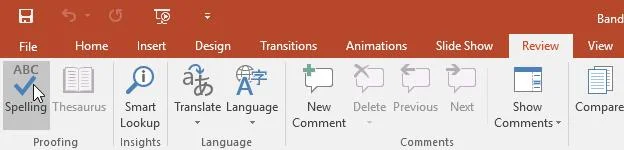
1. From the Review tab , click the Spelling command .
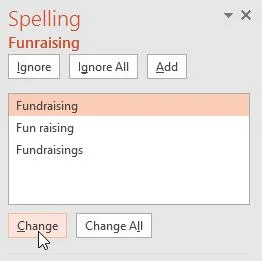
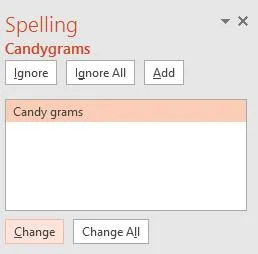
2. The Spelling panel will appear on the right. For each error in a presentation, PowerPoint tries to come up with one or two suggestions. You can select a suggestion and click Change to fix the error.
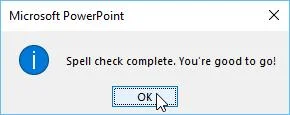
3. PowerPoint will mark each error for you. After you have assessed all the errors, a dialog box will appear confirming that the spell check is complete. Click OK .
If you don't see any suggestions, you can enter the correct spelling in the slide.
Spell check in PowerPoint is not always accurate. Sometimes, there's also the word PowerPoint that thinks it's wrong but is actually right. This often happens with people's names, proper nouns, or words that are not in the dictionary. If PowerPoint errors them out, you can choose not to change it using one of these 3 options:
By default, PowerPoint automatically checks for spelling errors in presentations. Therefore, you may not even need to run a check for each error with the Spelling command . Errors will be marked with red wavy lines.
To use automatic spell check :
1. Right click on the underlined word. A menu will appear.
2. Click on the correctly spelled word in the list of suggestions.
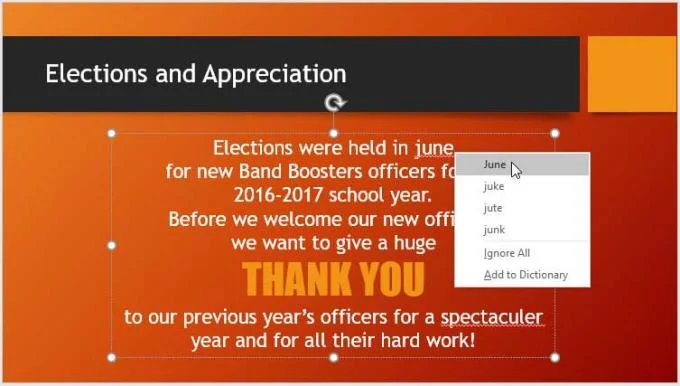
3. The correct word will appear in the PowerPoint presentation.
You can also select Ignore and the underlined word or Add to Dictionary .
PowerPoint lets you edit proofing options, giving you more control over how it evaluates text. For example, you can customize automatic spell checking to change the way PowerPoint marks errors. You can also turn on the grammar check option to find and correct spelling mistakes in context.
To edit proofing options:
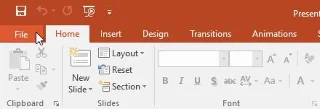
1. Click the File tab to access Backstage view .
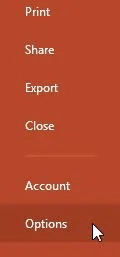
2. Select Options . A dialog box will appear.
3. Select Proofing , then customize the options as needed. Once done, click OK .
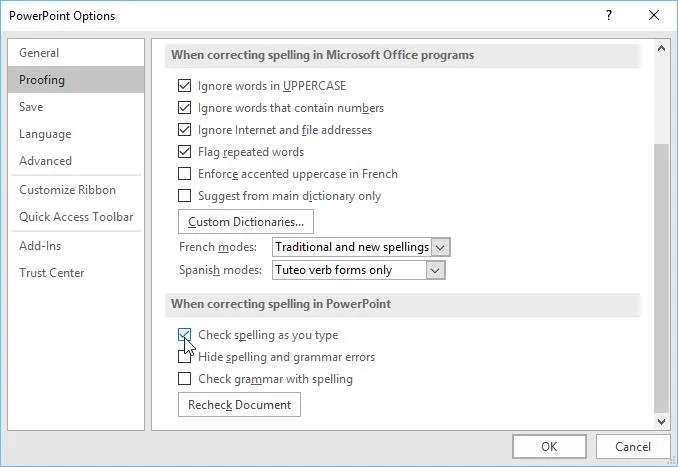
Editing settings in PowerPoint Options , including proofing, will affect any presentation you edit in PowerPoint, not just the current one.
Above is how to check spelling in PowerPoint . Hope the article is useful to you.
A guide to NATO Articles 4 and 5, UN self-defense rules, and why consultation does not mean automatic European entry into war.
Assess claims about Iran in six steps, distinguishing uranium enrichment, weapons development and verified possession.
Understand nuclear decision authority in six steps, including US civilian control and the limits of public information about Israel.
A guide to official 2026 evidence on Hormuz shipping disruption, Iran-related claims, confirmed incidents, and what remains uncertain.
A source-based guide to nuclear escalation risks, UN Charter rules and NATO Article 5 in a strictly hypothetical Iran scenario.
Use five steps to prepare for an outage; nuclear and EMP scenarios are hypothetical, and official shelter instructions come first.
Use 5 defensive steps to verify a cyber disruption, protect household accounts, and avoid mistaking an outage for war.
Use these 5 steps to assess climate effects from a hypothetical Iran strike, compare model assumptions, and avoid unsupported predictions.
Explore six steps for reading research on climate, food and ecosystem recovery after a hypothetical nuclear conflict.
Build a practical fallout preparedness kit in six steps, with sealed food and water, a radio, medical supplies and shelter guidance.