Home
» Today
»
Planet X2 Hypothesis: New Model Points to a Search Beyond Neptune — Nov. 23, 2026
Planet X2 Hypothesis: New Model Points to a Search Beyond Neptune — Nov. 23, 2026
Checked: November 23, 2026, 3:28 p.m. Pacific Standard Time (UTC−08:00). A new peer-reviewed study has outlined a possible “Planet X2,” an Earth-class world that could orbit far beyond Neptune and help explain several puzzling paths taken by distant icy objects. The paper, published online today in Monthly Notices of the Royal Astronomical Society, presents computer simulations and a testable hypothesis. It does not report that astronomers have found a new planet.
The distinction matters: Planet X2 is a modeled explanation for the outer Solar System’s architecture, not a newly imaged object. The research team says some long-running orbital puzzles can be reproduced in simulations that include a distant planet. The Vera C. Rubin Observatory’s ongoing sky survey may help test those predictions by finding and tracking more trans-Neptunian objects—or by narrowing the conditions such a planet could occupy.
Key points
The Planet X2 hypothesis describes a possible planet roughly 1.5 to 2 times Earth’s mass.
In the model, it would travel on a distant, elongated orbit hundreds of times farther from the Sun than Earth.
The findings come from 4.5-billion-year Solar System simulations, not a direct observation.
Rubin Observatory could help test the predictions, but no Planet X2 detection has been announced.
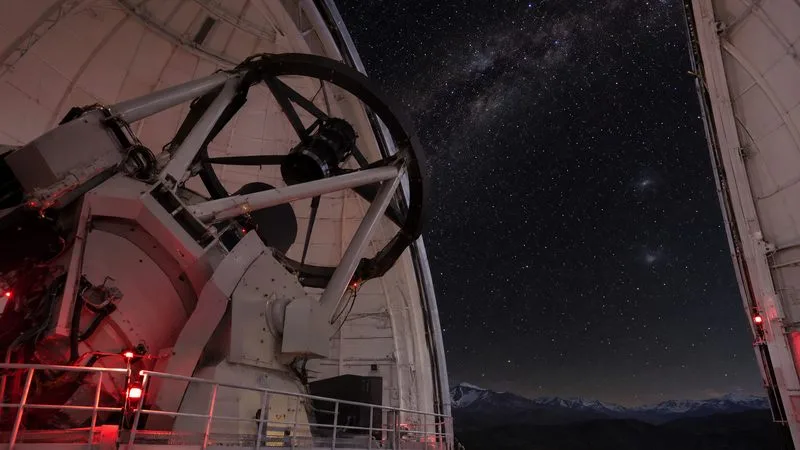
Illustrative view of an astronomical telescope at night; this is not a photograph of Rubin Observatory or a detection of Planet X2.
What is the Planet X2 hypothesis?
Planet X2 is the name the researchers give to a refined version of the idea that an undiscovered planet could be shaping objects beyond Neptune. It is distinct from the better-known Planet Nine proposal, which generally involves a more massive world on a different orbit. The new study’s abstract describes a distant, stable planet with about one to two Earth masses; the Royal Astronomical Society’s research summary gives a range of roughly 1.5 to 2 Earth masses.
The modeled orbit is extremely remote. The study describes successful configurations with a semimajor axis—half the long dimension of an elliptical orbit—of about 350 to 500 astronomical units. One astronomical unit, or AU, is the average Earth–Sun distance. In the proposed configurations, the planet’s closest approach to the Sun is still around 200 AU. These are model parameters, not a measured orbit for a known object.
The scientists are trying to explain a set of trans-Neptunian objects, or TNOs: icy bodies whose orbits carry them beyond Neptune. Some are “detached,” with closest approaches that keep them relatively distant from Neptune; others have unusually steep inclinations or very elongated paths. Sedna is one example of a distant object with an extreme orbit. The researchers argue that Planet X2’s gravity could help generate several of these orbital populations together.
What did the new study actually find?
The team ran numerical simulations covering 4.5 billion years of Solar System evolution. They included a “grainy” migration of Neptune, in which the planet’s outward movement is affected by interactions with many smaller bodies. They compared scenarios involving early Mars- to Earth-mass bodies scattered from the inner Solar System with scenarios that included a stable, distant Earth-class planet.
In the simulations, a Planet X2 configuration could produce detached objects, a reservoir of high-inclination bodies and orbits resembling those of known extreme TNOs. The research team also compared its preferred models with observations, including objects detected by the Dark Energy Survey. The paper reports that some model distributions match several observed population ratios and orbital features, while a mismatch in the semimajor-axis distribution remains an area for refinement.
That limitation is important. A simulation can show that a proposed cause is dynamically plausible and can make predictions for future observations; it cannot by itself establish that the cause exists in the real Solar System. Other models, observational limits and the incomplete sample of distant objects remain relevant. The authors present Planet X2 as an explanation worth testing, not a confirmed ninth or tenth planet.
How could Rubin Observatory test Planet X2?
The Vera C. Rubin Observatory in Chile is conducting the Legacy Survey of Space and Time, a repeated, wide-field survey of the sky. The study and the Royal Astronomical Society say that observations from Rubin could help search for a distant planet directly and test the orbital signatures predicted by the model. A larger, consistently observed sample of TNOs can also show whether the patterns the simulations predict are present across the population.
Testing does not guarantee a discovery. If a planet is bright enough, within the survey’s coverage and in a region Rubin observes, repeated images could reveal its slow movement against background stars. If the predicted object is too faint or lies outside a survey’s effective reach, non-detection may only rule out part of the parameter space. The paper’s central value for observers is therefore the set of possible signatures to look for, not a promise that Rubin will find a planet.
For now, the confirmed development is the publication of a new model. The planet itself remains hypothetical. The research could sharpen the search beyond Neptune by giving astronomers a more specific mass-and-orbit scenario to test as Rubin and other observatories add to the distant-object record.
Frequently asked questions
Have astronomers discovered Planet X2?
No. The paper models a hypothetical planet; it does not report a direct detection.
How large could Planet X2 be?
The proposed scenario is Earth-class, with the study describing about one to two Earth masses and the research summary giving roughly 1.5 to 2.
Is Planet X2 the same as Planet Nine?
No. Planet X2 is a distinct, lower-mass scenario with a different predicted orbit, although both hypotheses concern possible planets beyond Neptune.