Home
» Today
»
Nvidia CEO Jensen Huang Returns: What Tech Investors Should Watch — November 23, 2026
Nvidia CEO Jensen Huang Returns: What Tech Investors Should Watch — November 23, 2026
Information checked: November 23, 2026, 9:50 a.m. Pacific Standard Time (PST, UTC−08:00); 17:50 UTC. This is the verification time, not the time Nvidia issued its announcement or the stock-market close.
Nvidia said on November 23 that its board had reinstated co-founder Jensen Huang as president, chief executive officer and a director, effective immediately. The decision removes a major short-term uncertainty for the company at the center of the AI infrastructure trade. It does not, however, resolve every question investors face: Nvidia's board says an independent investigation will continue, and the economics of the global AI buildout still have to justify high expectations.
U.S. markets reacted sharply. Reuters reported Nvidia shares jumping roughly a third in early trading on November 23, with the technology-heavy Nasdaq and semiconductor shares also rallying. Those are intraday observations, not a verified closing price. For Australian investors, the practical issue is broader than whether one session ends higher: how leadership stability, governance oversight, customer spending and U.S.-dollar exposure affect the risk of owning NVDA directly or through an ETF.
Highlights
Confirmed leadership change: Nvidia reinstated Jensen Huang on November 23; CFO Colette Kress continues in her finance role after serving as interim CEO.
Market response: Reuters reported an early-session NVDA surge of about 33%, alongside a broad rebound in AI and U.S. technology shares; final closing levels are not asserted here.
Governance remains relevant: Nvidia says its independent board investigation will continue, and it is strengthening national-security and export-control oversight.
Australian investor checklist: Review concentration, the AUD/USD conversion, ETF overlap and the company's ability to turn AI spending into sustainable cash flow.
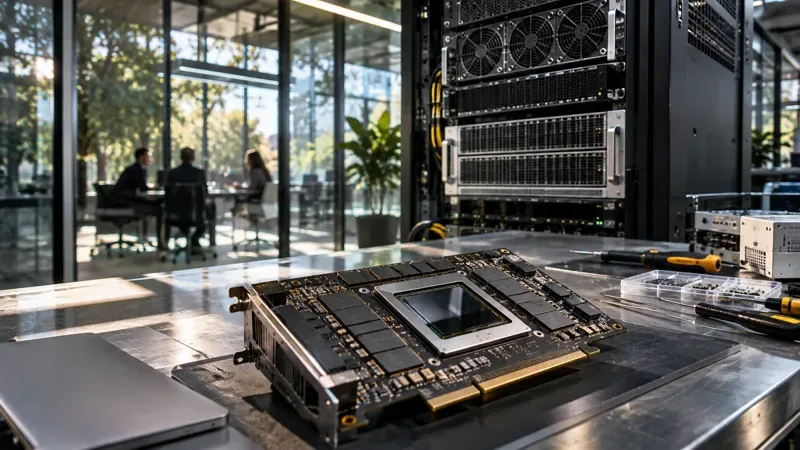
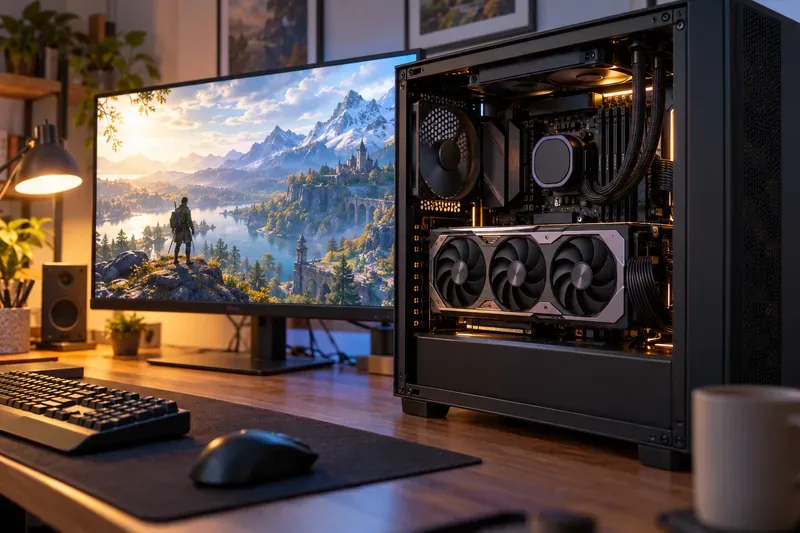
Illustrative image of AI computing hardware and a technology laboratory; not a photograph of Nvidia leadership or the November 23 announcement.
What exactly changed at Nvidia on November 23?
In its November 23 statement, the Santa Clara, California-based company said its board voted unanimously to bring Huang back following discussions with him. The statement said the board received input from senior U.S. government officials and concluded that reinstatement did not present a national-security risk. These are the board's stated conclusions, not a substitute for the results of an independent investigation.
The company's filing with the U.S. Securities and Exchange Commission specifies that the board acted on November 22, 2026, and that the reinstatement was effective immediately; the public announcement was dated November 23. This distinction matters when comparing reports across time zones. No exact clock time for the board vote is established by the cited filing, so it should not be inferred from the news publication time.
Nvidia also said its independent-director committee's investigation would continue. A separate National Security and Export Control Committee has been formed, and the company plans to recruit a chief compliance officer. Harvey C. Jones remains board chair, while Colette Kress returns to her continuing role as chief financial officer. Investors therefore have both a restored chief executive and new governance measures to monitor.
Why does Jensen Huang's return matter to investors?
Huang's importance is operational as well as symbolic. Nvidia sells an ecosystem of AI accelerators, networking hardware and software, and its roadmap requires coordination across chip design, advanced manufacturing, cloud customers and government trade rules. Investors who were uncertain about management continuity now have a clearer leadership arrangement. That can lower one source of perceived risk without guaranteeing revenue growth or a higher stock price.
The difference between a relief rally and a durable re-rating is crucial. A relief rally reflects the removal of a feared outcome; a durable re-rating requires evidence that future earnings, margins and competitive positioning support the valuation. Following an unusually large one-day move, investors should avoid treating the market's first reaction as a permanent verdict on the company's governance or growth.
What do Nvidia's latest earnings say about AI demand?
Nvidia's November 17 earnings release provides a separate operating benchmark. Revenue for the third quarter of fiscal 2027, which ended October 25, 2026, was $115.8 billion, up 103% year over year. Data Center revenue was $107.6 billion, up 110% year over year. GAAP gross margin was 74.8%. These figures show very strong reported demand before the CEO reinstatement; they are not evidence that the November 23 leadership decision itself created new sales.
The company projected fourth-quarter fiscal 2027 revenue of $130.0 billion, plus or minus 3%, and a GAAP and non-GAAP gross-margin range of 71% to 72%. These are management forecasts, not achieved results. Nvidia said its outlook did not assume Data Center compute revenue from China, a reminder that export policy and geographic access remain material constraints.
The Vera Rubin platform and the industry's expansion of AI infrastructure may support continuing orders if hyperscale cloud providers and enterprises maintain their spending. But customers must still deliver useful AI products, secure financing, build power and data-center capacity, and earn acceptable returns on expensive infrastructure. A faster supply ramp could also pressure margins or create inventory risks if demand weakens.
How could Nvidia's leadership return affect other technology and AI stocks?
Nvidia is a major weight in U.S. technology benchmarks and a central supplier to cloud computing. A sharp change in its valuation can influence index funds and market sentiment even for investors who have never bought NVDA directly. Suppliers of memory, semiconductor equipment, networking and data-center infrastructure may also move in sympathy, although their fundamentals and contracts differ from Nvidia's.
The November 23 rally indicates that investors repriced some near-term leadership risk across the AI trade. It does not mean every AI-linked company will benefit equally. Some are Nvidia customers, some compete for the same capital budgets, and others face higher financing costs. The next important test is whether new orders, deployment schedules and profit margins match the optimism reflected in share prices.
What should Australian investors check before reacting to NVDA?
For Australians, Nvidia is a U.S.-listed share quoted in U.S. dollars. That creates two separate moving parts: the change in NVDA's USD price and the change in AUD/USD. Even when the U.S. share price rises, an appreciation of the Australian dollar can reduce the return measured in AUD; a weaker Australian dollar can have the opposite effect. Brokerage foreign-exchange spreads and tax treatment can also matter.
Check the timestamp: Compare quotes from the same U.S. trading session. On November 23, New York observes Eastern Standard Time (EST, UTC−05:00), while Sydney observes Australian Eastern Daylight Time (AEDT, UTC+11:00). A U.S. Monday session extends into Tuesday, November 24 in Sydney.
Measure concentration: Look at direct NVDA holdings alongside exposure within Nasdaq-100, S&P 500, global technology and AI-themed ETFs. Overlapping holdings can make a diversified-looking portfolio heavily dependent on the same company.
Separate headlines from filings: Track the independent investigation's outcome, the new compliance role, board disclosures and SEC filings rather than relying on commentary about the CEO's personality.
Compare expectations with fundamentals: Watch Data Center revenue growth, margins, customer capital-expenditure plans, product rollout and free cash flow, rather than the share-price percentage alone.
Account for local rules: An Australian tax resident may have Australian tax obligations on foreign dividends and capital gains; personal circumstances determine the details.
A simple example illustrates currency exposure: suppose a U.S. stock gains 10% while the Australian dollar strengthens 10% against the U.S. dollar over the same period. Ignoring fees and distributions, the AUD-denominated return is approximately flat rather than 10%. The figures are illustrative, not a statement of NVDA's actual price or the current exchange rate.
Could Nvidia's rebound continue, and what are the risks?
Upside scenario: If management stability helps preserve customer relationships and Nvidia meets its sales outlook while demonstrating resilient margins, investors may become more confident about the earnings outlook. Downside scenario: If the ongoing investigation produces new governance issues, export restrictions tighten, customer spending slows, or the market reduces the valuation multiple assigned to AI earnings, the stock could retreat despite Huang's return. These are conditional scenarios, not predictions of a specific price.
Investors should also watch the distinction between Nvidia's own results and the economics of the entire AI supply chain. Nvidia can report rapid sales growth while its customers face pressure to monetize their AI investments. If that gap persists, future infrastructure budgets may eventually change. Leadership continuity helps execute a strategy; it does not eliminate the strategy's commercial risks.
FAQ: Nvidia CEO return and AI stock impact
Is Jensen Huang officially back as Nvidia CEO?
Yes. Nvidia announced his reinstatement on November 23, 2026, and its SEC filing states the board approved the move on November 22, effective immediately.
Did Nvidia shares rise because of his reinstatement?
The announcement coincided with a major November 23 rally, and Reuters linked the market response to reduced uncertainty around leadership. Stock prices also reflect broader technology-sector sentiment; the move cannot be attributed exclusively to one factor.
Does an Australian investor get the same return as the U.S. NVDA quote?
Not necessarily. Returns measured in Australian dollars depend on the U.S.-dollar share price, the AUD/USD exchange rate, trading costs and any applicable tax treatment.