Home
» Today
»
Nvidia Stock Surges as Jensen Huang Returns as CEO: November 23, 2026
Nvidia Stock Surges as Jensen Huang Returns as CEO: November 23, 2026
Verified November 23, 2026, at 17:46 UTC (November 24, 2026, 04:46 AEDT in Sydney, UTC+11:00).
Nvidia confirmed on Monday, November 23, that co-founder Jensen Huang has returned as president and chief executive officer and rejoined its board after a brief resignation. The surprise reversal sparked an extraordinary rally in NVDA shares: market reports described a rise of roughly 32%–33% during the U.S. trading session. This is an intraday snapshot, not a verified closing price. Other AI-linked stocks and major U.S. indexes also advanced, underscoring how closely investors associate Huang with the chipmaker’s strategy.
The leadership decision is verified by Nvidia’s November 23 board announcement and Nvidia’s Form 8-K filing with the SEC. The market surge does not, by itself, settle the separate governance, national-security, or regulatory questions facing the business. For investors in Australia, the distinction between a confirmed leadership announcement and an unfinished investigation is central to assessing what has actually changed.
Destaques
Nvidia announced Huang’s immediate return as CEO and a director on November 23; an SEC filing records the board decision on November 22.
NVDA climbed more than 30% intraday on November 23 in U.S. trading, while AI and semiconductor shares rallied broadly; a final closing return was not verified at this check.
Colette Kress returns to her continuing chief financial officer duties; Harvey C. Jones remains board chair.
An independent investigation and enhanced export-control oversight remain in progress, so the reinstatement does not remove every risk.
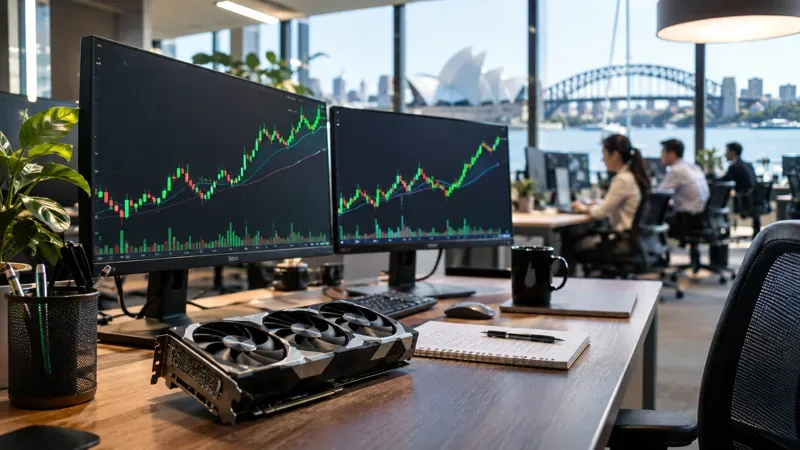
Illustration: A trading workspace overlooking Sydney Harbour. The charts are generic and do not show verified Nvidia prices or the actual November 23 trading session.
What happened to Jensen Huang at Nvidia?
On November 12, Nvidia announced that Huang had resigned from the positions of president, CEO and board director. CFO Colette Kress was appointed interim CEO, and Harvey C. Jones became board chair. See the company’s November 12 leadership announcement. It was an abrupt change for a business led by Huang since its founding in 1993.
The company said on November 23 that its board unanimously reinstated Huang following discussions and meetings with him. The board said it considered his candor and leadership ability and had received input from senior U.S. government officials concerning national-security risks. The company's assessment is a board statement, not a published finding that every allegation or inquiry has been resolved.
The Form 8-K identifies November 22 as the effective board decision date, while the public news release is dated November 23. Those are different milestones, not contradictory dates. Nvidia said Kress would continue as executive vice president and CFO, and Jones would remain chair.
Why did Nvidia stock surge after the CEO reinstatement?
The immediate catalyst was the removal of a major uncertainty about who would lead Nvidia’s product roadmap, relationships with hyperscale cloud customers, and dealings with regulators. News coverage of Monday’s U.S. session reported an approximately 32%–33% jump in NVDA shares, a powerful rebound after earlier leadership turmoil. The exact percentage depends on the observation time and reference price; it should not be treated as a confirmed full-day close.
A founder-CEO's return can alter expectations about execution and continuity, but a rising share price is an expression of market sentiment, not proof of improved cash flow. Investors also repriced other technology companies as attention shifted from the disruption toward Nvidia’s underlying AI infrastructure demand. A broad rally can amplify movement in heavily weighted technology indexes and semiconductor funds, even when some companies have not announced new earnings of their own.
For international readers, Nasdaq’s core U.S. stock session normally runs 9:30 a.m.–4:00 p.m. New York, Eastern Standard Time (UTC−05:00) on November 23, equivalent to 14:30–21:00 UTC and 1:30 a.m.–8:00 a.m. Sydney, AEDT (UTC+11:00), on November 24. The intraday percentage reported here is not assigned to a precise timestamp because no exchange timestamp was verified for that specific quote.
What do Nvidia's latest earnings say about the business?
The rebound was not occurring in a financial vacuum. Nvidia’s November 17 fiscal third-quarter results reported revenue of $115.8 billion for the quarter ended October 25, 2026, up 103% from the same quarter a year earlier. Data Center revenue reached $107.6 billion, up 110% year over year. GAAP diluted earnings per share were $2.70.
Nvidia also provided fourth-quarter fiscal 2027 revenue guidance of $130.0 billion, plus or minus 3%, and said its forecast assumed no Data Center compute revenue from China. These are company-reported historical results and forward-looking guidance, respectively. They should not be confused with independently guaranteed future sales.
Those results help explain why investors cared so much about continuity at the top: Nvidia supplies critical systems used to build and run AI services, and the company’s expansion depends on complex supply chains, major cloud customers, software ecosystems, and export regulations. However, rapid growth does not automatically make any share price attractive; valuation still matters.
Is the Nvidia investigation over now?
No. In its reinstatement statement, Nvidia said an independent board committee would continue investigating reports concerning a possible foreign intelligence effort targeting Huang. It also described a separate National Security and Export Control Committee, involvement of specialized legal advisers, and plans to recruit a chief compliance officer. Nvidia said it would cooperate with government inquiries.
These announcements are governance steps, not final investigative conclusions. Unproven claims should not be presented as established misconduct. Readers should watch for subsequent SEC filings and company disclosures rather than treating a single day’s market reaction as evidence that legal and operational risks are finished.
What should Australian NVDA investors watch next?
Official filings: Look for updated governance disclosures, committee findings and any material legal developments published by Nvidia or the SEC.
Leadership execution: Check whether the resumed CEO arrangement changes the product roadmap, customer partnerships or compliance reporting.
Operating performance: Compare subsequent revenue, gross margins and guidance with the November 17 results rather than extrapolating a one-session rally.
Portfolio concentration: Investors may own Nvidia directly and indirectly through global equities or technology ETFs, increasing their effective exposure.
Currency risk: NVDA trades in U.S. dollars. For Australians measuring returns in AUD, changes in the AUD/USD exchange rate and brokerage conversion costs can alter outcomes.
Monday's surge could extend if investors become more confident in leadership stability and demand remains strong. It could also reverse if valuation expectations become stretched, new negative disclosures arise, or broader market conditions weaken. Neither direction is guaranteed. Retail investors should distinguish a rapid recovery in sentiment from a durable improvement in fundamental value.
Frequently asked questions
Is Jensen Huang Nvidia CEO again?
Yes. Nvidia confirmed his reinstatement as president and CEO on November 23, 2026, following a board decision recorded on November 22.
How much did NVDA stock rise on November 23?
Contemporaneous U.S. market reporting put the intraday rise around 32%–33%. That figure is not represented here as an official closing percentage.
Does Huang’s return end Nvidia’s investigation?
No. Nvidia said the independent investigation would continue and announced additional national-security and export-control oversight.