Home
» Today
»
SpaceX Starship Flight 15: Orbital Catch Marks a Major Step, Nov. 23 Update
SpaceX Starship Flight 15: Orbital Catch Marks a Major Step, Nov. 23 Update
Verified and updated: November 23, 2026, 9:46 a.m. UTC (8:46 p.m. AEDT).
SpaceX’s latest major Starship test flight delivered a milestone and a setback: Flight 15’s Ship returned from orbit and was caught by the launch tower at Starbase, Texas, while the Super Heavy booster was lost during its return. The result demonstrates a new recovery capability for the upper stage, but the full two-stage recovery SpaceX wanted remains unproven.
Destaques
Flight 15 launched from Starbase on November 13, 2026, local time, and Ship completed about 14 orbits.
Ship was caught by the tower arms on its return roughly 22 hours later, a first for a Starship returning from space.
The Super Heavy booster did not make it back: its engines stopped firing too soon and its guidance system diverted it to a water landing.
SpaceX has not announced when the next Starship flight will happen or whether the caught Ship will fly again.
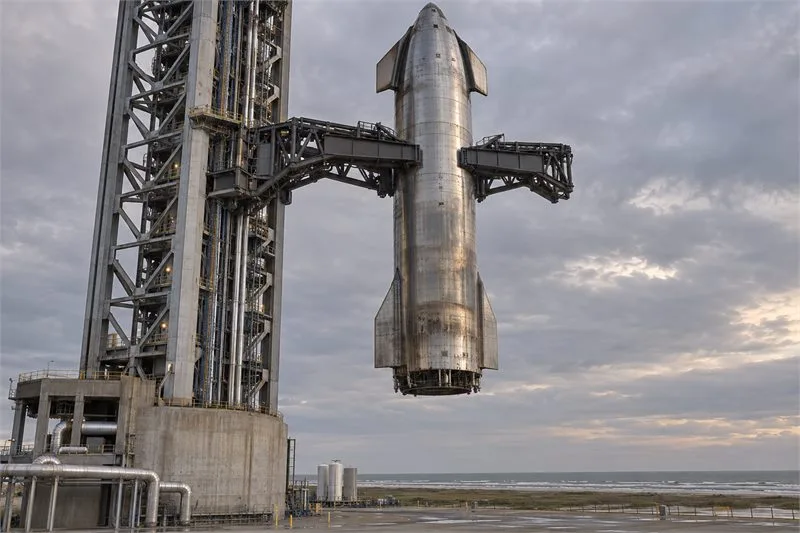
Illustrative image of a Starship tower catch; this is not a photograph of Flight 15.
What happened on SpaceX Starship Flight 15?
SpaceX’s Flight 15 was the fifteenth flight of a full-scale Starship and only its second trip to orbit. The rocket lifted off from the company’s Starbase site in Texas on Friday, November 13, local time. The booster and Ship separated as planned, and Ship continued into orbit. SpaceX’s mission page lists the flight among its Starship missions, while the Associated Press reported the flight’s outcome and recovery sequence.
Ship completed roughly 14 circuits of Earth at an altitude of about 265 kilometres, according to AP’s reporting. During the mission, it released 26 Starlink satellites. The spacecraft then made its controlled return to Starbase. On Saturday, November 14, local time, it descended upright and was caught by the launch tower’s mechanical arms. The roughly 22-hour flight turned the tower catch from a booster-recovery technique into a demonstrated recovery for Starship’s upper stage.
The flight was not a clean double recovery. SpaceX had aimed to bring both stages back to the launch site. The booster’s engines shut down too early during descent, and its guidance system detected that it was out of position. It diverted toward the water and was destroyed, leaving the booster unrecovered. SpaceX was still investigating the cause in the latest reporting available for this update.
Why is the Ship catch a significant milestone?
A caught spacecraft could, in principle, be inspected, refurbished and prepared for another flight without the recovery and transport steps associated with a splashdown. That could support faster reuse. But one successful catch does not establish a repeatable turnaround rate, operating cost or flight reliability. SpaceX has not said whether the Ship used on Flight 15 will fly again, and the booster’s failed return shows that the complete recovery sequence still needs work.
The flight also moved Starship’s orbital operations forward. AP reported that Flight 15’s Ship released a batch of 26 advanced Starlink satellites and streamed views of itself and Earth through Starlink. The spacecraft’s 14 laps were a substantial increase over the previous mission’s one to two laps, according to the same report. Those milestones provide more operational experience, though they do not by themselves confirm the system is ready for routine commercial service.
What does Flight 15 mean for NASA’s Artemis plans?
NASA has contracted SpaceX to develop Starship as a lunar lander for the Artemis programme. That makes progress on flight, in-space operations and recovery relevant well beyond SpaceX’s launch business. NASA welcomed the Ship catch, AP reported, but the test does not demonstrate a crewed lunar landing. Starship still needs to meet the requirements of its specific NASA contract, and a missed booster recovery remains an engineering issue to investigate.
SpaceX has described future Starship operations from Florida as part of its plans, but no confirmed date for the next flight was available in the sources checked for this update. The company’s main page showed USSF-266 as an upcoming Falcon 9 mission scheduled for November 24, 2026, and USSF-380 for November 29. These are separate missions and should not be mistaken for a Starship launch date.
What should viewers watch for next?
The next meaningful Flight 15 update will be SpaceX’s explanation of the booster shutdown and whether the company identifies hardware or software changes for a future attempt. Watch for a new official Starship mission page, a confirmed launch window and details on vehicle assignment. Until SpaceX publishes those specifics, any forecast for when Starship will fly again is provisional.
For Australian viewers, the Texas and UTC dates can differ: Flight 15 launched on November 13 in Starbase and returned on November 14 local time, corresponding to November 14 in UTC for the return. This article uses the local event dates and states UTC explicitly in the verification timestamp.
It achieved orbit, deployed 26 Starlink satellites and returned Ship for a tower catch. The booster recovery failed, so the intended two-stage recovery was not achieved.
When did Starship Flight 15 launch?
It launched on November 13, 2026, local time at Starbase, Texas. Ship returned on November 14, local time.
When is the next Starship launch?
SpaceX had not confirmed a date for the next Starship flight in the sources checked on November 23, 2026.