Creator Likeness Protection: Practical Steps and UK Changes | 22 November 2026
Learn how creators can protect their face, voice and work from unauthorised AI replicas, document misuse and use platform tools and UK protections.
Information checked November 22, 2026, at 9:14 a.m. Greenwich Mean Time (GMT, UTC+00:00; 9:14 a.m. UTC).
Australia edged Wales 29–26 in a closely fought Nations Championship rugby union match at Principality Stadium, Cardiff, on Saturday, November 21, 2026. Kickoff was scheduled for 8:10 p.m. GMT (UTC+00:00). The deciding difference was not try count: both sides crossed four times. Instead, the Wallabies made greater attacking headway with their possession and Carter Gordon kicked the only successful penalty goal, preserving an advantage Wales could not overturn in the closing moments.
Wales showed enough attacking quality to briefly lead 21–19 during the second half, but Australia responded through Len Ikitau and then Gordon's late kick. The 29–26 final score matters for the standings, but it also reveals a broader tactical story: Wales' set-piece pressure repeatedly worked, while Australia's direct running, kick contest and ability to regain the initiative ultimately supplied the decisive points.
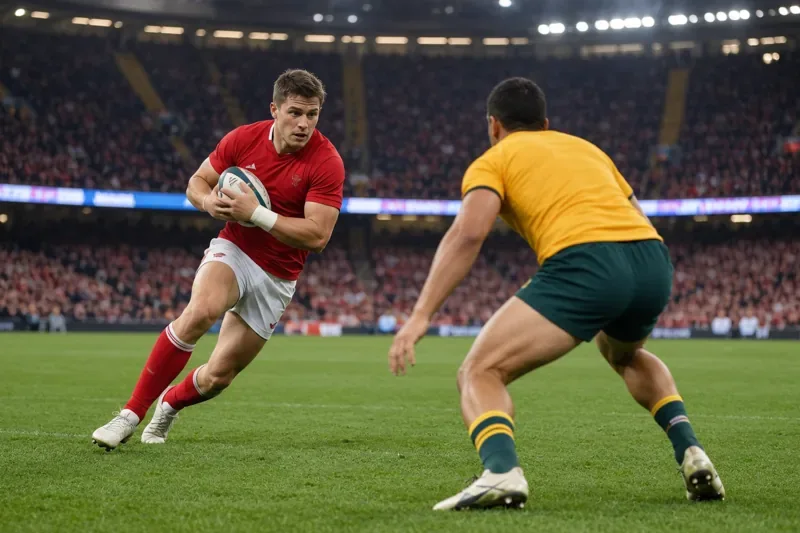
Australia led 12–7 at halftime through scores by props Taniela Tupou and Brandon Paenga-Amosa, while Wales responded through captain Dewi Lake. Early in the second half, Max Jorgensen finished an Australia move sparked by an aerial contest. Lake then scored again, and Blair Murray finished a sweeping Welsh attack that put the hosts ahead. That sequence proved Wales could threaten through two different methods: structured close-range mauls and quicker attacks into wide space.
The crucial Australian answer was a sustained attacking sequence that finished with Ikitau crossing. His try restored Australia's lead at 26–21 after the conversion. In the 74th minute, Gordon's penalty extended it to 29–21. Substitute hooker Ryan Elias scored a fourth Wales try near the end, but the missed conversion left Wales needing another score. The last Welsh attack broke down before they could complete the comeback. Rugby Australia's account notes that defensive pressure forced a forward pass on the final passage; reporting descriptions of the precise last error vary, but the result is not in dispute.
The official Rugby Australia match center provides a useful comparison of the teams' approaches. The Wallabies made 130 carries to Wales' 116 and gained 474 meters compared with 391. Australia also made 187 passes to Wales' 146, recorded six clean breaks to five and produced twice as many offloads, eight against four. Those measures collectively suggest that Australia generated more movement and support play from comparable shares of possession, rather than simply monopolizing the ball.
| Metric | Wales | Australia |
|---|---|---|
| Tries | 4 | 4 |
| Meters gained | 391 | 474 |
| Carries | 116 | 130 |
| Offloads | 4 | 8 |
| Possession | 51% | 49% |
| Rucks won | 94 | 105 |
| Penalties conceded | 8 | 14 |
| Conversions | 3 of 4 | 3 of 4 |
Wales had advantages elsewhere. Their lineout won 21 throws compared with Australia's 11, and Wales won 10 mauls to Australia's one in the published match center. They also conceded fewer penalties. Yet Australia earned one successful penalty goal and Wales none. This distinction shows why raw discipline totals do not alone establish the outcome: when and where a penalty is awarded, and the decision to take a kick at goal, can matter more than the aggregate count.
The driving maul offered Wales a reliable route to points close to the line. Lake's two tries underscored how difficult it was for Australia to stop a well-organized Welsh forward unit once the ball was secured at the lineout. Elias' late score reinforced that strength. Set-piece control is a sustainable platform, particularly when a team can draw penalties or force defenders into narrow channels.
Its limitation in this match was that Wales needed to turn more early pressure into scoreboard separation. Australia's defense resisted several first-half advances, and its ability to respond with tries from different attacking phases meant that Wales could not depend solely on close-range possessions. Wales also missed the final conversion after Elias' try, which meant the hosts needed a try rather than merely a penalty to win from 29–26. That was consequential, although it would be misleading to treat one kick as the only reason for defeat.
Jorgensen's try highlighted the value of a competitive attacking kick: Gordon kicked into a contest, Australia recovered possession and used the continuation to score. The Wallabies combined that approach with direct carrying and support runners, particularly during the sequence that produced Ikitau's try. Australia had 56% of second-half possession according to the match center, reversing Wales' first-half advantage. The shift gave the visitors more chances to force Wales to defend repeated phases.
These observations should not be confused with a complete possession-by-possession tactical audit. Published statistical totals establish what occurred; identifying every defensive call or individual assignment would require verified full-match footage and coaching information. The clearest supported inference is that Australia's broader attacking variety created enough scoring opportunities to offset the pressure Wales generated through their maul and lineout.
The victory ended Australia's four-Test losing streak and helped the Wallabies finish third in the Southern Hemisphere group. They are scheduled to meet Ireland at Allianz Stadium, Twickenham, in the fifth-place playoff. Wales finished fifth in the Northern Hemisphere group and will play Japan for ninth place. These are scheduled next matchups, not forecasts of their outcomes.
For Wales, the improvement from earlier struggles is visible in the number and variety of attacking threats, but the next step is better conversion of territorial pressure into points and a cleaner finish to tight matches. For Australia, the challenge against Ireland is whether the same balance of contested kicking, support running and decisive second-half attacks holds up against a different defensive structure. Neither future outcome can be assumed from this one result.
Australia won 29–26 at Principality Stadium in Cardiff, Wales.
Dewi Lake scored twice; Blair Murray and Ryan Elias scored once each.
Both teams scored four tries and converted three. Carter Gordon's successful penalty goal provided Australia's three-point winning margin.
Match result, statistics and fixture details: Rugby Australia official match center. Match development and player contributions: Rugby Australia match report. Tournament format and Finals Weekend: Six Nations Nations Championship guide. Tactical conclusions are analysis of these verified accounts and match statistics, not statements from the teams' coaching staff.
Learn how creators can protect their face, voice and work from unauthorised AI replicas, document misuse and use platform tools and UK protections.
AI reskinning puts synthetic characters into creators’ existing performances. Here’s how it works, why it matters and what UK creators can do.
UK ministers address AI creator impersonation as YouTube expands likeness detection. What changed in 2026, where rights fall short and what comes next.
Bell says a Nov. 17 cyber incident exposed some enterprise customer data, with no service impact reported. Learn how Bell customers can protect accounts and spot impersonation scams.
Bell Canada says a November 17 cyberattack exposed enterprise contacts, ticket details and some IP addresses. Here is what is known—and what remains unclear.
Bell says a Nov. 17 intrusion exposed some enterprise customer data, with no service disruption reported. Here is what is confirmed and what remains unknown.
Australia edged Wales 29–26 in Cardiff, withstanding a late comeback after four tries from each side. See the score, key moments, and what comes next.
Why Australia beat Wales 29–26 in the 2026 Nations Championship: the tactical turning points, match statistics, late penalty, and what comes next.
After Verstappen’s Las Vegas win, see the verified 2026 F1 drivers’ and constructors’ standings, title status, and the nine-point Red Bull–McLaren battle.
Max Verstappen won the 2026 Las Vegas Grand Prix by 0.639 seconds. See the FIA final classification, points, penalties, fastest lap and race highlights.