Home
» Today
»
Australia Interest Rate Hike: What It Means for Mortgages and Savings — November 16, 2026
Australia Interest Rate Hike: What It Means for Mortgages and Savings — November 16, 2026
Information checked November 16, 2026, at 8:35 p.m. Sydney time (AEDT, UTC+11:00; 09:35 UTC). Australia's latest interest rate increase is already putting pressure on variable-rate mortgage budgets, while giving some savers an opportunity to earn more interest. The Reserve Bank of Australia (RBA) raised its cash rate target by 0.25 percentage points to 4.85% at its November 3 meeting, with the new target taking effect on November 4. The cash rate is not the rate homeowners or savers automatically receive: individual banks decide when and how much of a policy change to pass through.
For a household with A$600,000 outstanding on a principal-and-interest mortgage and 25 years remaining, a rise from 6.00% to 6.25% would increase an illustrative monthly repayment by about A$92, from A$3,866 to A$3,958. Actual repayment changes depend on the loan rate, outstanding balance, remaining term, offset balance and lender's recalculation rules. That practical difference matters more to many families than the headline cash rate alone.
Destaques
The RBA's cash rate target stands at 4.85%, effective November 4, 2026; no newer rate decision was listed at this check.
A full 0.25-percentage-point pass-through would add roughly A$61 a month to a A$400,000 loan over 25 years at an illustrative starting rate of 6%.
Variable mortgage borrowers may pay more, but fixed-rate borrowers generally keep their contracted rate until the fixed period ends.
Savers should check actual account rates and bonus conditions rather than assuming deposits receive the entire RBA increase.
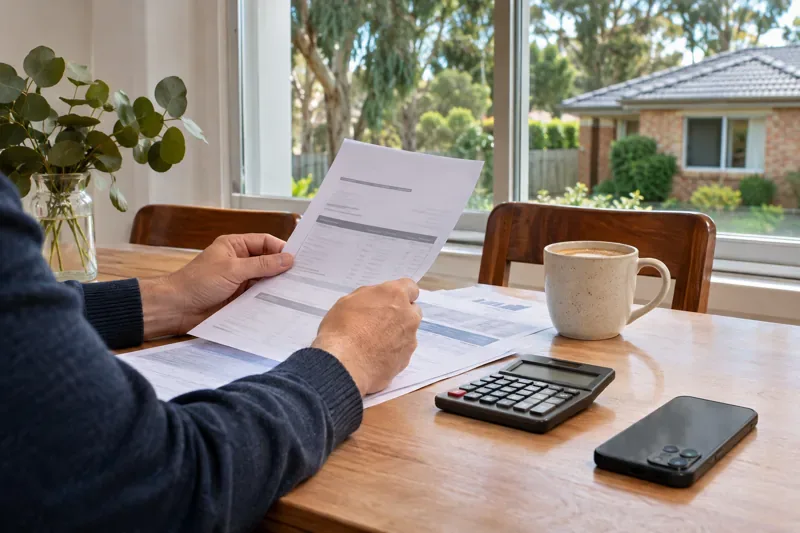
Illustrative generated photograph of a household reviewing mortgage and savings costs; not a photograph of the RBA's announcement.
What changed in Australia's interest rates?
The RBA's November 3 decision increased the cash rate target from 4.60% to 4.85%. Its statement said inflation remained elevated and broad-based, with higher fuel and commodity prices and domestic capacity pressures contributing to the outlook. Six board members favored the increase and three favored holding the rate. The RBA currently lists its next scheduled decision for December 8, 2026, at 2:30 p.m. Sydney time (AEDT, UTC+11:00; 03:30 UTC). A future increase or cut is not predetermined.
How much more could your mortgage cost each month?
For an apples-to-apples illustration, assume the full 0.25-point rate increase is passed on, the loan is principal-and-interest, payments are monthly, the starting interest rate is 6.00%, and 25 years remain. Figures are rounded and exclude fees.
Outstanding mortgage
Payment at 6.00%
Payment at 6.25%
Extra each month
A$400,000
A$2,577
A$2,639
A$61
A$600,000
A$3,866
A$3,958
A$92
A$800,000
A$5,154
A$5,277
A$123
These are modeled payment differences, not advertised mortgage rates or a prediction of any particular bank's charges. Some lenders adjust required repayments after applying a rate increase; on other loans the immediate repayment notice or loan term treatment can differ. Check the effective date and next repayment amount on your bank's letter or app. A change to the cash rate does not, by itself, add 0.25% to an individual mortgage on announcement day.
Are fixed-rate home loans affected immediately?
Generally, the contracted interest rate on the fixed portion remains unchanged for the fixed term. The main risk is what happens when that period expires and the loan rolls to a variable rate or a newly negotiated fixed rate. A split loan exposes only its variable portion to an immediate repricing. Compare refinance fees and any fixed-rate break costs before switching.
Will Australian savings accounts pay higher interest?
Potentially, but there is no automatic one-for-one increase. Banks set savings and term-deposit rates separately from the RBA's overnight cash rate. On A$20,000 of savings, a full 0.25-percentage-point annual increase would generate about A$50 more gross interest over a year if the balance and rate remained constant. On A$50,000, it would be about A$125. Interest earned is generally assessable for Australian income tax, so the after-tax benefit can be smaller.
ASIC's Moneysmart guidance, updated November 11, says competitive savings products may offer 5% or more, but bonuses can require deposits, minimum balances or other conditions. Check the ongoing rate, not only an introductory headline, and compare fees and withdrawal rules. Eligible deposits at Australian authorized deposit-taking institutions are protected under the Financial Claims Scheme up to A$250,000 per account holder per institution, subject to scheme rules.
Is an offset account better than keeping money in savings?
An eligible mortgage offset account reduces the loan balance used to calculate interest. For example, A$20,000 held in a fully linked offset account against a 6.25% mortgage could avoid approximately A$1,250 of interest over one year if the balance and rate stayed unchanged, using a simple annual approximation. Actual savings depend on daily balances and interest calculations. Unlike savings interest, avoided interest on a private owner-occupied home loan is not generally taxable income. However, offset packages can carry higher fees or mortgage rates, and tax treatment differs for investment properties. Compare the net benefit and confirm that your offset is correctly linked.
What can households do before the next RBA decision?
Check your actual loan notice. Record the new interest rate, effective date, required repayment and whether you have variable, fixed or split borrowing.
Stress-test the household budget. Calculate an additional 0.25-point and 0.50-point increase as scenarios, not forecasts, and consider groceries, insurance, energy and transport at the same time.
Ask for a better deal. Request a retention-rate review from your existing lender, then compare alternatives using the comparison rate, ongoing fees and switching costs.
Use cash deliberately. Compare the after-tax benefit of a savings account with the interest saving from a suitable offset account, while preserving an accessible emergency buffer.
Seek help early if payments are at risk. Contact your lender's hardship team before missing a payment. ASIC says lenders may consider temporarily reduced payments or changed loan terms; the National Debt Helpline offers free financial counseling on 1800 007 007.
Could Australian interest rates rise again?
The RBA said it would respond to incoming inflation, economic activity and employment information, rather than committing to a fixed path. The November statement projected inflation to remain elevated into 2027. Higher rates could persist or increase further if inflation pressure proves stubborn; weaker demand or easing inflation could change the outlook. Neither scenario is a confirmed future decision. The immediate priority for borrowers and savers is to verify their own bank's terms, rather than treating the policy rate as a universal retail rate.
FAQ
When did the latest RBA rate hike take effect?
The RBA increased its cash rate target to 4.85% effective November 4, 2026. Your bank's mortgage or savings rate may change on a different date.
Does a 0.25% RBA hike mean my mortgage rises by 0.25%?
Not necessarily. Lenders determine retail rate changes. A variable loan may reflect some, all or none of the increase, while a fixed loan generally retains its contractual rate during the fixed period.
Should I move savings into an offset account?
It can make sense for some owner-occupiers with eligible loans, but compare offset fees, access to funds, the loan rate, savings returns and your personal tax circumstances first.