Home
» Today
»
NHS Cancer Sponge Tests: NICE Backs Wider Access in Draft Guidance | Nov. 16, 2026
NHS Cancer Sponge Tests: NICE Backs Wider Access in Draft Guidance | Nov. 16, 2026
Information checked November 16, 2026 at 9:29 AM UTC (UTC+00:00). England is moving a step closer to offering capsule sponge tests more routinely to people at increased risk of changes in the esophagus associated with cancer. New draft recommendations from the National Institute for Health and Care Excellence (NICE), reported on November 16, 2026, support wider use of two swallowable devices, Cytosponge and EndoSign. Crucially, this is a proposed expansion, not a completed nationwide rollout: the devices are already used in some NHS programs, and final NICE guidance is still expected in 2027.
The tests are intended to find abnormal cells and Barrett’s esophagus, a condition that can increase the likelihood of esophageal cancer. They may help specialists identify people who need an endoscopy, but the swallowed capsule cannot by itself definitively diagnose or rule out every cancer. People with persistent symptoms should not delay medical assessment while waiting for the technology to become available in their area.
Destaques
NICE’s November 2026 draft recommendation supports wider NHS use of Cytosponge and EndoSign in selected patients with persistent acid reflux and relevant risk factors, and in some patients monitored for Barrett’s esophagus.
Capsule sponge devices collect a sample of esophageal cells in minutes, generally without sedation, in settings that can include community clinics.
NHS England reported in February 2024 that more than 8,500 patients had received the test in pilots; in an evaluated group, almost eight in ten completed tests did not require subsequent endoscopy.
A suspicious capsule sponge result is a reason for further investigation, generally with endoscopy. A reassuring result does not guarantee a person will never develop cancer.
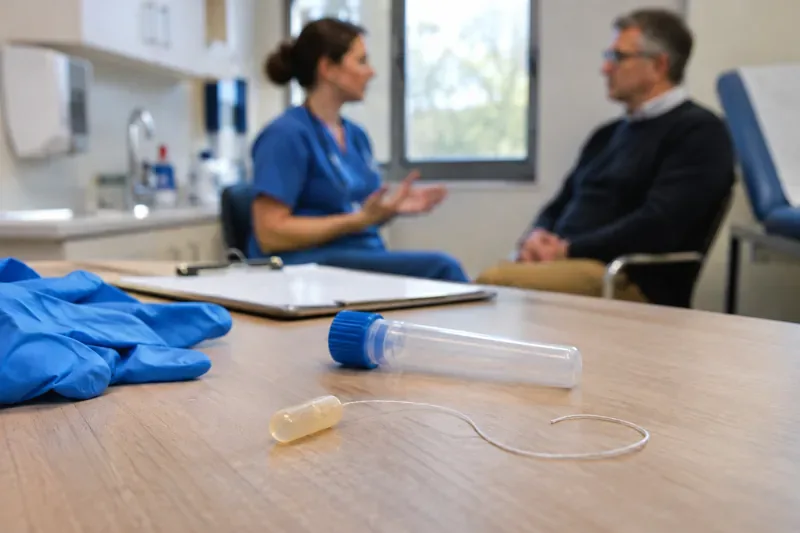
Illustrative clinical consultation showing a capsule-and-thread concept; this generated image does not document an actual NHS procedure or show a particular commercial test device.
What has changed in the NHS cancer sponge test announcement?
The immediate news is NICE's draft position on broader routine use, rather than the invention of a new diagnostic test or the start of universal screening. Cytosponge has previously been evaluated through NHS pilots, and other capsule sponge devices are being used or studied in different areas. NICE is assessing their role for identifying Barrett's esophagus and early changes that can develop into esophageal cancer, and for monitoring selected people already diagnosed with Barrett's.
NICE's published development schedule lists February 24, 2027 as the expected publication date for its technology appraisal, titled “Capsule sponge tests for detection of Barrett's oesophagus and early-stage oesophageal cancer and surveillance of Barrett's oesophagus” (ID6683). The recommendations remain subject to the formal process. How quickly access might expand in any individual NHS area cannot be stated as a confirmed outcome today.
Earlier activity provides important context: in July 2025, NHS England announced a pilot to bring heartburn health checks, including capsule sponge testing, into selected high-street pharmacies in England. This was explicitly a pilot whose independent evaluation would inform decisions about any future expansion. Existing access should therefore not be confused with automatic eligibility for every adult with indigestion.
How does the Cytosponge or EndoSign test work?
A patient swallows a small capsule attached to a thin thread. The capsule coating dissolves after reaching the stomach and releases a small sponge. A trained healthcare professional then uses the thread to gently retrieve the sponge through the esophagus. As the sponge passes up the food pipe, it gathers cells from its lining; the sample is sent for laboratory analysis.
The sampling stage usually takes only minutes and does not generally need sedation. An appointment can take longer because staff must assess suitability, explain the procedure and provide follow-up instructions. Some patients may experience temporary throat discomfort. Suitability depends on medical history and the particular service's assessment; for example, someone with swallowing difficulties or certain esophageal conditions may need a different investigation.
Laboratory findings can suggest Barrett's esophagus or other changes that need closer examination. They are not a substitute for the camera examination and tissue biopsies that may be needed to establish a diagnosis. The NHS continues to describe gastroscopy as the main investigation when clinicians suspect esophageal cancer.
Who could be eligible for the sponge test?
The proposed wider pathway focuses on people with persistent gastroesophageal reflux and additional risk factors, as well as certain patients already under surveillance for Barrett's esophagus. Eligibility is not determined by heartburn alone. Age, symptom history, previous test findings, medications and other clinical factors may influence whether a person is offered a capsule sponge test or goes directly to endoscopy.
Local NHS pathways differ. For example, the Lancashire and South Cumbria Cancer Alliance describes community projects that have used criteria such as age over 50 and long-term use of acid-suppressing medication, while another NHS trust describes its capsule sponge service for suitable people who already have Barrett's esophagus. Those are examples of local arrangements, not a universal NHS eligibility rule.
Anyone with difficulty swallowing, unexplained weight loss, vomiting blood or other symptoms suggesting a potentially serious condition should seek medical advice rather than assuming a sponge test is the appropriate next step. A GP can determine whether an urgent suspected-cancer pathway is needed. The capsule sponge proposal does not replace those urgent referral pathways.
Why might wider access matter for early cancer detection?
Long-standing reflux can sometimes be associated with Barrett's esophagus, in which the lining of the lower food pipe changes. Most people with Barrett's will not develop cancer, but identifying abnormal changes may help doctors decide who requires surveillance or treatment. Because a capsule sponge can be offered without a full endoscopy procedure for suitable patients, it could reduce pressure on endoscopy services and allow them to prioritize people whose findings warrant direct visualization and biopsy.
NHS England's February 2024 evaluation reported over 8,500 capsule sponge tests during a pilot. In one evaluated cohort, almost eight out of ten patients who completed the test were discharged without additional testing. This does not mean the test detects eight out of ten cancers: it describes a service-pathway outcome, not the test's cancer sensitivity or cure rate. The evidence also should not be extrapolated to every future population offered the test.
Important uncertainties remain. NICE's appraisal must assess effectiveness, patient selection, follow-up and value for the NHS. If final recommendations support broader use, practical implementation could depend on training, laboratory capacity, referral arrangements and local commissioning. A wider rollout might reduce some unnecessary endoscopies, but its precise effect on cancer outcomes and NHS waiting lists cannot be guaranteed in advance.
What should patients with persistent heartburn do now?
People with regular reflux or persistent indigestion can speak with their GP about symptoms and risk factors, particularly if symptoms are worsening or treatment is not helping. Ask which investigation is appropriate in your local service, rather than assuming a capsule sponge appointment can be booked directly. If you already receive surveillance for Barrett's esophagus, continue the schedule agreed with your clinical team unless they advise otherwise.
If you are offered a capsule sponge test, ask how your result will be communicated, whether you may still require endoscopy and which symptoms should trigger another clinical review. Even a normal result should be interpreted together with your ongoing symptoms and medical history.
What happens next for NICE and NHS England?
The next meaningful milestone is the completion of NICE's appraisal, currently scheduled for February 2027. Its final wording and the NHS's implementation arrangements will determine which groups are prioritized and how widely testing becomes available. Until then, statements that the NHS has launched a universal cancer-detecting pill or replaced endoscopy nationwide overstate what is confirmed.
Has the NHS rolled out the cancer sponge test across England?
No. Some services already offer capsule sponge testing, but NICE’s November 2026 recommendations are still in draft. A broader, consistent rollout depends on final guidance and NHS implementation.
Can the swallowed sponge confirm cancer?
It can detect potentially concerning cellular changes, including changes associated with Barrett's esophagus. Abnormal findings generally need follow-up endoscopy and sometimes biopsies; a negative result cannot rule out every cancer.
Can I request a Cytosponge test from my GP?
You can ask whether capsule sponge testing is available and suitable, but access varies by local NHS service and clinical criteria. Your GP may recommend endoscopy or another assessment instead.