Home
» Today
»
Australia Interest Rates Reach 4.85%: Why the RBA Is Hiking in November 2026
Australia Interest Rates Reach 4.85%: Why the RBA Is Hiking in November 2026
Last verified: November 16, 2026, 8:33 p.m. Sydney, AEDT (UTC+11:00); 9:33 a.m. UTC.
Australia's interest rates are rising because inflation has proved more persistent than the Reserve Bank of Australia (RBA) expected, and a new wave of global energy costs is adding to domestic price pressures. On November 3, 2026, the RBA raised its cash rate target by 25 basis points to 4.85%, effective November 4. It was the fifth quarter-percentage-point increase of 2026, adding pressure to borrowers even as the economy slows. Source: RBA November 3 monetary policy decision and RBA cash rate history.
For households, the central issue is not simply that mortgage rates are higher. It is why the RBA believes weaker spending is still necessary to prevent price increases from becoming entrenched. The latest Australian Bureau of Statistics (ABS) reading showed annual consumer inflation at 4.3% in September, compared with the RBA's 2%–3% target; trimmed mean inflation, which helps identify underlying price trends, was 3.6%. Source: ABS September 2026 inflation release.
Destaques
The RBA's cash rate target rose to 4.85% on November 4 following its November 3 decision.
September's annual CPI inflation was 4.3%, while trimmed mean inflation was 3.6%.
Higher fuel and commodity prices, widespread business costs and domestic capacity pressures are driving the inflation outlook.
The RBA forecasts inflation will ease only gradually; future rate moves are not guaranteed.
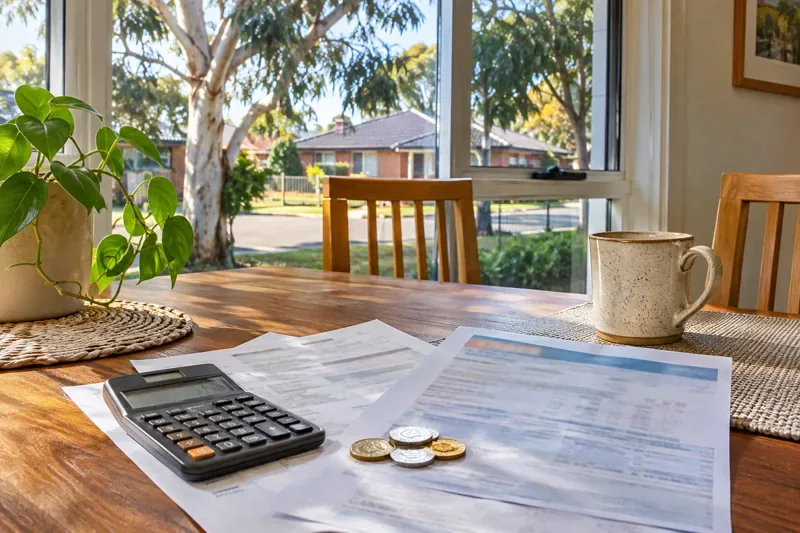
Illustrative household budgeting scene: rising borrowing costs can affect mortgage repayments and everyday spending. AI-generated image, not a photograph of an RBA event.
What changed in Australia's interest rates in November 2026?
The Monetary Policy Board announced the latest increase at 2:30 p.m. Sydney, AEDT (UTC+11:00), on November 3, 2026 (3:30 a.m. UTC). The new 4.85% target took effect November 4. The official cash rate is the benchmark for overnight lending between banks, not the interest rate every customer automatically pays. Banks make separate decisions about mortgage, business loan and deposit pricing, so customer rates can move by different amounts or with a delay. See the RBA cash rate and next decision schedule.
The 2026 increases followed a 3.60% rate at the end of 2025. The RBA raised the rate to 3.85% in February, 4.10% in March, 4.35% in May, 4.60% in September and 4.85% in November, holding at its June and August meetings. These dates describe changes in the policy target, not necessarily when individual lenders changed their rates. Source: RBA cash rate history.
Why is the RBA raising interest rates when economic growth is slowing?
1. Inflation is above the RBA's 2%–3% target
The RBA aims for low, stable inflation over time. September's 4.3% annual CPI rate was up from 4.0% in August, and the trimmed mean measure rose to 3.6% from a revised 3.5%. That combination matters because it suggests inflation is not restricted to a handful of volatile items. The bank is trying to avoid a cycle in which businesses and consumers come to expect ongoing large price increases. Source: ABS September 2026 inflation release.
2. Global fuel and commodity prices are pushing up costs
The RBA attributes part of the higher inflation outlook to fuel and commodity price increases linked to conflict in the Middle East. Higher energy prices can raise direct transport bills and also make freight, food distribution and other goods more expensive to supply. But higher interest rates cannot produce more oil or reverse a supply disruption. Instead, the RBA attempts to prevent the initial shock from spreading into wider, sustained inflation. Source: RBA November 3 monetary policy decision.
3. Domestic capacity and business cost pressures are persisting
The RBA also judges the economy's capacity constraints to be somewhat greater than previously assumed. When demand presses against available workers, equipment, housing and other resources, prices can rise even without rapid overall growth. Business consultations cited by the bank point to companies facing higher costs and either passing them on or planning to do so. The November statement also identified rising prices for technology-related goods amid strong AI-related investment demand. These domestic and sector-specific pressures help explain why the bank is not treating inflation as merely a temporary fuel-price problem. Source: RBA November 3 monetary policy decision.
4. Inflation expectations can make price increases more persistent
Expectations affect decisions about wages, supplier contracts and pricing. If businesses and households anticipate high inflation for a long period, they may adjust behavior in ways that perpetuate it. The RBA's November outlook says inflation expectations have increased, contributing to upward pressure. Raising rates aims to moderate spending and reinforce confidence that inflation will eventually return to the target band. Source: RBA November 2026 economic outlook.
How do higher interest rates slow inflation?
When the cash rate rises, lenders generally face higher short-term funding benchmarks. Variable borrowing costs may rise, leaving households with less money after debt payments; new loans can become less attractive, and higher returns on savings may encourage people to save instead of spend. Businesses may delay some investment. Together, these effects reduce demand and make it harder to sustain fast price increases. This transmission takes time, and it comes with a cost: softer economic activity and potentially higher unemployment.
The effect is not uniform. A borrower on a variable mortgage can feel it relatively quickly if the lender passes on the increase. A fixed-rate borrower may see no immediate change until the fixed term expires. Renters are not charged the cash rate directly, but financing conditions and broader housing-market dynamics may influence their budgets indirectly. Savers may benefit from better deposit rates, although each institution's products and conditions differ.
What does a 0.25-percentage-point increase mean for a mortgage?
As an illustration, for an outstanding A$500,000 principal-and-interest loan with 25 years remaining, a rise in the mortgage interest rate from 6.00% to 6.25% would increase a calculated monthly repayment from about A$3,222 to about A$3,298, or roughly A$76 a month. This assumes the entire increase is passed through, the balance and remaining term stay the same and repayments are recalculated on that basis. It is not a prediction of any lender's rate or a universal repayment change.
Borrowers can check their lender's actual notice, compare the new repayment against their budget, review offset-account benefits, and consider requesting a rate review or comparing refinancing costs. Before switching, allow for discharge and application fees, product features and possible fixed-rate break costs. People under financial stress can contact their lender's hardship team before missing a payment.
Will Australian interest rates keep rising in 2027?
No future increase has been confirmed. The November RBA forecast expects headline inflation to peak around 4.5% in the December 2026 quarter and remain above 3% until late 2027, while underlying inflation is projected to reach around 2.5% in mid-2028. These are conditional forecasts, not promises about future CPI readings or cash-rate decisions. They reflect assumptions about energy prices, demand and other conditions as well as a market-implied path for interest rates. Source: RBA November 2026 economic outlook.
The RBA's outlook also projects a gradual increase in the unemployment rate and weaker economic growth, illustrating the trade-off: bringing inflation down can restrain hiring and household spending. A quicker easing in fuel costs and underlying inflation could reduce pressure for further rate increases; renewed price shocks or stubborn domestic inflation could keep policy restrictive. The next scheduled monetary policy update is December 8, 2026, at 2:30 p.m. Sydney, AEDT (UTC+11:00), equivalent to 3:30 a.m. UTC. Source: RBA cash rate and next decision schedule.
What should Australian households watch next?
Three signals matter more than rate speculation alone: whether headline and trimmed mean inflation decline, whether labor-market conditions soften, and whether businesses keep passing on energy and supply costs. The next ABS CPI release, covering October 2026, is scheduled for November 25, 2026, at 11:30 a.m. Sydney, AEDT (UTC+11:00), or 12:30 a.m. UTC. Its figures may offer a clearer indication of whether price pressure is easing. Source: ABS September 2026 inflation release.
For household planning, it can help to stress-test repayments under an additional 0.25- or 0.50-percentage-point increase without assuming either will occur, and to keep emergency savings accessible where possible. The essential distinction is that the RBA is reacting to inflation data and risks, not trying to raise every individual bank rate by an identical amount.
FAQ: Australia's rising interest rates
Why did the RBA raise rates in November 2026?
Because inflation remained above target and the bank saw increased risks from higher fuel costs, broad business price pressures, and tighter-than-expected domestic capacity.
Does an RBA rate hike automatically increase my mortgage rate?
No. Lenders set their own customer rates. Variable mortgages may be repriced, while fixed loans generally retain their contracted rate until their fixed period ends.
When is the next Australian interest rate decision?
The next scheduled RBA cash rate announcement is December 8, 2026, at 2:30 p.m. Sydney, AEDT (UTC+11:00), or 3:30 a.m. UTC. A rate change is not assured.