Home
» Today
»
BYD Great Tang Wheel Error Explained: Rim Mix-Up, Safety Checks and Fixes — Nov. 14, 2026
BYD Great Tang Wheel Error Explained: Rim Mix-Up, Safety Checks and Fixes — Nov. 14, 2026
Information checked: November 14, 2026, 16:08 AEDT (UTC+11:00), Sydney; November 14, 2026, 05:08 UTC. This is the article verification time, not a vehicle production or incident timestamp.
The “BYD Great Tang wheel error” attracting attention is primarily an assembly problem, not a confirmed dashboard warning code. On November 11, 2026, BYD acknowledged that some Great Tang (Da Tang) SUVs sold in China had their front and rear wheel rims installed in the wrong positions. It blamed a supplier’s code-entry mistake, pledged free inspections and rim correction, and said its specific testing found no effect on vehicle handling or driving safety. The automaker did not publicly state how many vehicles were affected.
For an owner, the essential distinction is between a physical rim mix-up and an electronic alert such as low tire pressure, ABS, electronic stability control or steering assistance. A dashboard warning cannot, by itself, establish that a Great Tang has the reported assembly defect. Conversely, no warning light is required for a rim to be mounted at the wrong axle.
Destaques
Confirmed issue: BYD says some Great Tang vehicles had incorrectly positioned front and rear wheel rims due to a supplier coding error.
Company response: Free inspection and professional rim correction, transport assistance, and a restart of the full-vehicle warranty for affected vehicles were announced in China.
No official “wheel error” code verified: The reporting concerns wheel-rim assembly, not a named instrument-cluster message.
What to do: Document wheel specifications, avoid unqualified wheel swapping, and ask a BYD service facility to confirm the vehicle identification number and correct fitment.
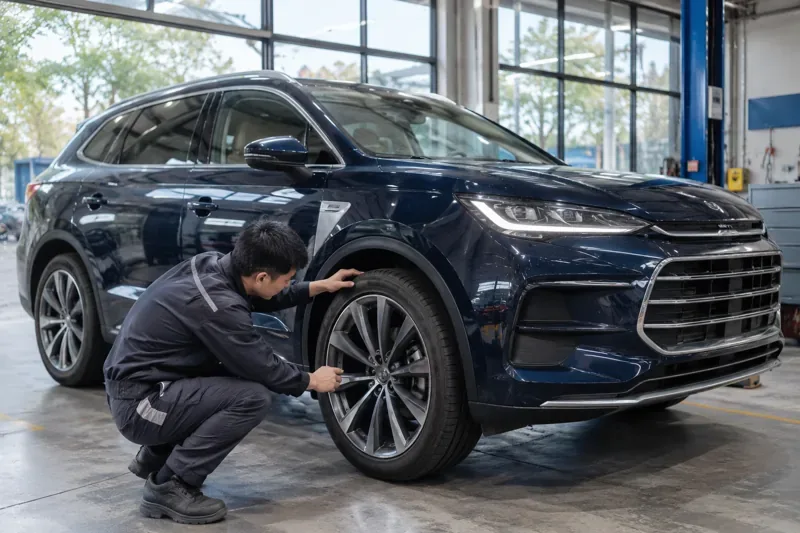
Illustrative service-bay image showing a mechanic inspecting an SUV wheel; not an actual Great Tang or a photograph of an affected vehicle.
What happened with the BYD Great Tang wheels in November 2026?
After owners raised questions about wheel placement, BYD issued a statement on Wednesday, November 11, 2026, in China. Its account identified a code-entry mistake at wheel-rim subassembly supplier Hubei Boyu Industrial as the cause of incorrect installations on some vehicles. The manufacturer said it checked the issue, corrected production codes, and worked with the supplier to add camera-based visual mistake prevention. The full response was reproduced by reproduced text of BYD’s November 11 statement.
BYD said dedicated testing had found the vehicles’ handling unaffected and no driving safety risk. That is the manufacturer’s reported test conclusion, not an independent inspection of every customer vehicle. The company also promised to invite affected owners to local service sites for free inspections and professional rim swaps, offer a loaner vehicle or transport-expense compensation, and restart the affected vehicles’ whole-car warranty from November 11. The scope and logistics of those remedies should be confirmed by the servicing dealer, especially outside mainland China.
What does “wheel error” mean on a BYD Great Tang?
In this news context, “wheel error” is an informal description of incorrectly assembled wheel rims. It should not be treated as an official, universal BYD fault code. The front and rear wheels of certain Great Tang versions have different rim widths. If the wider rims intended for the rear are mounted at the front and narrower rims are mounted at the rear, the resulting wheel-and-tire combination no longer matches the specified arrangement even though the tires themselves may still show the expected front and rear sizes.
Owner reports surrounding the 20-inch staggered setup describe front 20×8J rims with 255/50R20 tires and rear 20×9J rims with 275/45R20 tires. These dimensions come from reporting about the affected configuration, not a verified specification for every trim or market. Owners must check their exact vehicle’s compliance information and factory documentation before using these numbers to judge their own car.
Is a reversed rim the same as a tire-pressure or steering warning?
No. A tire-pressure monitoring system (TPMS) alert can point to low pressure, high temperature, missing sensor communication or a system malfunction. An ABS or electronic stability warning can indicate faults in braking or vehicle-control systems; an electric power-steering warning calls for its own diagnosis. None of these messages should be relabeled “Great Tang wheel error” without the actual display text and a qualified diagnostic check. Equally, do not assume a tire-pressure light automatically identifies swapped front and rear rims.
How can owners check whether the Great Tang has the wrong wheels?
Record the evidence: Take clear photographs of each wheel and tire, their positions, the dashboard if an alert appears, and the VIN. Do this with the SUV parked safely.
Read the tire sidewalls: Note the tire sizes on each axle. Tire-sidewall markings alone cannot establish the rim width.
Ask for rim-marking verification: A trained technician can check markings on the inside of the alloy wheel and compare the four rims with the build specification for the VIN. The rim width may not be visible with the wheel fitted.
Book an authorized inspection: Tell the workshop you are checking the November 2026 Great Tang front/rear rim assembly issue, and ask for the correct parts and a written inspection outcome.
Keep the paperwork: Save repair orders, part numbers, tire-condition notes and any transport-expense or warranty correspondence.
Do not move complete wheels from front to rear as a DIY fix. A staggered setup can use different tire dimensions; reversing wheel-and-tire assemblies may create a different fitment problem. Correcting a rim-only mistake can require tires to be dismounted and remounted by a tire specialist, followed by appropriate balancing, torque checks and system verification.
What should you do if a warning appears while driving?
Respond to the actual warning and vehicle behavior, rather than assuming it is the Great Tang rim issue. If the vehicle pulls sharply, vibrates severely, develops sudden tire-pressure loss, makes unusual wheel noises, or shows red braking or critical steering warnings, reduce speed smoothly, stop in a safe location as soon as practical and arrange roadside assistance. Do not continue simply because BYD reported reassuring results from its own testing of the assembly error.
If a low-pressure alert occurs and the vehicle is otherwise controllable, stop safely and inspect the tires for visible damage before checking pressures when appropriate. Inflate to the pressure specified for the exact vehicle and load, rather than borrowing a value from another BYD model. If an ABS, stability-control or power-steering fault remains illuminated, arrange prompt professional diagnosis; an electronic fault may be unrelated to the rim installation.
The BYD Australia owner’s-manual portal is the appropriate starting point for Australian BYD models, while the BYD Australia’s app information explains that supported vehicles may expose tire-pressure status through the app. Features and alerts vary by vehicle and market; neither source is a Great Tang-specific Australian warning-code bulletin.
What caused the rim installation problem?
BYD attributed the problem to an incorrect code entered by its wheel-rim subassembly supplier. That explanation points to the manufacturing and parts-identification process rather than a driver setting, a software update, or a TPMS sensor failure. The company said it corrected the code and added visual error-prevention checks. At this review there was no verified public count of affected Great Tang vehicles and no independently established, comprehensive VIN range in the sources checked.
Some owner accounts raised concerns about tire wear and fitment. Those reports should be documented and assessed by a technician rather than used as proof that every affected car has experienced damage. The practical next step is a rim-width verification and inspection of each tire for abnormal wear or sidewall damage, with measurements and any proposed repair documented on the service invoice.
Are Great Tang owners in Australia affected?
The November 11 announcement relates to Great Tang vehicles discussed in China. There is no verified Australian Great Tang recall, local batch list or Australian remedy announcement in the sources checked for this article. This does not establish that no vehicle could ever be affected; it means owners should not assume that the China-specific support arrangement automatically applies in Australia. Buyers of imported vehicles in particular should confirm the VIN, market of origin, warranty responsibility and service access directly with the seller and BYD.
Australia-based readers can check the current BYD Australia support and owner-manual channels, and seek a qualified wheel-and-tire inspection if their vehicle appears to have mismatched components. The Great Tang should not be confused with older vehicles sold under the Tang name in other regions: their manuals, rim specifications and support coverage can differ.
What happens next for BYD and affected owners?
The next meaningful developments would be an official list of affected production batches, a detailed service campaign or a confirmed regulator notice. None should be assumed before it is issued. Meanwhile, BYD’s stated free correction offer gives owners in the affected China market a concrete way to resolve the assembly problem. Individual cases may still need tire and rim assessment, especially if abnormal wear or handling concerns are reported.
Frequently asked questions (FAQ)
Did BYD issue a Great Tang “wheel error” dashboard code?
No official alert with that exact name was verified. The November 2026 news concerns front and rear wheel rims installed in the wrong positions on some SUVs.
Can I fix the Great Tang wheel problem by rotating the tires?
No. Rotating complete wheels is not an appropriate substitute for verifying rim widths and the approved axle-specific tire fitment. Arrange professional inspection and correction.
Will BYD fix the affected Great Tang wheels for free?
BYD announced free inspections and professional rim swaps for affected vehicles in China, plus transport support and a warranty restart. Eligibility and arrangements elsewhere need separate confirmation.