Podcasting Trends You Need to Know in 2026: A Beginner’s Roadmap

New to podcasting? Learn the 2026 trends shaping video, discovery, transcripts, AI, analytics, monetization, and a practical launch plan.
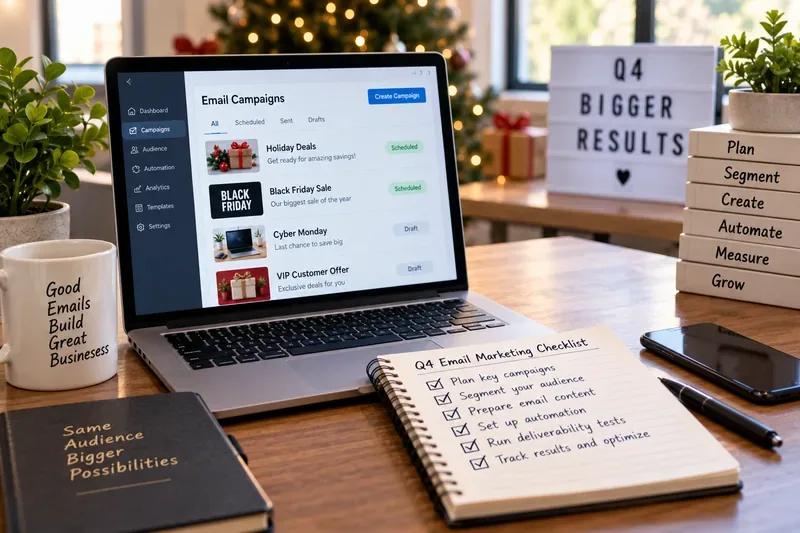
Updated September 2026. Q4 email marketing is not a contest to send the most messages. It is a capacity-planning problem: how much reach can you add without damaging deliverability, how much urgency can you create without training customers to wait for discounts, and how much automation can you use without losing relevance. The strongest plan depends on your list quality, purchase cycle, margins, inventory, and the amount of email your audience already receives.
The practical goal is to make those trade-offs explicit before Black Friday, Cyber Monday, holiday shipping deadlines, and year-end promotions compress the calendar. This reference guide compares the main choices, shows what to measure, and explains which strategy fits different situations.
Most Q4 plans fail for one of four reasons: the list is not healthy enough for a sudden volume increase, the offer is not profitable enough to scale, the customer experience cannot support the demand created, or measurement is too weak to distinguish revenue from noise. Identify the limiting factor first.
| If your main constraint is... | Prioritize... | Avoid... |
|---|---|---|
| Deliverability or a cold list | Engaged segments, gradual volume increases, authentication, suppression | Sending the entire database because Q4 is “too important to miss” |
| Thin margins | Bundles, threshold offers, exclusivity, loyalty value, product education | Automatically matching the deepest competitor discount |
| Limited inventory | Segment by product interest and stock availability | Promoting scarce items broadly without a fallback offer |
| Limited creative capacity | Reusable campaign frameworks and a few high-value automations | Building a unique design for every send |
| Weak analytics | Consistent UTM naming and conversion/revenue tracking | Optimizing mainly for opens |
Frequency can rise during Q4 when subscribers expect promotions, inventory changes quickly, and your offers are materially different from one message to the next. A retailer might reasonably communicate a launch, a Black Friday preview, a main sale, a shipping-deadline reminder, and a gift-card option because each email answers a different buying question.
The trade-off is complaint risk. Google tells senders to keep spam rates reported in Postmaster Tools below 0.1% and avoid ever reaching 0.3% or higher, while its sender requirements require rates below 0.3%. Google also advises senders to increase volume gradually rather than creating abrupt spikes. See the current Gmail email sender guidelines and sender requirements FAQ.
Yahoo similarly requires senders to keep complaint rates below 0.3% and recommends mailing active, engaged recipients. Its current guidance also says bulk senders should support easy unsubscribe and authenticate with SPF, DKIM, and DMARC. Review Yahoo Sender Hub best practices.
Choose lower frequency when your buying cycle is long, your audience has low recent engagement, or your content would repeat the same offer without adding new value. In those cases, a smaller number of well-timed messages can protect sender reputation and make each email feel more consequential.
A useful compromise is frequency by segment rather than one global calendar. Highly engaged customers can receive the full promotional sequence. Less-engaged subscribers can receive only major moments. Recent buyers can be removed from acquisition-heavy sends and moved into post-purchase messaging.
Sending to everyone maximizes theoretical reach, but segmentation usually gives you better control over relevance and risk. The right segmentation depth depends on the amount and reliability of customer data you actually have.
For Q4, recency often matters more than complicated persona labels. A customer who clicked a product yesterday is usually a stronger signal than a demographic category inferred months ago.
A deep percentage discount can produce a fast response, but it also gives away margin to customers who might have purchased with a smaller incentive. It can also make later full-price messages less persuasive. Instead of treating discount depth as the only lever, compare offers by business objective.
| Offer type | Best fit | Main trade-off |
|---|---|---|
| Sitewide percentage discount | Simple catalog, strong margins, rapid conversion goal | Margin erosion and weak product-level control |
| Tiered discount or spend threshold | Increasing average order value | More explanation required |
| Bundle | Complementary products or inventory balancing | Requires bundle economics and fulfillment readiness |
| Free shipping threshold | Stores where shipping cost is a purchase barrier | Can be expensive on low-margin or heavy orders |
| VIP early access | Loyalty and high-value segments | Less effective if the “exclusive” offer becomes universal immediately |
| Gift with purchase | Protecting headline price while adding value | Requires extra stock and operational coordination |
Before launch, calculate the contribution margin at expected redemption rates. A campaign that produces more gross revenue but less contribution profit is not automatically the better Q4 campaign.
Broadcasts are best for calendar-driven events: a Black Friday launch, shipping cutoff, limited-time collection, or holiday-hours notice. Automations are best for behavior-driven moments: welcome, browse interest, cart recovery, post-purchase education, replenishment, or win-back.
During Q4, the strongest approach is usually a blend. Use broadcasts for major market moments, then let automations handle individual intent between those moments. The trade-off is overlap. A customer should not receive a cart reminder, a VIP offer, and a broad sale announcement within minutes simply because three systems fired independently.
Build suppression logic before the peak period. Recent purchasers, active support cases, refunded orders, unsubscribed users, and transactional-message recipients may need different treatment. Gmail's current email subscription guidelines also recommend separating subscription messages from non-subscription messages such as receipts and password resets.
Highly designed email can strengthen branding and merchandising, especially for visual products. Simpler layouts are easier to produce, edit, and QA under Q4 time pressure. Neither format wins universally.
Choose richer creative when product imagery is central to the buying decision and you have reliable rendering QA. Choose simpler creative when speed matters, the offer needs explanation, or your team must launch many variations. In both cases, the core message should still be understandable when images are blocked, and the primary call to action should be obvious.
Do not confuse visual complexity with personalization. A short email that reflects a subscriber's recent product interest can be more relevant than a beautifully designed generic newsletter.
Open rate is increasingly limited as a decision metric. Apple Mail Privacy Protection can privately download remote content in the background, which prevents senders from reliably learning whether a recipient actually viewed a message. Apple explains this behavior in its Mail Privacy Protection documentation. Google also states that it does not track open rates in Gmail and cannot verify third-party open-rate accuracy.
For Q4, use a measurement hierarchy that moves closer to business value:
Tag links consistently so campaign traffic can be separated in analytics. Google Analytics supports UTM parameters such as utm_source, utm_medium, utm_campaign, and utm_content; its documentation recommends consistent naming to avoid fragmented reporting. See Google Analytics guidance on custom campaign URLs.
A practical Q4 calendar is easier to manage when each phase has a specific customer question to answer.
| Phase | Customer question | Email focus |
|---|---|---|
| Early Q4 | Why should I pay attention to this brand? | List cleanup, preference capture, education, product discovery |
| Pre-Black Friday | Should I wait, shop now, or join early access? | Expectation setting, previews, VIP access, wish-list behavior |
| Black Friday/Cyber Monday | What is the offer and when does it end? | Clarity, availability, urgency, category relevance |
| December fulfillment window | Will this arrive in time? | Shipping deadlines, pickup options where applicable, in-stock alternatives |
| After shipping cutoff | What can I still buy? | Digital gifts, gift cards, local options, self-purchase messaging |
| Final days of Q4 | What is still useful after the holiday? | Year-end value, replenishment, loyalty, post-purchase support |
As of September 2026, Gmail's bulk-sender requirements remain a material planning constraint. Senders who send more than 5,000 messages per day to Gmail accounts must meet additional requirements that include SPF and DKIM authentication, DMARC, and one-click unsubscribe for marketing and promotional messages. Google says it began ramping up enforcement on non-compliant traffic in November 2025, including temporary and permanent rejections.
Yahoo has parallel requirements for bulk senders, including SPF, DKIM, a valid DMARC policy, low spam complaints, and easy unsubscribe. If Q4 is the first time your brand plans to send at high volume, authentication and list hygiene should be finished before the peak, not during it.
For U.S. commercial email, also review the Federal Trade Commission's CAN-SPAM compliance guide. Among other requirements, commercial messages must use accurate header information and non-deceptive subject lines, include a valid postal address and opt-out mechanism, and honor opt-out requests within 10 business days. Provider requirements can be stricter operationally; Gmail and Yahoo currently expect unsubscribe processing within 48 hours or two days for relevant subscription/bulk messages.
Q4 testing time is limited, so prioritize tests that can change a business decision. Subject-line punctuation is rarely as important as offer structure, audience, timing, or product mix.
Choose one primary outcome before the test starts. If the business goal is contribution profit, do not declare a winner merely because one version gets more clicks.
If your list is large but engagement is uneven, protect deliverability first: segment more tightly, raise volume gradually, and make unsubscribe easy. If your audience is highly engaged but margins are thin, focus on offer architecture rather than deeper discounts. If your team is small, prioritize a few reusable broadcasts plus high-value automations instead of producing dozens of one-off campaigns. If measurement is weak, fix campaign tagging and conversion reporting before adding more sends.
Q4 email success comes from matching the strategy to the constraint. More volume, more design, more automation, and bigger discounts can all work—but each carries a cost. The better plan is the one that makes those costs visible, protects sender reputation, and measures the result close to actual business value.
New to podcasting? Learn the 2026 trends shaping video, discovery, transcripts, AI, analytics, monetization, and a practical launch plan.
A practical UGC masterclass for sourcing, permissioning, briefing, publishing, and measuring customer and creator content without losing authenticity.
Community building can deepen trust, retention, feedback, and advocacy, but it is not a replacement for every marketing channel. Compare the tradeoffs and choose the right model.
Learn what major social platforms have actually confirmed about ranking changes in 2026, what depends on context, and how to adapt without chasing myths.
Learn how to make brand storytelling feel credible, human, and specific—using proof, real tension, ethical customer stories, and a practical authenticity check.
Build a smarter Q4 email strategy by balancing reach, frequency, discounts, automation, deliverability, and measurement for profitable holiday growth.
Learn how to create short-form video that converts by balancing hooks, format, authenticity, CTA, platform fit, and testing across TikTok, Reels, and Shorts.
Why are brands testing KOCs instead of relying only on influencers? Learn what KOCs are, why social commerce favors them, common myths, and how to run a measurable pilot.
Learn a practical TikTok SEO workflow for 2026: find real search demand, match search intent, optimize each video, and measure what improves visibility.
Prepare your e-commerce store for Black Friday with a practical checklist for offers, site speed, checkout, inventory, fulfillment, analytics, security, and support.