Podcasting Trends You Need to Know in 2026: A Beginner’s Roadmap
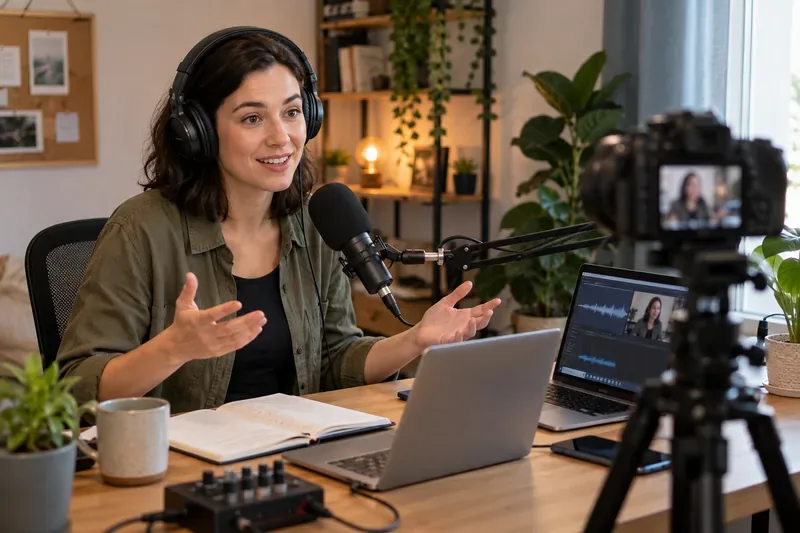
New to podcasting? Learn the 2026 trends shaping video, discovery, transcripts, AI, analytics, monetization, and a practical launch plan.
Short-form video can earn attention quickly, but attention is not the same as conversion. A clip can generate views, likes, and comments while producing very few leads or sales. The practical challenge is to make creative choices that fit both the platform experience and the business outcome you actually want.
There is no single “best” short-form video formula for every brand. A creator-style product demo may outperform a polished studio ad for one offer, while a carefully produced explainer may be better for a high-consideration service. The useful question is not “What format is winning right now?” but “Which trade-off gives this audience enough reason to act?”
As of September 2026, the major platforms still point in the same broad direction. TikTok recommends social-first creative built around a strong hook, value delivery, and a clear close; Meta emphasizes vertical Reels creative with audio and key messages kept inside the safe zone; and Google recommends vertical, sound-on, social-first Shorts assets, with action-oriented Shorts ads generally kept concise. See TikTok’s Creative Center guidance, Meta’s Reels ads guidance, and Google’s YouTube Shorts ad specifications and best practices.
The first trade-off is between broad attention and qualified action. A hook designed to maximize curiosity may pull in a large audience that has little purchase intent. A more specific hook may attract fewer viewers but a higher share of people who actually need the product.
Start by choosing one primary action: buy, book, sign up, download, request a quote, visit a product page, or follow for future consideration. Then define the value exchange. What does the viewer get for taking that action, and why should they care now?
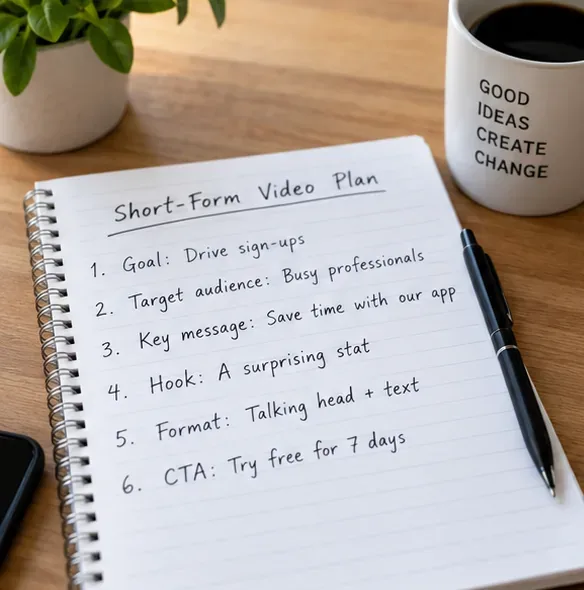
For a low-friction offer such as a free trial, a direct-response structure can work well: problem, benefit, proof, CTA. For a higher-cost service, asking for an immediate purchase may be unrealistic. In that case, the better conversion could be a consultation request, a saved post, a case-study visit, or another next step that matches the buyer’s level of readiness.
Choose one promise for the video. Trying to explain every feature usually weakens the opening and makes the CTA feel disconnected. A short video about a scheduling app, for example, might focus on “cutting manual follow-up” rather than listing calendars, integrations, permissions, reminders, analytics, and pricing in one clip.
| Choice | Advantage | Risk | Best fit |
|---|---|---|---|
| Broad curiosity hook | Can increase initial reach | May attract low-intent viewers | Awareness, entertainment-led brands, upper funnel |
| Specific problem hook | Filters for relevant viewers | May reduce total views | Lead generation, B2B, niche products, high-intent offers |
| Offer-led hook | Makes the commercial intent obvious | Can feel like an ad too early | Retargeting, strong promotions, known products |
Short-form video usually performs best when it feels native to the feed, but “native” does not have to mean sloppy. The real decision is how much polish helps credibility without making the video feel distant from the content around it.
TikTok’s current business guidance encourages advertisers to study high-performing examples in Creative Center and test creative patterns instead of assuming one format will always work. TikTok also supports Spark Ads, which let advertisers promote their own organic posts or authorized creator posts while preserving engagement on the organic post. See TikTok’s Spark Ads documentation.
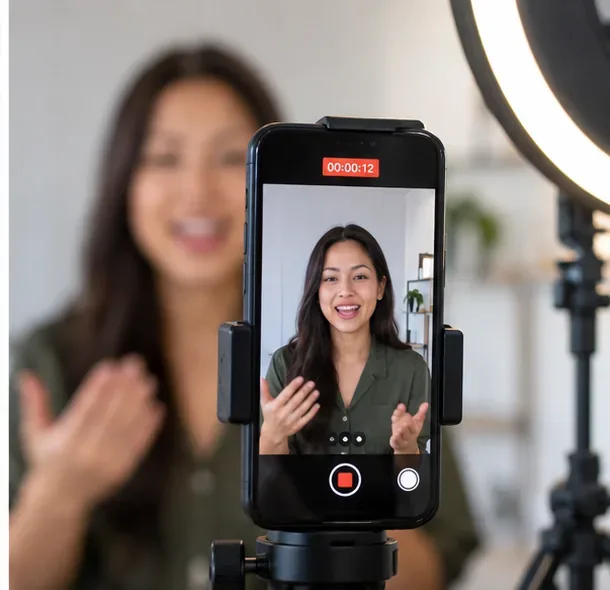
Creator-style footage is often a strong choice when trust, relatability, demonstration, or testimonial-style explanation matters. Polished brand footage can be stronger when the product depends on visual quality, luxury cues, design, or complex demonstrations. The middle ground is often the most practical: natural delivery, clean lighting, readable visuals, and controlled sound without making the scene look like a television commercial.
| Approach | Strength | Weakness | Recommended when |
|---|---|---|---|
| Creator-style / UGC-like | Feels familiar and personal | Can look generic if the script lacks specificity | You need trust, demonstrations, social proof, or rapid testing |
| Highly polished | Strong control over brand image | Higher cost and slower iteration | Visual quality itself supports the value proposition |
| Hybrid | Balances authenticity and clarity | Requires discipline to avoid overproduction | Most performance campaigns that need both trust and brand consistency |
Whenever possible, shoot in 9:16 for feed-first use rather than relying on an after-the-fact crop. Meta says Reels ads using 9:16 video, audio, and safe-zone-aware messaging performed better in its own split-test analyses, but that should be treated as platform evidence rather than a guarantee for every account. Google likewise recommends vertical 9:16 assets for Shorts. If you plan to repurpose the same footage, leave extra visual space so headlines, captions, and platform interface elements do not cover the product or the speaker’s face.
A fast edit is useful only if the viewer can still understand the value. The better trade-off is not “slow versus fast”; it is “necessary information versus friction.” Remove pauses, repeated explanations, and setup that does not change the viewer’s decision.
TikTok’s official creative guidance describes a simple hook-body-close structure. The hook earns the next few seconds, the body shows the value or proof, and the close tells the viewer what to do. Google recommends action-oriented Shorts ads in the 10–30 second range, while allowing longer assets in some campaign types. That is a paid Shorts recommendation, not a universal rule for every organic video, but it is a useful reminder that conversion creative should usually reach the point quickly.
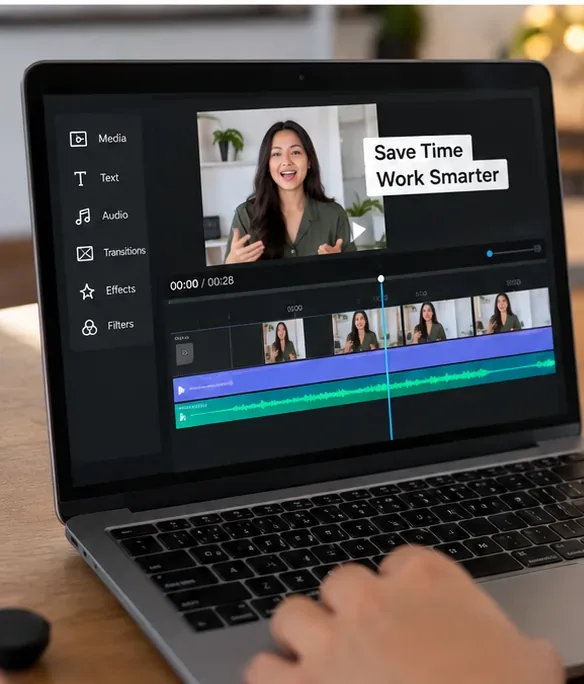
Use on-screen text when it improves comprehension, especially for the core promise, a key proof point, or the CTA. Do not turn every spoken sentence into a wall of captions. Keep important text away from interface-heavy areas. Meta specifically recommends keeping key messages inside Reels safe zones; YouTube also provides previews so advertisers can see how Shorts interface elements affect the creative.
Audio creates another trade-off. Sound, music, and voice can improve energy and comprehension, but the visual story should still make sense when a viewer has sound reduced or is distracted. For commercial use, respect music rights. Meta notes that its licensed music library is intended primarily for personal, non-commercial use and directs businesses to Sound Collection for eligible commercial uses; TikTok maintains commercial audio resources as well.
The strongest short-form programs are built around controlled iteration. Publishing one “perfect” video gives you very little information. Publishing several versions that deliberately vary one important element gives you evidence you can use.
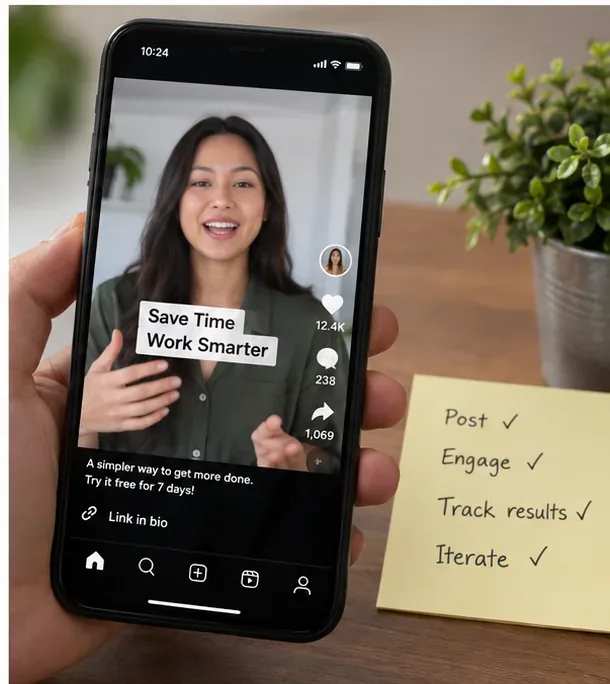
For conversion-focused creative, evaluate the entire path. A high view rate with a weak click-through rate may mean the hook is entertaining but not commercially relevant. Strong clicks with poor conversion can indicate a mismatch between the video promise and the landing page, offer, audience, or checkout experience. A lower view count with a stronger conversion rate can be the better business result.
Use platform metrics carefully because definitions differ. TikTok’s Creative Center, for example, surfaces measures such as two-second view rate, six-second view rate, CTR, and CVR in its Top Ads tools. Meta and Google use their own reporting definitions and attribution settings. Compare variants inside the same platform, campaign structure, audience, and measurement window whenever possible rather than treating a metric from one platform as directly equivalent to another.
If your offer is new, favor more creative variation. Test different hooks, presenters, proof types, and CTAs before investing heavily in production. If you already know which angle converts, invest more in execution quality, brand consistency, creator partnerships, and scale. The mistake is spending heavily on polish before you know whether the message itself works.
A simple testing sequence is enough: keep the offer and audience stable, change one major creative variable, run the comparison long enough to collect meaningful data, then keep the winner as the new control. Platform A/B testing tools can help, but even without a formal experiment, disciplined versioning is more informative than changing the hook, music, offer, audience, CTA, and landing page all at once.
| Primary goal | Creative emphasis | CTA style | Main metric to watch |
|---|---|---|---|
| Direct sale | Product in use, specific benefit, offer clarity | Shop, buy, claim offer | Conversion rate, CPA, revenue or ROAS |
| Lead generation | Problem specificity, authority, useful preview | Book, request, download, sign up | Qualified lead rate and cost per lead |
| App or free trial | Fast demonstration of the job-to-be-done | Install or start trial | Install/trial conversion and downstream activation |
| Awareness with future conversion | Distinctive idea, memorable product cue, creator fit | Learn more, follow, visit | Qualified reach, engagement quality, assisted conversions |
Short-form video that converts is not simply shorter advertising. It is a sequence of deliberate trade-offs: reach versus relevance, authenticity versus polish, speed versus clarity, and volume of testing versus production quality. The best choice depends on what you sell, how much trust the decision requires, and what action you want the viewer to take next.
Build the video around one conversion goal, make the opening relevant to that goal, choose a native-looking format that fits the offer, edit until every second earns its place, and measure the full path from view to action. Then iterate. That process is more reliable than chasing a universal hook formula or copying whatever happened to go viral last week.
New to podcasting? Learn the 2026 trends shaping video, discovery, transcripts, AI, analytics, monetization, and a practical launch plan.
A practical UGC masterclass for sourcing, permissioning, briefing, publishing, and measuring customer and creator content without losing authenticity.
Community building can deepen trust, retention, feedback, and advocacy, but it is not a replacement for every marketing channel. Compare the tradeoffs and choose the right model.
Learn what major social platforms have actually confirmed about ranking changes in 2026, what depends on context, and how to adapt without chasing myths.
Learn how to make brand storytelling feel credible, human, and specific—using proof, real tension, ethical customer stories, and a practical authenticity check.
Build a smarter Q4 email strategy by balancing reach, frequency, discounts, automation, deliverability, and measurement for profitable holiday growth.
Learn how to create short-form video that converts by balancing hooks, format, authenticity, CTA, platform fit, and testing across TikTok, Reels, and Shorts.
Why are brands testing KOCs instead of relying only on influencers? Learn what KOCs are, why social commerce favors them, common myths, and how to run a measurable pilot.
Learn a practical TikTok SEO workflow for 2026: find real search demand, match search intent, optimize each video, and measure what improves visibility.
Prepare your e-commerce store for Black Friday with a practical checklist for offers, site speed, checkout, inventory, fulfillment, analytics, security, and support.