Home
» Today
»
Fall Clock Change 2026: When the U.S. Falls Back and How to Check Your Plans
Fall Clock Change 2026: When the U.S. Falls Back and How to Check Your Plans
In most of the United States, daylight saving time ends on Sunday, November 1, 2026. At 2:00 a.m. local daylight time, clocks move back to 1:00 a.m. local standard time. The hour from 1:00 to 1:59 a.m. occurs twice. The practical goal is simple: know whether your location changes time, arrive at appointments at the intended instant, and check the devices and routines that depend on the clock. NIST lists the 2026 period of daylight saving time as March 8 through November 1. NIST daylight saving time rules for 2026.
What changes on November 1—and where?
The switch happens at 2:00 a.m. local time in each participating time zone, rather than at one shared clock reading nationwide. Before the switch, 1:30 a.m. is daylight time; after the clock reaches 2:00 and returns to 1:00, another 1:30 a.m. is standard time. Sunday therefore has an extra clock hour in locations that make the change. It does not mean everyone will sleep an extra hour. Standard time also shifts the clock placement of daylight: compared with the preceding day, sunrise and sunset occur about an hour earlier by the clock, alongside the ordinary day-to-day seasonal change. NIST explanation of the repeated hour and local time.
Location that observes the change
Just before the change
After the change
Eastern
EDT, UTC−4
EST, UTC−5
Central
CDT, UTC−5
CST, UTC−6
Mountain
MDT, UTC−6
MST, UTC−7
Pacific
PDT, UTC−7
PST, UTC−8
Most of Alaska
AKDT, UTC−8
AKST, UTC−9
These are examples of zones that observe daylight saving time; the table does not settle every local boundary or territory. NIST provides the offsets. Most of Arizona and all of Hawaii do not make this fall adjustment. American Samoa, Guam, the Northern Mariana Islands, Puerto Rico, and the U.S. Virgin Islands also do not observe daylight saving time. The Navajo Nation in Arizona is an important exception to the Arizona exception: it does observe daylight saving time. If a trip crosses a time-zone boundary, verify the actual destination rather than inferring its rule from the state name or a ZIP code alone. U.S. Department of Transportation list of exceptions ; NIST time-zone offsets and Navajo Nation note.
Four checks that make the change easier to manage
1. Confirm the rule for every place involved
Write down the time zone for home, work, a destination, and anyone joining a call from another region. This matters most if one person is in Phoenix and another is in Los Angeles, or if travel involves a community with a different daylight saving rule. Check the place, not just the region. A successful check leaves you with a named time zone and a clear answer to whether that place changes on November 1. If the location sits near a boundary or on tribal land, use an authoritative local source or confirm with the organization hosting the event. The Department of Transportation oversees U.S. time zones and the federal daylight saving framework. DOT overview of uniform time and time-zone boundaries.
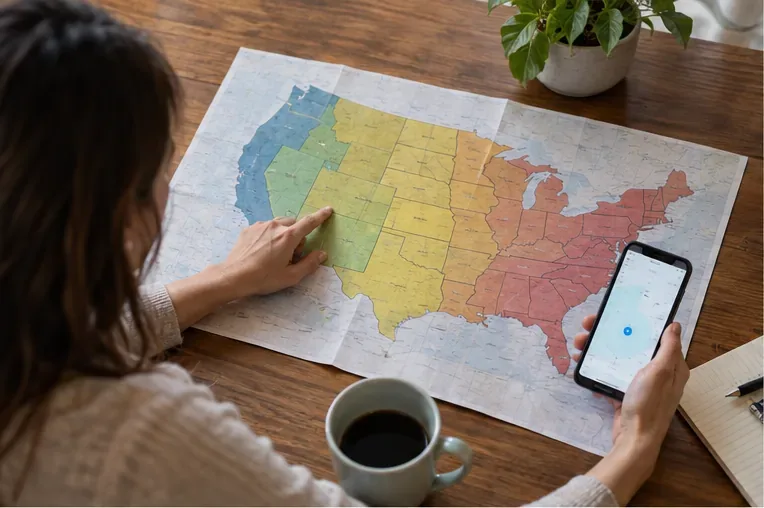
Check the specific destination and its time-zone rule before assuming that every part of a state changes clocks.
2. Audit events that cross the repeated hour
Review flights, shift handoffs, health appointments, medication alarms, virtual meetings, and automated jobs scheduled around late Saturday and early Sunday. A meeting at 1:30 a.m. on November 1 in a participating zone is ambiguous unless the organizer says whether it is the first 1:30, still daylight time, or the second 1:30, now standard time. Ask the airline, employer, event organizer, or system owner which instant applies. For a shared event across zones, an explicit UTC timestamp or an offset such as EDT versus EST helps distinguish the two. Do not change a confirmed flight or shift merely because a personal calendar displays a different hour; verify the issuer's schedule first.
For daytime appointments after the transition, confirm the calendar's time-zone setting and the recipient's local time. The desired result is that all parties agree on the same instant, not merely the same numbers on their screens. This is especially useful for a Sunday morning departure or a Monday call with someone in a place that stays on standard time year-round.
Review appointments and travel across the change; an event in the repeated 1 a.m. hour needs an explicit time-zone clarification.
3. Protect sleep rather than counting on a bonus hour
The clock moves back, but your sleep schedule may not adjust immediately. CDC's National Institute for Occupational Safety and Health notes that sleep and circadian rhythms can take time to adapt. Its guidance suggests that, beginning about three days before the fall change, people who need to shift their routine can move wake time, bedtime, meals, exercise, and light exposure later by roughly 15 to 20 minutes per day. It also emphasizes getting enough sleep in the days beforehand. This is an option for someone with an early Monday schedule or a tightly timed shift, not a requirement for everyone. CDC/NIOSH guidance for the fall time change.
Judge the result by whether you can meet the next day's commitments feeling adequately rested. If gradual changes make your routine harder, keep a consistent bedtime and plan enough time for sleep instead. A shift worker or anyone with an existing sleep problem may need a plan tailored to their schedule. Extra caution can also help with an evening commute that is newly dark by the clock; CDC/NIOSH specifically flags the change in late-afternoon driving conditions after the fall transition.
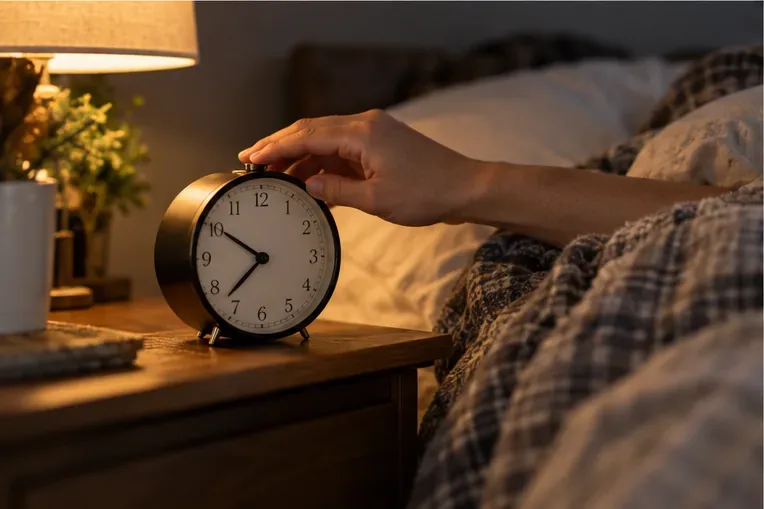
Check the bedside alarm and allow enough sleep before the new schedule begins.
4. Verify clocks and alarms on Sunday morning
Phones and many computers may update automatically, but do not treat automation as a guarantee. NIST says the operating system handles the local time-zone and daylight saving corrections and advises keeping software current. Check that location and automatic time settings are appropriate, then compare the displayed local time with a trusted source after the switch. Adjust manual wall clocks, appliance clocks, vehicle displays, and standalone alarms that remain one hour ahead. Avoid setting an automatically updating phone back a second time. NIST advice on operating-system updates and time correction.
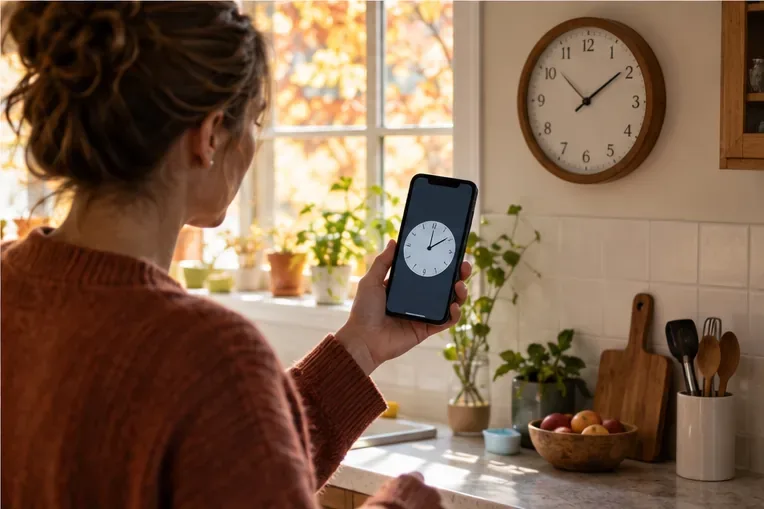
On Sunday morning, compare device time with a trusted reference and correct manual clocks only if needed.
How to tell the plan worked
Time-zone check: every relevant place has a known daylight saving rule, especially Arizona and U.S. territories.
Schedule check: any event between 1:00 and 1:59 a.m. has been clarified as the first or second occurrence, ideally with a time-zone abbreviation or UTC instant.
Device check: phone, computer, manual clocks, and alarms agree on the intended local time without a double adjustment.
Routine check: sleep and travel plans still support your actual commitments, including commutes after dark.
If a device disagrees after the transition, check its time zone and software settings before resetting every event in your calendar. If an appointment remains ambiguous, ask the organizer to identify the precise instant. If you live in a location that does not observe daylight saving time, leave your local clock alone while still checking the time difference with people in places that do. These steps reduce avoidable scheduling mistakes; they cannot guarantee that every service, timetable, or personal sleep pattern adjusts in the same way. As of September 2026, NIST's published 2026 schedule and the Department of Transportation's exception list support the date and coverage described here. Recheck official guidance if a later legal change is announced. NIST 2026 schedule ; DOT coverage and exemptions.