Home
» Today
»
How Electric Vehicles Work: Batteries, Charging and Everyday Costs Explained
How Electric Vehicles Work: Batteries, Charging and Everyday Costs Explained
Electric vehicles can seem complicated because the familiar gasoline-car ideas—fuel tank size, miles per gallon, oil changes, and filling up in minutes—are replaced by battery capacity, kilowatt-hours, charging power, regenerative braking, and software-controlled energy use. The underlying system is simpler than it may first appear: a battery stores electricity, power electronics control how that electricity flows, and one or more electric motors turn the wheels.
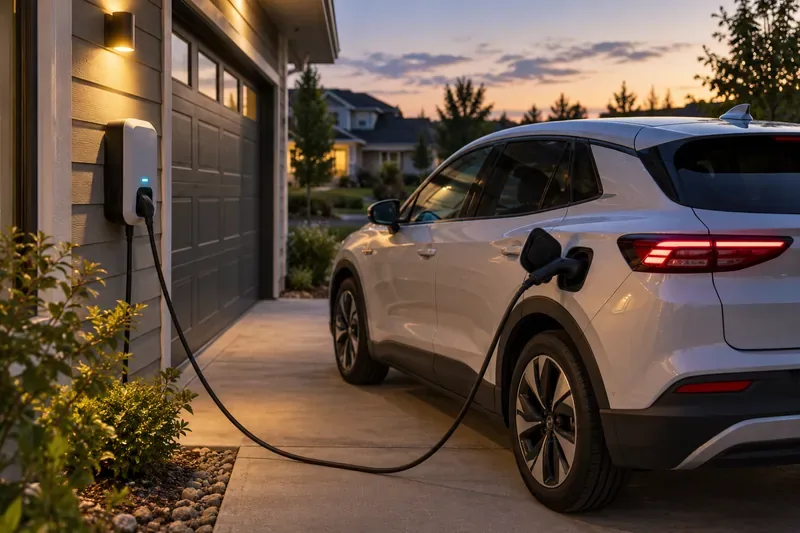
An electric SUV connected to a wall-mounted Level 2-style home charger. Home charging is often the most convenient way to replace the energy used during everyday driving.
Electric vehicle basics at a glance
Question
Practical answer
What stores the energy?
A high-voltage traction battery, usually lithium-ion in modern battery-electric vehicles.
What moves the car?
An electric motor converts electrical energy into mechanical motion.
What happens when you slow down?
Regenerative braking can use the motor as a generator and return some energy to the battery.
How is an EV “fueled”?
By charging from AC power at home or work, or by using DC fast charging on the road.
What mainly determines charging cost?
How many kilowatt-hours the car consumes and the price paid per kilowatt-hour.
How an electric vehicle actually works
A battery-electric vehicle, or BEV, stores electrical energy in a large traction battery pack. The pack feeds an inverter and other power electronics, which manage voltage and current for the electric motor. The motor then turns the wheels through a relatively simple reduction gear rather than the multi-speed transmission used by many gasoline vehicles.
The U.S. Department of Energy’s Alternative Fuels Data Center explains that battery-electric vehicles use a battery pack to store the electrical energy that powers the motor, and that they are charged by plugging into an external electricity source. See the DOE Alternative Fuels Data Center overview of all-electric vehicles.
When the driver lifts off the accelerator or presses the brake pedal, the motor can often reverse roles and generate electricity. This is called regenerative braking. It recovers part of the vehicle’s kinetic energy instead of wasting all of it as heat in friction brakes. That is one reason EVs can be particularly efficient in stop-and-go driving.
What the battery numbers mean
Kilowatt-hours are the EV equivalent of tank capacity
Battery capacity is usually stated in kilowatt-hours, written as kWh. A larger battery can generally store more energy, but it does not automatically mean the vehicle will travel farther. Vehicle weight, aerodynamics, tire choice, weather, driving speed, cabin heating or cooling, and drivetrain efficiency all influence real-world range.
For a simple example, suppose an EV has a usable battery capacity of 75 kWh and averages 3.5 miles per kWh. Multiplying those values gives a rough theoretical range of about 263 miles. Actual range can be lower or higher depending on conditions.
Most modern EVs use lithium-ion batteries
DOE states that most all-electric and plug-in hybrid vehicles use lithium-ion batteries because they provide high energy and power relative to their weight and volume. Exact cell chemistries vary by manufacturer and model. See the DOE battery technology overview.
Battery packs are not static components. Their usable capacity gradually changes with age, temperature exposure, charging habits, mileage, chemistry, and battery-management strategy. Drivers should rely on the warranty and guidance for the specific model rather than assuming that every EV battery ages at the same rate.
Charging: Level 1, Level 2 and DC fast charging
The easiest way to understand EV charging is to separate the places and purposes where each charging type makes sense.
Charging type
Typical use
What to know
Level 1 AC
Overnight charging for light daily driving
Uses a standard 120-volt outlet in the United States. Slow, but sometimes adequate for short commutes.
Level 2 AC
Home, workplace and destination charging
Usually uses 240-volt service at home and can add energy much faster than Level 1.
DC fast charging
Road trips and quick top-ups
Bypasses the vehicle’s onboard AC charger and sends DC power directly to the battery at much higher power.
DOE notes that charging time depends on battery state of charge, battery capacity, charger power, the vehicle’s charging limits and the available electrical service. Its charging infrastructure guidance is available at the Alternative Fuels Data Center charging page.
A useful practical point: the maximum number printed on a charging station is not a guarantee that the vehicle will receive that power. The car and charger negotiate an allowable rate, and the battery-management system can reduce charging power as the battery warms, cools or approaches a high state of charge. That is why a DC fast-charging session often charges fastest at lower or middle battery levels and then slows as the battery fills.
Home charging: what to check before installation
Daily mileage: Drivers with short commutes may not need the fastest home setup.
Electrical capacity: A licensed electrician can determine whether the panel and service can support a Level 2 circuit.
Parking location: Cable reach, weather exposure and where the charge port sits on the car matter.
Utility rate plan: Some utilities offer time-of-use prices that make overnight charging cheaper.
Equipment certification: DOE recommends using safety-certified charging equipment and qualified electrical installation.
For homeowners, DOE’s home charging guidance is a useful starting point. It notes that some homes may need electrical upgrades for Level 2 charging, while others can support it without major changes.
How to estimate what an EV costs to charge
The most useful calculation is simple:
Charging energy used × electricity price = charging energy cost.
Suppose your EV consumes 30 kWh to cover the driving you do in a week and your electricity price is $0.18 per kWh. The energy portion of that charging would cost about $5.40. If the car uses 0.30 kWh per mile, then electricity costs about 5.4 cents per mile at that price before accounting for charging losses, taxes or special utility fees.
For context, the U.S. Energy Information Administration reported an average U.S. residential electricity price of 17.30 cents per kWh for 2025. Its September 24, 2026 Electric Power Monthly update includes newer monthly data through July 2026. Prices vary substantially by state and utility, so a local bill is more useful than the national average for estimating your own cost. See EIA Electric Power Monthly, Table 5.3.
Public fast charging can cost differently
Public charging prices may be based on energy delivered, time connected, membership status or other network rules. Charging station operators may also face electricity demand charges, networking costs and maintenance expenses. DOE discusses these variables in its charging infrastructure operations and maintenance guidance.
That means a driver who mostly charges at home can have a very different energy cost from someone who relies heavily on public DC fast charging.
What affects real-world range?
EPA and DOE range ratings are useful for comparing vehicles under standardized test conditions, but day-to-day range changes with circumstances. DOE specifically identifies outside temperature, high-speed driving, rapid acceleration, heavy loads and steep grades as factors that can reduce range.
Cold weather can be especially noticeable because the battery may need thermal conditioning and the cabin may need heating. Hot weather can also increase energy use because of air conditioning and battery cooling. Highway driving often consumes more energy than moderate-speed city driving because aerodynamic drag rises quickly with speed.
Maintenance: what disappears and what remains
Battery-electric vehicles do not need engine oil changes, spark plugs or many other engine-related services. DOE says all-electric vehicles typically require less maintenance because they have fewer moving parts and fluids, while regenerative braking can reduce friction-brake wear. See the DOE EV maintenance and safety guide.
That does not mean maintenance disappears. Tires still wear, often quickly on heavy and powerful vehicles. Suspension components, cabin air filters, wiper blades, brake fluid, coolant systems where applicable, wheel alignment and 12-volt or low-voltage batteries still need attention according to the manufacturer’s schedule.
Purchase price versus everyday operating cost
An EV can cost more or less to own than a comparable gasoline vehicle depending on purchase price, depreciation, insurance, local incentives, electricity rates, annual mileage, charging mix, financing and maintenance. There is no single nationwide break-even point that applies to everyone.
The practical comparison is to separate costs into four buckets:
Up-front: vehicle price, taxes, registration and home charging equipment if needed.
Energy: home electricity plus any public charging.
Maintenance and repair: routine service, tires and out-of-warranty repairs.
Ownership: insurance, financing and depreciation.
DOE’s consumer EV resources emphasize that battery-electric vehicles can have lower fuel and maintenance costs, while also noting that purchase prices can be higher than comparable conventional vehicles. See the DOE consumer EV guide.
What “zero emissions” does and does not mean
A battery-electric vehicle has no tailpipe emissions. That does not mean its entire life cycle is emission-free: electricity generation, vehicle manufacturing and battery production all have environmental impacts. The U.S. Environmental Protection Agency states that EVs have no direct tailpipe emissions and that total driving-related emissions are typically lower than for gasoline vehicles, although the result depends in part on the electricity source. See the EPA electric vehicle overview.
Quick checklist before buying or leasing an EV
Measure your typical daily and weekly mileage, not just your longest occasional trip.
Check whether you can charge where you park overnight.
Estimate charging cost using your own utility rate.
Look up the exact vehicle’s EPA range and efficiency, not only battery size.
Check DC fast-charging capability if you take frequent road trips.
Review the battery warranty and thermal-management system.
Price insurance and tires before assuming total ownership will be cheaper.
Check local, state, utility and federal incentives at the time of purchase because eligibility rules can change.
Bottom line
An electric vehicle replaces a gasoline engine and fuel tank with a battery, electric motor and power electronics. Home charging can make daily use feel more like charging a phone than visiting a gas station, while DC fast charging provides a higher-power option for travel. The most important ownership numbers are not simply battery size or advertised range; they are your energy consumption in kWh per mile, the electricity price you actually pay, how often you depend on public charging, and the vehicle’s purchase and maintenance costs.
For a realistic personal estimate, start with your own annual mileage and electric bill, then compare the exact EV you are considering with a similar gasoline or hybrid model. That produces a much more useful answer than relying on a national average or a single “cost per fill-up” figure.