VW Recall 2026: Check Affected Models and Take Action

Check your Volkswagen VIN for open 2026 recalls, understand affected model examples, follow safety instructions, and arrange the correct free repair.
Daylight saving time in Australia can look simple on a wall clock and surprisingly complicated on a calendar. In 2026, the next change happens on Sunday, October 4 in New South Wales, Victoria, South Australia, Tasmania and the Australian Capital Territory. At 2:00 a.m. local standard time, clocks move forward by one hour. Queensland, the Northern Territory and Western Australia do not make the change.
That means the practical question is not only “Do I move my clock?” It is also “Which devices will move themselves, which appointments will keep their intended local time, and how will the time difference change between Australian cities?” The current 2026 date is confirmed by the Reserve Bank of Australia daylight saving schedule and the NSW Government daylight saving page. As of September 26, 2026, both list October 4, 2026 as the start of the next daylight saving period.
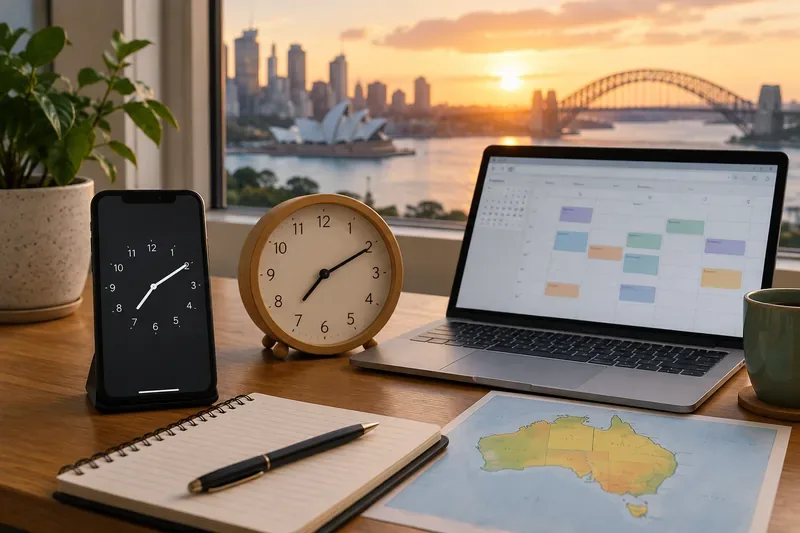
Illustrative example: imagine Maya lives in Sydney and has a recurring video meeting every Monday at 9:00 a.m. with coworkers in Brisbane and Perth. She also uses an iPhone as her alarm clock, a battery-powered kitchen clock, and a cloud calendar for work meetings. This is a hypothetical scenario used only to show how the rules work.
On Sunday, October 4, Sydney moves from Australian Eastern Standard Time (AEST, UTC+10) to Australian Eastern Daylight Time (AEDT, UTC+11). Brisbane stays on AEST at UTC+10, and Perth stays on Australian Western Standard Time (AWST) at UTC+8. So Maya’s Sydney clock moves ahead, while the clocks in Brisbane and Perth do not.
Before daylight saving starts, 9:00 a.m. in Sydney is also 9:00 a.m. in Brisbane and 7:00 a.m. in Perth. After the October change, 9:00 a.m. in Sydney is 8:00 a.m. in Brisbane and 6:00 a.m. in Perth. The meeting can still be at “9:00 a.m. Sydney time,” but the corresponding local times elsewhere have changed.
For the 2026–27 season, daylight saving applies in the ACT, New South Wales, Victoria, South Australia and Tasmania. It does not apply in Queensland, the Northern Territory or Western Australia. Official Australian sources use the following main abbreviations:
| Location | Standard time | During daylight saving |
|---|---|---|
| NSW, Victoria, Tasmania, ACT | AEST, UTC+10 | AEDT, UTC+11 |
| South Australia | ACST, UTC+9:30 | ACDT, UTC+10:30 |
| Queensland | AEST, UTC+10 | No change |
| Northern Territory | ACST, UTC+9:30 | No change |
| Western Australia | AWST, UTC+8 | No change |
The Reserve Bank of Australia states that clocks move forward one hour at 2:00 a.m. on October 4, 2026 in the participating states and territory. The next scheduled end is Sunday, April 4, 2027, when clocks move back one hour. Tasmania’s government also confirms the first-Sunday-in-October and first-Sunday-in-April pattern on its daylight saving information page.
Lord Howe Island does not follow the ordinary one-hour shift used in most daylight-saving areas. NSW Government information notes that Lord Howe Island changes by 30 minutes. Travelers, airlines, accommodation providers and anyone arranging calls to the island should therefore use the island’s actual time zone rather than assuming it matches Sydney exactly.
Most modern phones can adjust automatically, but that depends on the device settings and its ability to determine the correct time zone. Apple says iPhone and iPad users can enable automatic date and time so the device adjusts for time-zone and daylight-saving changes. Apple also recommends an internet connection and current software when troubleshooting incorrect time. See Apple’s official Date & Time support guidance.
Google provides similar controls for Android. Its Android time and time-zone help page explains how to turn on automatic date and time and, on supported devices, automatic time zone. Some Android devices may use location information to determine the time zone.
In Maya’s example, her phone should move from 1:59 a.m. to 3:00 a.m. in Sydney if automatic time and the correct time zone are enabled. Her phone does not “lose” data or shorten every hour of the day; rather, the local clock skips the hour between 2:00 a.m. and 3:00 a.m. at the transition.
Analog wall clocks, battery-powered kitchen clocks, older car clocks, some ovens, microwave clocks and basic digital watches usually do not know whether daylight saving is in effect. In Maya’s home, the kitchen clock will still show the old time on Sunday morning until she moves it forward by one hour.
A useful rule is to separate your clocks into two groups: devices connected to a network or time service, and standalone clocks. The first group may update itself; the second usually needs a manual change. Do not assume that every connected device is correct, though. A smart appliance with an incorrect region or time-zone setting can still display the wrong time.
Calendar behavior depends on how the event was created. A well-designed calendar system stores time-zone information and can show the same instant in different local times. But users can still create confusion by entering an event in the wrong time zone, using a fixed UTC offset instead of a named region, or copying a local time into a message without saying which city it refers to.
For Maya, a recurring meeting intended to stay at 9:00 a.m. Sydney time should be tied to the Sydney time zone. After October 4, the calendar can continue showing 9:00 a.m. for her while participants in Brisbane and Perth see an earlier local time. By contrast, if the meeting was meant to occur at the same worldwide instant every week, its displayed Sydney time could shift when daylight saving starts.
When scheduling across Australia, “Sydney time” or a calendar’s named Australia/Sydney zone is generally clearer than writing “UTC+10” year-round. Sydney is UTC+10 during standard time and UTC+11 during daylight saving. A fixed “UTC+10” label would therefore be wrong for Sydney during the daylight-saving season.
This distinction matters for automated jobs, webinar platforms, server schedules and recurring reminders. UTC itself does not change for daylight saving. The Australian Government’s Style Manual guidance on dates and time describes UTC as the standard reference from which local offsets are expressed.
The easiest way to avoid mistakes is to remember that daylight saving changes the difference between cities, not just the label on the clock. During the 2026–27 daylight-saving period:
The National Heavy Vehicle Regulator’s daylight saving guidance publishes the same practical offsets for the participating and non-participating regions, and also notes the separate treatment of Broken Hill, which follows South Australia’s central time pattern.
Phone alarms normally follow the phone’s local clock. If Maya sets an alarm for 7:00 a.m. Sunday and her phone changes automatically overnight, it should ring at 7:00 a.m. daylight time. The real elapsed time between bedtime and the alarm can be one hour shorter on the spring transition night.
Travel is more sensitive because departure and arrival times are published in local time at each location. A flight leaving Brisbane and arriving in Sydney after the change crosses a one-hour time difference even though both cities use “eastern” time terminology at other times of year. Always read the city-specific local times shown by the airline or transport operator.
People working overnight should also check payroll and workplace rules rather than assuming a seven-hour clock span always equals seven paid hours. The Fair Work Ombudsman’s daylight saving page explains that daylight saving can affect pay and that the applicable award or registered agreement matters.
Returning to Maya’s hypothetical Monday meeting, the phone may update itself, the kitchen clock will not, and the calendar can remain correct only if the event has the right time-zone context. Her 9:00 a.m. Sydney meeting is still 9:00 a.m. in Sydney, but it becomes 8:00 a.m. in Brisbane and 6:00 a.m. in Perth once daylight saving begins.
That is the most useful way to think about daylight saving in Australia: do not treat it as a nationwide one-hour shift. Treat it as a regional change that affects participating clocks and also changes the relationship between cities. If you verify the location, the named time zone and whether the device updates automatically, most daylight-saving scheduling problems become straightforward to prevent.
Check your Volkswagen VIN for open 2026 recalls, understand affected model examples, follow safety instructions, and arrange the correct free repair.
Australia’s 2026 daylight saving change starts October 4 in participating states. Learn what happens to clocks, phones, alarms, calendars and interstate schedules.
Compare PlayStation Plus Essential, Extra, and Premium in the U.S., including current prices, benefits, trade-offs, and steps to change or cancel a plan.
Learn how to view your NHS GP health record online, check test results and documents, request older records, correct errors, and use family or carer access.
Santander app or online banking not working? Learn how to check for an outage, fix common login issues, avoid phishing, and secure your account safely.
From October 1, 2026, major Australian card networks will prohibit card-payment surcharges. Here’s what changes, what fees can remain, and what consumers should check.
GTA VI launches November 19, 2026. Here’s what Rockstar has confirmed about Vice City, Leonida, editions, pre-orders and the new $399.99 collector’s box.
TalkTalk customers: what to check now amid insolvency concerns, including service status, contracts, switching, Direct Debits, bills, and backup options.
Rockstar currently lists Standard and Ultimate editions, not a separate GTA 6 Collector’s Edition. Compare the boxed code, digital extras, preorder bonuses, and what remains unconfirmed.
Learn how dengue spreads, which symptoms and warning signs matter, how to prevent mosquito bites, and when suspected dengue needs urgent medical care.