TalkTalk customers are seeing alarming headlines about insolvency and possible administration. The most useful first step is to separate a financial-risk story from an actual service failure. As of September 25, 2026, TalkTalk has been pursuing a formal sale process for parts of the group, but customers should not assume from the word “insolvency” alone that their broadband has stopped, that their contract has disappeared, or that they should immediately cancel payments.
TalkTalk’s own March 2, 2026 announcement said the group had secured £115 million of new funding and had appointed advisers to explore disposal options. The public TalkTalk Group funding announcement is useful background. The Companies House filing history for TalkTalk Telecom Group Limited is the official place to check company filings. Fast-moving reporting can change before corporate records or help pages are updated, so customers should treat unconfirmed claims about administration as a risk signal rather than as a substitute for an official notice.
What should you do first?
If your broadband is working, your account is accessible and you have received no official notice changing your service, the lowest-disruption response is usually to keep the connection running while you collect the information you would need if circumstances change. That does not mean ignoring the situation. It means preparing without creating a new problem yourself.
| Your situation | Practical choice | Main tradeoff |
|---|
| Service is working and you are still in contract | Stay connected, monitor official updates, and save your account records | Least disruption, but you continue to carry uncertainty about ownership or future terms |
| Service is critical for work, health, or caregiving | Keep TalkTalk active but prepare a backup connection or alternative provider | More resilience, but a backup may cost extra |
| You are out of contract and already wanted to move | Compare alternatives and consider switching through the normal process | Reduces exposure to uncertainty, but the new deal may have installation, equipment, or contract commitments |
| You are in contract but want to leave only because of the headlines | Check your contract and any early termination charge before placing an order elsewhere | Moving early may cost more unless your legal or contractual right to leave without charge has been triggered |
| You receive a formal transfer notice | Read the named provider, effective date, price, contract terms, support route, and payment instructions before acting | A transfer may preserve service with little work, but you need to verify whether any terms change |
1. Check whether there is an actual service problem
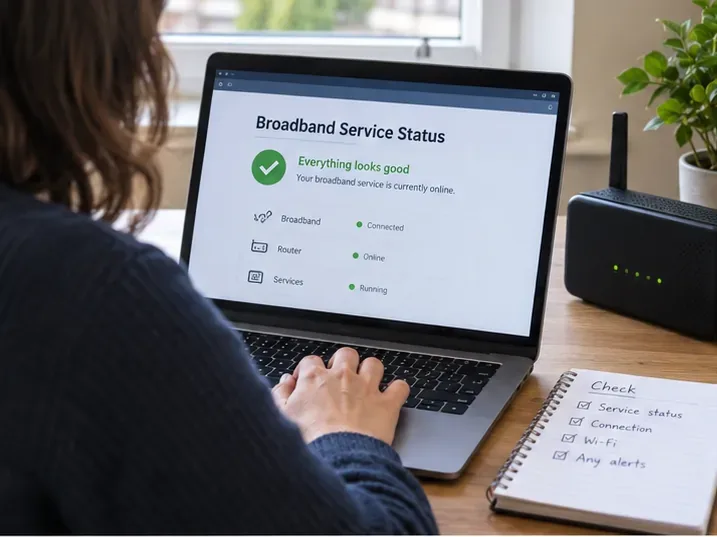
Caption: A customer checks connection status beside a router before making any decision about switching or canceling service.
Financial uncertainty and a broadband outage are different problems. TalkTalk maintains a service status page for planned maintenance and known network issues. If your connection stops working, check that page and your account messages before assuming the cause is corporate insolvency.
If you depend on broadband for remote work, medical communication, alarms, accessibility tools, or caring responsibilities, your tolerance for even a short outage may be lower than another household’s. In that case, the sensible tradeoff may be to spend a little on resilience now—for example, keeping sufficient mobile data available—rather than switching broadband immediately and risking a poorly timed installation gap.
2. Save the documents you would not want to lose access to
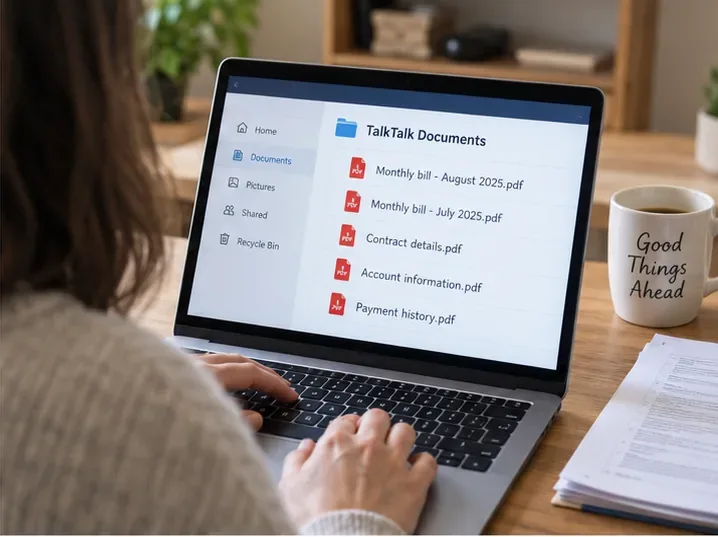
Caption: Saving bills, contract details, account information, and payment history makes it easier to resolve disputes or complete a future switch.
Download or save your latest bills, contract details, account number, current package, contract end date, recent payment history, and any important correspondence. TalkTalk says online bills are available through My Account, and its billing guidance notes that online bills are stored there for a limited period. Keeping your own copies gives you a reference if account systems, ownership, or support channels later change.
Also make a note of any add-ons, TV services, accessibility services, or home-phone features tied to the account. When switching, these can matter as much as the broadband price. TalkTalk’s cancellation guidance specifically notes that accessibility services do not automatically transfer to a new provider, so customers who rely on them should tell a new provider what support is required.
3. Do not cancel a Direct Debit just because you saw an insolvency headline
Stopping a Direct Debit preemptively can create an unpaid bill while your service and contract are still active. TalkTalk’s current cancellation guidance tells customers paying by Direct Debit to keep it active so the final payment can be collected and any credit can be refunded more easily.
If a formal administration, sale, or account transfer later changes who should receive payment, follow verified instructions from the provider, administrator, or acquiring company rather than a message from an unknown sender. Be especially cautious of emails or texts that create urgency around “updating bank details.” Go to the official site independently instead of signing in through an unexpected payment link.
4. Decide whether switching now solves a real problem for you

Caption: Comparing providers by price, contract length, speed, support, and switching process is more useful than reacting to a headline alone.
For a customer already unhappy with price or service and near the end of a contract, the current uncertainty may simply be a reason to review the market sooner. For a customer who is mid-contract and satisfied with the connection, switching immediately can introduce costs without guaranteeing a better result.
Ofcom’s broadband switching guidance says customers should check whether they are in or out of contract because early termination charges may apply. The UK’s One Touch Switch process means that, for many residential broadband moves, the gaining provider manages the switch. TalkTalk also explains this in its One Touch Switching guidance.
Compare more than the headline monthly price
- Contract length: A cheap introductory price can lock you into a new minimum term.
- Installation timing: If continuity matters, ask when the new service can actually go live.
- Network technology: Confirm whether the replacement uses Openreach, CityFibre, another full-fiber network, or a different access method at your address.
- Phone number: If you still use a landline number, confirm whether it can be retained.
- Equipment: Check router delivery, installation needs, and whether existing TalkTalk equipment must later be returned.
- Extras: Review TV, email, calling, security, and accessibility services separately.
- Price after the introductory period: Compare the whole contract, not only the first bill.
5. What if TalkTalk actually enters administration?
Ofcom has specific consumer guidance for this situation. Its guide for broadband or landline providers that go out of business says that if another company takes over, customers can generally continue using their services and in most cases the existing contract should transfer. If the new provider changes the contract terms, Ofcom says customers should have the right to leave without an early termination charge.
If no company takes over and the service is going to stop, Ofcom says the provider should tell customers the date. Customers would then need to sign up with a new provider and should not have to pay an early termination charge for doing so. Keeping an existing phone number may not always be possible in that scenario.
This is why “switch immediately” is not automatically the safest answer. A takeover can be less disruptive than a self-managed emergency switch. On the other hand, households that cannot tolerate uncertainty may reasonably prepare an alternative in advance, especially if they are out of contract and can move without a large exit charge.
6. Check whether your account has already been moved elsewhere
Not every TalkTalk customer is necessarily in the same operational position. TalkTalk has already published guidance for some customers whose contracts transferred to Rise Fibre on August 1, 2026. Its Rise Fibre transition page says affected customers were contacted directly and that the transition was intended to continue service without an equipment change.
If you have received a transfer email or letter, use the company name and effective date in that official communication as your starting point. Do not assume a generic TalkTalk insolvency article describes your account. If you have not received such a notice, do not assume you were transferred.
7. Keep payments and final bills under control if you do leave
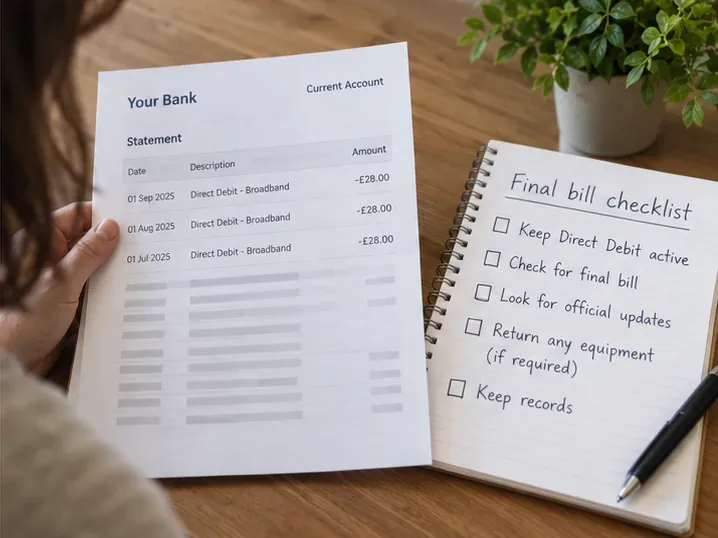
Caption: Before closing a payment method, check the final bill, any refund, equipment return requirements, and recent Direct Debit entries.
If you switch or cancel, keep a record of the confirmed service end date. TalkTalk’s final-bill guidance says the final bill can include charges up to the service end date, early termination charges where applicable, and potentially equipment-related charges. It also advises customers to keep Direct Debit active while the final payment or refund is processed.
After the final bill is settled, compare it with your bank statement. Save any equipment return receipt or tracking confirmation. If a charge looks wrong, challenge it through the official support channel and keep the reference number or transcript.
8. What about automatic compensation if service fails?
TalkTalk participates in Ofcom’s automatic compensation scheme, although Ofcom notes that restrictions can apply to TalkTalk customers who are not on the Openreach network. The current Ofcom automatic compensation guidance explains when compensation can apply for delayed repairs after a loss of service, missed appointments, and delayed starts of a new service.
Do not assume every outage connected with a corporate restructuring will automatically qualify. Eligibility depends on the specific service problem, network, provider participation, and scheme rules. Keep dates, outage reports, appointment details, and provider messages so you can establish what actually happened.
A practical checklist for TalkTalk customers today
- Confirm whether your broadband is working and check TalkTalk’s official service status information.
- Save your latest bills, account number, contract end date, package details, and recent correspondence.
- Check whether you are still within a minimum contract term before switching.
- Do not cancel Direct Debit solely because of insolvency rumors or headlines.
- If continuity is essential, arrange a realistic backup such as mobile data before you need it.
- Compare replacement providers on installation date, total contract cost, network, support, phone-number retention, equipment, and extras.
- Read any official transfer notice carefully and verify the named provider independently.
- If terms are changed after a takeover, check your right to leave without an early termination charge.
- If you leave, retain your final bill and equipment-return evidence.
- Recheck official TalkTalk, Ofcom, and Companies House information because the situation can change quickly.
Bottom line
The immediate customer question is not “Is TalkTalk in financial trouble?” but “Has anything changed in my service, contract, payment instructions, or provider?” Those are the facts that determine what you should do next. A stable connection and unchanged contract favor monitoring and preparation. An out-of-contract customer who already wants a different deal has more flexibility to move. A household that depends on uninterrupted connectivity should prioritize backup access. And if a formal takeover or administration occurs, Ofcom’s rules and the provider’s official communications become more important than speculation.
Because this situation is developing, check primary sources again before making an irreversible decision. The most useful official references are TalkTalk’s help center and newsroom, Ofcom’s switching and provider-failure guidance, and the Companies House record for the relevant TalkTalk company.