Home
» Today
»
Fallout 5 and Next-Gen Hardware: What Bethesda’s Update Means for PC and Console Buyers — November 11, 2026
Fallout 5 and Next-Gen Hardware: What Bethesda’s Update Means for PC and Console Buyers — November 11, 2026
Checked: November 11, 2026, 5:32 p.m. GMT (UTC+00:00).
Bethesda’s latest specific update says Fallout 5 is in preproduction, uses Creation Engine 3, and remains a long-range project; The Elder Scrolls VI is the studio’s primary focus. The studio has not announced a release date, supported platforms, PC requirements, resolution targets, or performance modes. For UK players, that means there is no confirmed reason to buy a new graphics card or console specifically for Fallout 5 today.
The hardware story is about planning, not a revealed spec sheet. If the game launches years from now, it may be designed around console and PC hardware that has not yet been announced. That is a reasonable possibility given Bethesda’s stated development stage, but it is not a platform confirmation or a prediction of its launch generation. Until Bethesda or Xbox publishes technical details, upgrade decisions should be based on games you can play now.
Highlights
Bethesda says Fallout 5 is in preproduction on Creation Engine 3; the latest specific studio statement located is dated July 17, 2026.
No official release window, console list, PC system requirements, or graphics targets have been announced.
Creation Engine 3 confirms a shared technology platform for Fallout 5 and The Elder Scrolls VI, not a minimum GPU, RAM, or SSD specification.
For UK buyers, wait for a platform announcement and requirements before making a game-specific hardware purchase.
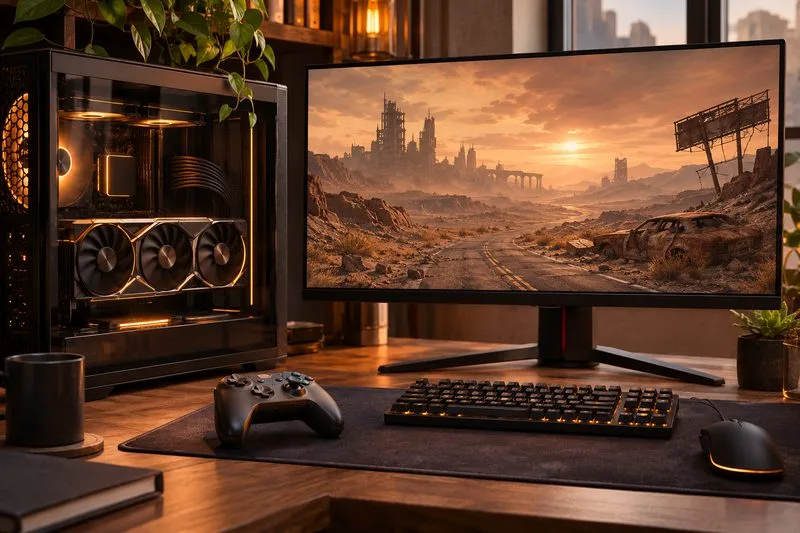
Illustration: A gaming PC and console controller beside a post-apocalyptic landscape. This is not official Fallout 5 artwork or a representation of confirmed gameplay.
What has Bethesda actually confirmed about Fallout 5?
In a studio note dated July 17, 2026, Bethesda Game Studios described Fallout 5 as a “long-range destination” and said it is currently in preproduction. Bethesda also said that it and The Elder Scrolls VI are being developed on Creation Engine 3, a shared technology platform that the studio has been building since Starfield launched. The note calls The Elder Scrolls VI the primary development focus and says most of the team is working on that game.
That is the newest game-specific official information found in this check. The statement does not set a launch year or say whether the game is coming to Xbox, PlayStation, or PC. It also does not disclose a trailer, gameplay footage, minimum or recommended PC specifications, storage size, frame-rate target, or support for upscaling and ray tracing. Bethesda’s official studio update is the source for the confirmed development details.
Does Creation Engine 3 mean players need next-generation hardware?
No. The engine name alone does not determine which GPUs or consoles can run a game. Bethesda says Creation Engine 3 supplies shared tools, rendering, and systems for its next RPGs, but has not explained the specific features Fallout 5 will use or the hardware those features will require. A new engine version can support better visuals or more complex systems, but developers can also scale a game across different performance modes and hardware tiers.
For comparison, Microsoft’s published Xbox Series X specifications describe current-generation hardware with a custom processor, 16 GB of GDDR6 memory, and NVMe SSD storage. That helps explain why modern games are built with fast storage and shared memory in mind, but it does not tell us whether Fallout 5 will support Series X, require a successor console, or target any particular PC configuration. No equivalent requirements have been published for this game.
Even a familiar Bethesda engine does not guarantee that older hardware will be supported. Compatibility depends on the final game’s design, the developer’s optimization choices, and the platforms Bethesda chooses to target. Those details usually become useful to buyers closer to launch, when system requirements and console editions can be compared rather than inferred from an engine label.
What could Fallout 5 mean for PC gaming hardware?
If you are choosing a PC for several years of gaming, prioritize balanced performance for the games and display you use now. A GPU suited to your preferred resolution and frame rate, enough system memory for current releases, a capable CPU, and an SSD with adequate free space are practical considerations. Those are general PC-buying principles, not Fallout 5 requirements. Bethesda has not stated a VRAM threshold, memory amount, CPU generation, or SSD capacity for the game.
A large open-world RPG can place different demands on a system: rendering affects the GPU, simulation and crowds can load the CPU, and asset streaming can make storage performance relevant. That makes it tempting to assume Fallout 5 will need a top-tier graphics card. There is no evidence for that conclusion yet. The final workload will depend on the game’s scale, visual settings, optimization, and any PC features the studio decides to include.
For players who already own a gaming PC, a sensible approach is to monitor actual announcements and revisit the question when Bethesda publishes a minimum and recommended configuration. If a component upgrade would improve several games you currently play, it may make sense on those grounds. Buying early on the assumption that one unannounced game will demand a particular GPU or a very large amount of memory risks spending for an unsupported target.
Should console players wait for the next generation?
There is no official Fallout 5 platform list, so current console owners cannot yet know whether the game will run on Xbox Series X|S or PlayStation 5, or whether it will be released only for newer hardware. The long-range label and preproduction status suggest a lengthy wait could remain, but Bethesda has supplied no timeline from which to calculate a launch date. It would be premature to buy a future console, or delay a current purchase, solely because of this game.
For UK players deciding what to do now, consider your present library, TV or monitor, storage space, and whether your existing console meets your needs. If you plan to buy a console soon, use confirmed games and currently available features to make the decision. Reassess when Bethesda names platforms and publishes performance information. A specific promise—such as a 60 frames-per-second mode, 4K output, or a console-generation requirement—should not be repeated as fact until the studio confirms it.
What should PC and console buyers watch next?
The most useful future signals will be official platform announcements, a release window, technical footage, and PC system requirements. A developer explanation of Creation Engine 3 could also clarify whether the game relies on hardware features that are absent from older systems. Until then, rumors about a launch generation or detailed component requirements should be treated as speculation, even when they appear alongside credible reporting about Bethesda’s broader plans.
The practical takeaway is straightforward: Fallout 5 is a real project in preproduction, but it is not yet a hardware-buying guide. Bethesda’s confirmed facts define the project’s direction at a high level; they do not establish what UK gamers will need to run it. Keep your upgrade budget tied to current needs, and wait for concrete requirements before spending for this title.
FAQ
Has Bethesda announced Fallout 5’s release date or platforms?
No. The latest specific Bethesda update found gives no release date, window, or platform list.
Is Fallout 5 confirmed for next-generation consoles?
No. Bethesda has not confirmed which console generation will support the game.
Should I upgrade my PC now for Fallout 5?
Not specifically for this game. Bethesda has not published PC system requirements, so base an upgrade on current games and needs.