Home
» Family
»
How to Budget Early for the Holiday Season Without Starting January in Debt
How to Budget Early for the Holiday Season Without Starting January in Debt
The most important move is to set one all-in holiday spending limit now, before you start shopping, and fund it gradually from money you can actually afford to set aside. Do not begin with a gift list and then try to make the numbers work. Begin with your normal bills, savings needs, and expected take-home pay. Whatever remains for the holidays becomes the limit for gifts, travel, food, hosting, decorations, shipping, tips, and other seasonal costs.
This approach works because holiday spending is predictable even when the exact purchases are not. The earlier you decide what the season can cost, the more paychecks you have to spread that cost across. It also gives you time to change plans before a last-minute expense turns into credit-card debt.
1. Find the amount you can truly afford
Start with an “as-is” monthly budget rather than an idealized one. Review several months of bank and card statements, then list your normal housing, utilities, groceries, transportation, insurance, debt payments, childcare, subscriptions, medical costs, and regular savings. The Consumer Financial Protection Bureau recommends looking back over several months so less-frequent expenses are not missed. Its spending assessment guidance and Your Money, Your Goals toolkit provide practical budgeting and spending-tracker tools.
Next, estimate the take-home income you expect between now and your final holiday spending date. Subtract normal expenses and any savings commitments you do not want to interrupt. The remainder is the maximum pool available for the season. If the number is smaller than you expected, that is useful information: it means the plan should change before the shopping starts.
Start with real monthly expenses and take-home pay so the holiday budget is based on money that is actually available.
Keep your emergency fund separate
A planned holiday is not an emergency. The Federal Reserve’s May 2026 report on U.S. household economic well-being found that 63% of adults said they could cover a hypothetical $400 emergency expense using cash, savings, or a credit card paid off at the next statement, while 55% said they had savings for three months of expenses. Those figures are a reminder that financial cushions are valuable. Unless your circumstances require otherwise, do not count your emergency reserve as holiday spending money.
2. Turn the total into a per-paycheck savings target
Once you have a total, divide it by the number of paychecks you expect before you need the money. For example, suppose your all-in holiday budget is $1,600 and you have eight paychecks left before your main spending deadline. Setting aside $200 from each paycheck would fully fund the plan without depending on a year-end credit-card balance.
If $200 per paycheck is unrealistic, do not force it. You have three clean choices: lower the total budget, start saving earlier, or find a temporary source of additional income that does not interfere with required bills. What you should avoid is treating the difference as future-you’s problem.
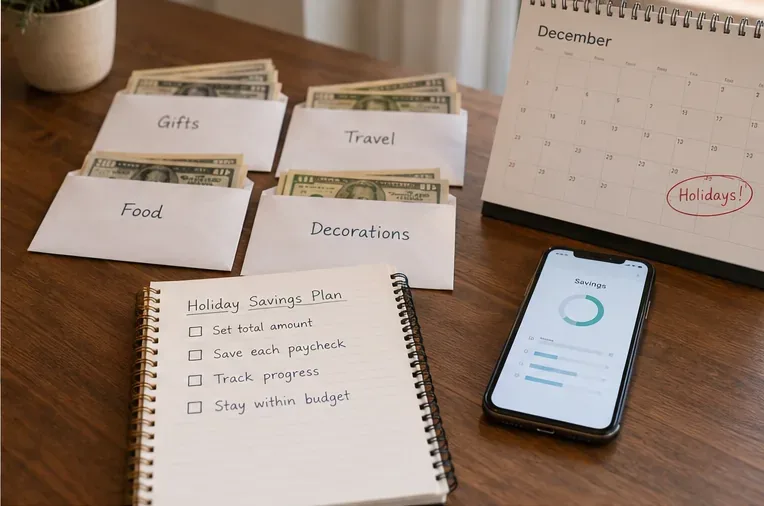
A separate savings bucket can make this easier. That might be a dedicated savings account, a labeled subaccount offered by your bank or credit union, or a simple cash-envelope system. The key is separation: money for December should not silently become money for everyday discretionary spending in October.
Break the total into holiday categories and move a planned amount toward them each payday instead of waiting for December.
3. Budget for the whole season, not just gifts
Gifts are only one line item. The CFPB’s holiday-spending guidance specifically calls out travel, parties, meals, and decorations in addition to presents. The FDIC’s November 2025 holiday banking guidance likewise recommends creating a gift list, comparing prices, tracking purchases, and being careful about impulse buying.
A useful holiday plan might include the categories below. The numbers are only a hypothetical example; your mix should reflect your actual traditions and obligations.
Category
Example amount
What to include
Gifts
$650
Family, friends, coworkers, gift exchanges
Travel
$350
Fuel, airfare, lodging, parking, baggage
Food and hosting
$250
Special groceries, drinks, restaurant meals, parties
Decorations and events
$125
Decor, tickets, activities, school or community events
Shipping, tips, and giving
$125
Postage, service tips, donations, small thank-you gifts
Buffer
$100
Small price changes or forgotten seasonal costs
Total
$1,600
All-in seasonal cap
The buffer is not permission to spend more. It is a cushion inside the existing cap. If you do not use it, keep the money.
4. Make the gift list before the sale notifications arrive
Write down every person or exchange you expect to buy for, assign a maximum amount to each, and note one or two acceptable gift ideas. Then compare prices over time. This is more useful than chasing the largest advertised discount because a 40% discount on an unplanned purchase is still 60% of a purchase you had not budgeted for.
Set a simple rule that fits your personality. For example: “If it is not on the list, I wait 24 hours before buying it.” Another option is to require any unplanned purchase to be funded by reducing a different holiday category by the same amount. These rules are especially useful if promotional emails, social media, or limited-time offers tend to push you toward impulse purchases.
Create the recipient list and spending limits first, then compare prices for planned gifts instead of letting sales decide what you buy.
5. Decide how you will pay before you reach checkout
Cash, debit, and credit can all fit a holiday budget, but the payment method should not increase the spending cap. The FDIC notes that credit cards can offer convenience, rewards, and consumer protections, while also advising consumers to pay balances promptly when possible to avoid interest. The CFPB similarly recommends having a specific plan to pay a credit-card bill and setting aside enough in the budget to do it.
If you use a rewards card, a practical approach is to treat every purchase as if the cash has already left your account. Keep the matching amount in your holiday fund so the statement can be paid without borrowing. Rewards are a bonus, not additional purchasing power.
Treat Buy Now, Pay Later as debt, not as a smaller price
For budgeting purposes, count the full purchase price on the day you buy, even if the payment service divides it into installments. The Federal Reserve’s May 2026 household report said 16% of adults used Buy Now, Pay Later in the prior 12 months, and 11% of users had a BNPL payment trigger an overdraft or nonsufficient-funds fee. The installment size may look small, but several overlapping plans can compete with rent, groceries, and other bills later.
If the full price does not fit the holiday budget today, the item does not fit simply because the checkout screen offers four payments.
6. Track actual spending at least once a week
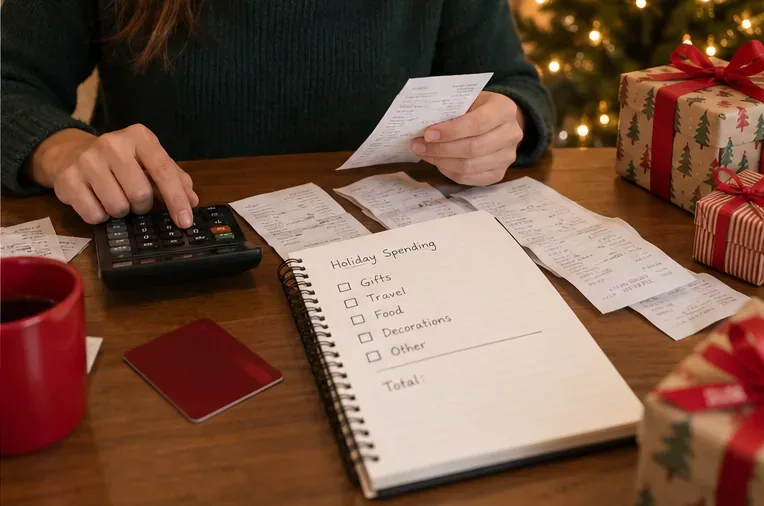
A budget is only useful if actual purchases are compared with it. Save receipts, review card activity, and update the remaining amount by category. The FDIC recommends recording what you actually spend or keeping receipts, and the CFPB’s spending tools use the same basic idea: capture real transactions rather than relying on memory.
A five-minute weekly review is usually enough for a simple plan. Check what is spent, what is committed but not yet charged, and what still needs to be purchased. If gifts are running $75 over budget, decide immediately whether another category will be cut by $75. Do not wait until the statement arrives after the holidays.
Update the plan with receipts and card activity each week so overruns are corrected while there is still time to adjust.
7. Use a smaller plan when money is tight or income is irregular
If your income varies, base the holiday budget on conservative income that is reasonably predictable, not on hoped-for overtime, bonuses, commissions, or gig earnings. Extra income can increase the plan only after it arrives. This protects required bills if work slows down.
If you are already struggling to pay regular expenses, the appropriate holiday budget may be very small. Consider a name-draw exchange, homemade gifts, shared meals, free local events, or giving time instead of buying more items. CFPB holiday guidance has long suggested lower-cost alternatives such as homemade gifts and gift exchanges. The goal is not to imitate someone else’s December; it is to enter January with your core finances intact.
A quick test: is your holiday budget ready?
You know the maximum total you can spend without skipping normal bills or required debt payments.
You are not counting emergency savings as routine holiday money.
You have divided the total by the number of paychecks remaining and the per-paycheck target is realistic.
Your plan includes travel, food, hosting, shipping, decorations, tips, and giving where relevant—not just gifts.
Every planned recipient or exchange has a spending limit.
You know whether purchases will be made with cash, debit, or credit and, if using credit, how the statement will be paid.
You have a place to track actual purchases at least weekly.
If any of those answers is “no,” fix that part before you begin serious holiday shopping. Starting early is valuable not because it gives you more time to buy, but because it gives you more time to save, compare, adjust, and say no to purchases that would make January harder.