Coffee Culture: How to Brew the Perfect Cup at Home

Fix bitter, sour, or weak coffee at home with a practical guide to beans, grind size, water, ratio, temperature, pour-over technique, and tasting.
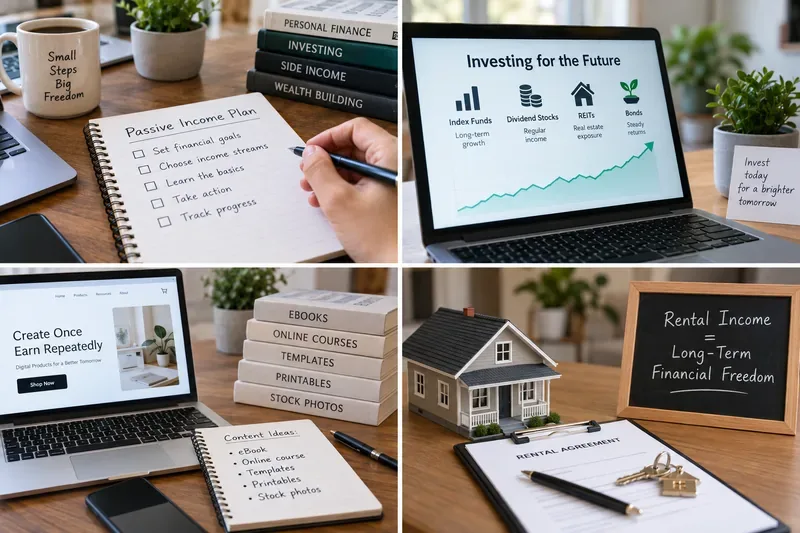
For most beginners, the best passive income idea is not the one with the highest advertised return. It is the one that matches the money, time, skills, and risk you can realistically commit. A useful way to think about passive income is to split it into three groups: income from capital you already have, income from an asset you already own, and income from work you do once and can sell or monetize repeatedly.
That distinction matters because almost no income stream is completely passive. Savings accounts and Treasury securities require very little ongoing effort, but they require capital. Digital products can start with little money, but they require meaningful up-front work and occasional updates. Rental income may look passive on paper, yet maintenance, customer service, taxes, insurance, and vacancies can turn it into a hands-on activity.
| Idea | Starting cash | Ongoing effort | Main risk | Best fit |
|---|---|---|---|---|
| Insured savings or money market deposit account | Low to high | Very low | Rate changes; inflation can outpace interest | Emergency funds and near-term cash |
| Certificates of deposit (CDs) | Low to high | Very low | Money can be locked up; early-withdrawal penalties | Cash you will not need until a known date |
| U.S. Treasury bills | Moderate | Very low | Rate and reinvestment risk; market price risk if sold early through a broker | U.S. investors seeking short-term government securities |
| Diversified index funds or ETFs | Low to high | Low | Market losses and changing distributions | Long-term investors who can tolerate volatility |
| Publicly traded REITs | Low to high | Low | Real-estate and stock-market risk | People wanting real-estate exposure without being a landlord |
| Digital downloads or templates | Low | Medium at first, then low to medium | Low demand, competition, platform dependence | People with a useful repeatable skill |
| Self-published eBooks or guides | Low | Medium to high at first | Demand is uncertain; royalties depend on platform terms | Writers and subject-matter experts |
| Evergreen video or affiliate content | Low to moderate | High at first, ongoing maintenance | Audience and platform changes; income is not guaranteed | Creators willing to build an audience over time |
| Renting an asset you already own | Depends on asset | Medium | Damage, vacancy, liability, maintenance | People with underused property, space, or equipment |
If you already have cash that must remain accessible, an interest-bearing savings account or money market deposit account can be the most practical first passive-income stream. The return may not be exciting, but the effort is minimal and the principal is not exposed to stock-market volatility.
At an FDIC-insured bank, eligible deposit accounts such as checking, savings, money market deposit accounts, and CDs receive automatic deposit insurance. The standard insurance amount is $250,000 per depositor, per insured bank, for each ownership category. The exact coverage for a particular account structure can be more complicated, so use the FDIC deposit insurance resources when balances become significant.
Best for: emergency savings, short-term goals, or beginners who are not ready to accept investment losses.
Watch for: variable interest rates, minimum-balance requirements, withdrawal restrictions, and fees. Compare the annual percentage yield and the full account terms rather than assuming the account with the biggest headline rate is automatically better.
A certificate of deposit is a deposit account that generally pays interest in exchange for leaving your money at the bank for a set period. The FDIC notes that CDs commonly require you to keep money deposited for a stated term; withdrawing early may lead to a penalty or loss of some interest.
CDs work well when you have money for a goal with a predictable date, such as a future tuition payment or a home project. They are less suitable for an emergency fund because access can be limited.
Best for: predictable savings goals where liquidity is less important than stability.
For U.S. investors, Treasury bills can provide another low-maintenance option for money that is not needed immediately. TreasuryDirect states that individuals can buy marketable Treasury securities through a TreasuryDirect account or through a bank, broker, or dealer. The interest rate on a new Treasury security is determined at auction, so the rate is not known when a purchase is scheduled in TreasuryDirect.
Start with the official TreasuryDirect guide to buying marketable securities. If you buy through a brokerage and sell before maturity, the market value can move, so do not confuse “backed by the U.S. government” with “the price can never change.”
Best for: U.S. investors who want short-term fixed-income exposure and can match maturities to upcoming cash needs.
Index funds and many ETFs are popular because they can hold a diversified basket of securities and require little day-to-day management from the investor. Investor.gov explains that index funds seek to track a market index, while ETFs can generate investor returns through distributions and changes in market price.
The important beginner lesson is that distributions are not guaranteed. In an August 19, 2026 investor bulletin, the SEC explained that a fund may make regular distributions, but investors can still lose money even when a fund pays them. Review the SEC bulletin on fund distributions and the Investor.gov ETF guide before treating a dividend or distribution yield as a promise.
Best for: long-term goals, especially when you can tolerate market declines and do not need the invested money soon.
Practical rule: choose diversification, understandable fees, and a strategy you can stick with instead of chasing the fund with the highest recent yield.
A real estate investment trust, or REIT, owns or finances income-producing real estate. Investor.gov notes that REITs give individuals access to large-scale real estate such as apartments, warehouses, hotels, offices, and other property types without buying the buildings directly.
For beginners, publicly traded REITs or diversified REIT funds are usually easier to understand and exit than non-traded REITs. The SEC warns that non-traded REITs can have significant liquidity limitations and may be difficult to value. Read the Investor.gov REIT overview and its non-traded REIT risk bulletin before investing.
Best for: long-term investors who want real-estate exposure but do not want the operational burden of direct rental property.
If you have more time than money, a small digital product can be one of the most accessible ways to build a semi-passive income stream. Examples include spreadsheet templates, printable planners, checklists, design assets, code snippets you own, or specialized reference materials.
The business model is simple: create an asset once, then sell copies repeatedly. The difficult part is not uploading the file; it is creating something people actually need and keeping it accurate. Expect to spend time on research, formatting, customer questions, updates, marketing, and refunds.
Best for: people who can solve a narrow problem for a specific audience.
Beginner test: before building a large product, create one small item that solves one concrete problem. If people buy it and ask for adjacent features, expand from there.
An eBook is another “work first, earn later” model. It is not passive while you are researching, writing, editing, designing, and launching it, but a useful title can continue earning royalties after publication.
As of April 21, 2026, Amazon Kindle Direct Publishing lists 35% and 70% eBook royalty options, with eligibility and calculation rules that depend on factors such as territory, pricing, taxes, and delivery costs. Check the current KDP Digital Book Pricing page before modeling expected earnings.
Best for: writers, educators, technical specialists, and professionals who can package expertise into a focused resource.
Better beginner strategy: write a narrow book that answers a specific recurring question instead of trying to write a broad “everything about the topic” book.
Videos, tutorials, and product comparisons can keep generating views long after publication, but this category is often mislabeled as fully passive. You still need research, production, updates, audience development, and compliance with platform rules.
YouTube states that creators accepted into the YouTube Partner Program can earn from advertising and other monetization features, but it also explicitly says there is no guarantee about how much, or whether, a creator will be paid. Review the current YouTube partner earnings overview because platform terms can change.
If you use affiliate links, U.S. Federal Trade Commission guidance says the financial relationship should be disclosed clearly and conspicuously. The FTC specifically advises affiliate marketers to explain that they earn commissions from purchases made through their links. See the FTC endorsement and affiliate disclosure guidance.
Best for: people who enjoy teaching, reviewing, or explaining and are willing to build a content library before expecting meaningful revenue.
If you already own a spare room, parking space, storage area, camera, tool, vehicle, or other useful asset, renting it can produce income without buying a new investment solely for that purpose. This can be attractive because the asset already exists, but it is usually only semi-passive.
Before renting anything, estimate cleaning, maintenance, insurance, damage, vacancy, platform fees, taxes, and the value of your time. A gross monthly payment is not the same as profit.
The tax meaning of “passive” can also differ from everyday language. IRS Publication 925 explains U.S. passive activity rules and notes that rental activities are generally passive for tax purposes unless an exception applies. It also explains that portfolio income such as interest and dividends is generally excluded from passive activity income. That is a useful reminder that “passive income” in personal-finance conversation is not the same as the technical tax definition. See IRS Publication 925 for the current rules.
Use this simple decision framework:
Be skeptical of anything promising unusually high returns with little or no risk, especially when there is pressure to act immediately. Investor.gov lists “risk-free” opportunities, guaranteed returns, aggressive sales tactics, and “too good to be true” offers among common investment-fraud warning signs. Use the Investor.gov investment fraud checklist before sending money to an unfamiliar promoter.
For beginners, that means avoiding the assumption that crypto yield products, leveraged trading systems, opaque private investments, non-traded real-estate products, or automated “money-making” bots are safer simply because someone calls the income passive. If you cannot explain how the return is generated, what can cause losses, how fees are charged, and how you can exit, the product is not beginner-friendly.
The best passive income strategy for a beginner is usually boring and understandable. Use insured savings or short-term government securities for money that must stay relatively stable, diversified investments for long-term goals, and small digital or content products when you have more time than capital. Treat rental income as a business calculation, not free money.
Start with one stream, measure the real return after costs and time, and scale only after it works. Passive income is most reliable when it is built on an asset, investment, or piece of work you understand—not on a promise that money will appear without effort or risk.
Source review: September 2026. Rates, platform terms, tax rules, and investment conditions can change. This article is general educational information, not individualized investment, legal, or tax advice.
Fix bitter, sour, or weak coffee at home with a practical guide to beans, grind size, water, ratio, temperature, pour-over technique, and tasting.
Learn beginner-friendly winter houseplant care for light, watering, humidity, temperature, fertilizer, pests, and the mistakes that commonly damage plants.
Declutter your home without chasing perfection. Learn which spaces to tackle first, how clutter may affect stress and attention, and how to keep results manageable.
Discover which smart kitchen gadgets are genuinely useful, what to check before buying, how to set them up, and common beginner mistakes to avoid.
Functional beverages promise energy, hydration, gut support, protein, and more. Learn which benefits have evidence, what labels can hide, and how to choose wisely.
Learn practical zero-waste cooking habits that reduce food waste, stretch groceries, use leftovers safely, and turn edible scraps into useful meals.
Plan a cozy dinner party with the right guest count, make-ahead menu, warm atmosphere, food-safety basics, and a realistic hosting timeline.
Refresh your home for fall 2026 with budget-friendly decor trends, practical tradeoffs, and smart ways to add warmth, texture, and personality.
Compare practical meal-prep methods by time, flexibility, texture, cost, and food safety so you can build a weekday system that actually fits your life.
Make five reliable fall comfort-food recipes with clear doneness cues, troubleshooting tips, storage guidance, and realistic ways to adjust texture and flavor.