Coffee Culture: How to Brew the Perfect Cup at Home
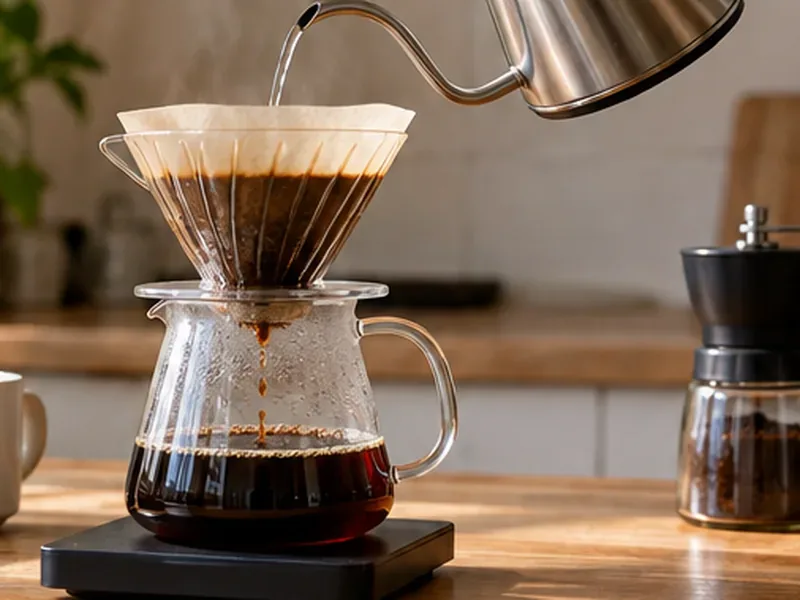
Fix bitter, sour, or weak coffee at home with a practical guide to beans, grind size, water, ratio, temperature, pour-over technique, and tasting.
The simplest way to keep houseplants alive in winter is to change your routine with the season: give plants the brightest appropriate light you can, water only when the potting mix actually needs it, protect them from cold drafts and hot vents, and ease up on fertilizer when growth slows. Winter plant care is less about doing more and more about responding to slower growth and a drier, dimmer indoor environment.
That matters because the same routine that worked in July can cause trouble in January. Shorter days reduce available light, heated homes can become dry, and many houseplants use water more slowly. A plant that needed watering every five days in summer may need a very different interval in winter. The goal is not to memorize a new calendar. It is to learn a few signals you can check in minutes.
Light is usually the first limiting factor indoors. Iowa State University Extension notes that even bright indoor locations receive far less light than outdoor locations, and light intensity drops quickly as a plant is moved away from a window. “Bright indirect light” means strong, diffuse light that is bright enough to cast a distinct shadow without direct sun rays striking the foliage for long periods. You can review Iowa State’s houseplant guidance at How to Care for Houseplants.
Temperature is the next piece. Iowa State says about 65–75°F is ideal for many common indoor plants and recommends avoiding temperatures below 55°F. Equally important, avoid rapid temperature swings from exterior doors, radiators, heat registers, or leaves pressed against cold glass. If you bring plants in from outdoors, a University of Minnesota Extension update dated September 10, 2026 recommends bringing most houseplants inside when temperatures fall below about 50°F, with species-specific exceptions. See Bringing houseplants in for winter.
Water demand commonly drops as growth slows. Winter watering should therefore be based on moisture in the pot, not the day of the week. Iowa State’s winter watering guidance says to check the potting mix and, for many common houseplants, water when it is dry to the touch about one inch down. The exact threshold still depends on the species, potting mix, temperature, light, and humidity.
Humidity may also fall in heated homes. Relative humidity, or RH, is the percentage of moisture in the air compared with the maximum the air could hold at that temperature. Many tropical houseplants prefer more humidity than a heated winter room provides, while cacti and succulents are often happier in drier conditions. The right target is plant-specific rather than universal.
You do not need a cabinet full of plant-care products. Start with what helps you observe conditions and drain water safely:
Before changing anything, identify the plant if you can. A snake plant, pothos, fern, orchid, and succulent do not all want the same watering pattern. General winter rules are a starting point; the species’ care requirements take priority.
Start by moving light-hungry plants closer to the brightest suitable window, while keeping foliage from touching cold glass. South- and east-facing windows often provide abundant light, but window size, curtains, roof overhangs, nearby buildings, and distance from the glass all change the result. A plant several feet from a bright window may receive much less light than it appears to.
Watch the plant rather than the compass alone. Long, weak stems, obvious leaning toward a window, smaller new leaves, or leaf drop can be signs that light is inadequate. University of Minnesota Extension’s February 2, 2026 winter houseplant tips says supplemental lighting may be useful when plants stretch toward a light source and notes that a full-spectrum LED can be used.
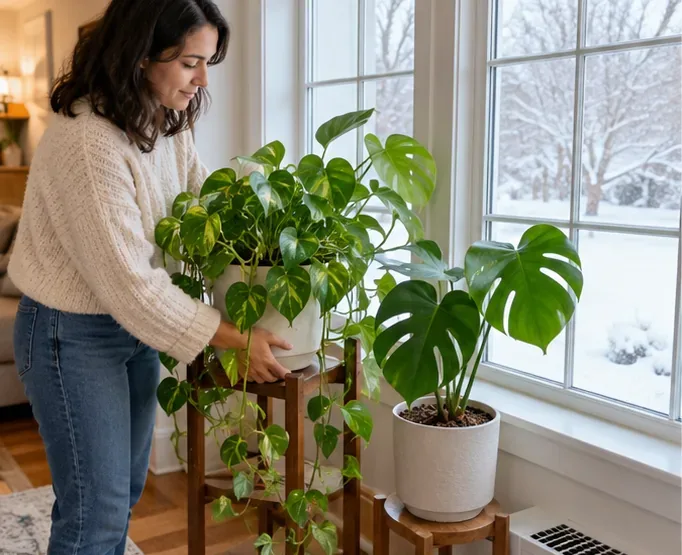
If a plant was outdoors for summer, make the transition before cold weather becomes severe. Inspect it before bringing it inside and keep it separate from your established collection while you watch for insects. Sudden leaf drop after a move can happen as some plants adjust to lower indoor light, but persistent decline deserves a closer look at watering, temperature, and pests.
The most useful beginner habit is simple: check moisture first. Push a finger into the potting mix about an inch. If it still feels damp, wait and check again later. If it feels dry at that depth, many common foliage houseplants are ready to be watered. Iowa State specifically advises checking rather than watering on a fixed schedule because light, temperature, humidity, pot size, plant size, and season all affect how quickly a container dries.
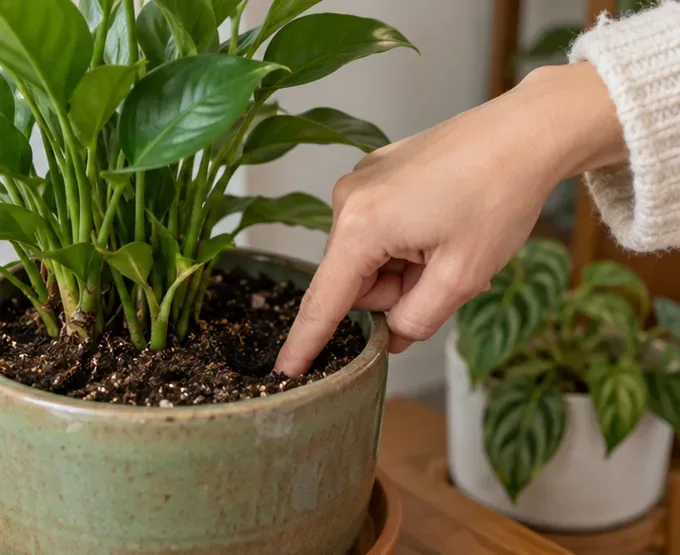
Do not turn “one inch dry” into a rigid rule for every plant. Succulents may need the mix to dry more thoroughly, while moisture-loving plants may prefer less drying. The key lesson is to check conditions, then match the response to the plant.
Also notice the pot itself. A container without a drainage hole makes winter overwatering much easier because water has nowhere to escape. Iowa State advises that houseplant containers should have drainage and warns that a layer of gravel does not substitute for a drainage hole.
“Water less often” does not mean “give a tiny splash.” When the plant needs water, apply enough to wet the root ball and continue until water begins to drain from the bottom of the pot. Then let the container finish draining and empty any water collected in the saucer or decorative outer pot. Iowa State recommends removing excess water rather than leaving roots sitting in it.
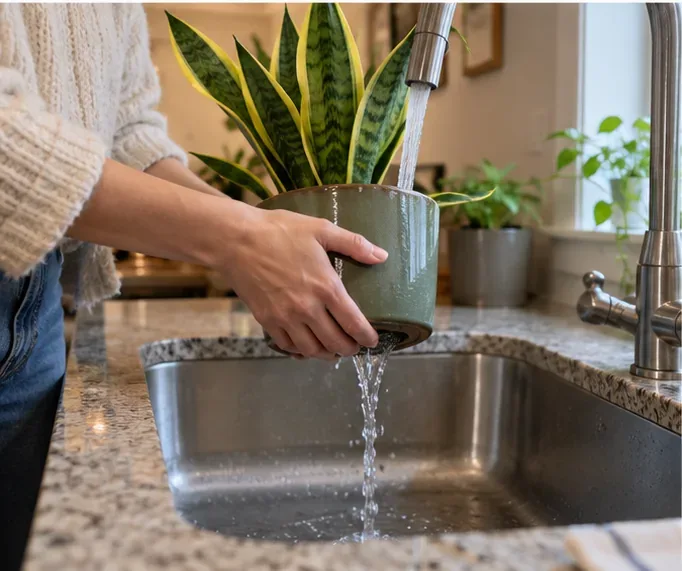
Why is this safer than frequent small sips? A thorough wet-and-dry cycle gives the root zone both water and air. Constantly wet potting mix can deprive roots of oxygen and encourage root damage. “Root rot” is a general term for roots dying and decaying in persistently wet, poorly aerated conditions, sometimes with disease organisms involved.
If a pot has become extremely dry and water rushes straight down the sides, apply water in a few passes so the mix can rehydrate. For a badly dried root ball, Iowa State also describes soaking the root ball briefly so the potting mix can take up water, then draining it fully.
Once light and watering are under control, look at the room around the plant. Heating can reduce indoor humidity enough to stress humidity-loving plants. Brown leaf edges can have several causes, but dry air is one possibility. For plants that need more humidity, grouping plants can help create a slightly more humid microclimate, and a room humidifier is a more effective way to raise humidity than occasional misting. Iowa State notes that misting changes humidity only briefly and can also help spread some plant diseases.
Penn State Extension’s updated December 13, 2024 guidance also emphasizes that there is no single ideal RH for every houseplant and explains why winter heating can push indoor humidity lower. See Humidity and Houseplants. If you use a humidifier, maintain it according to the manufacturer’s instructions and avoid aiming a constant wet plume directly at foliage.
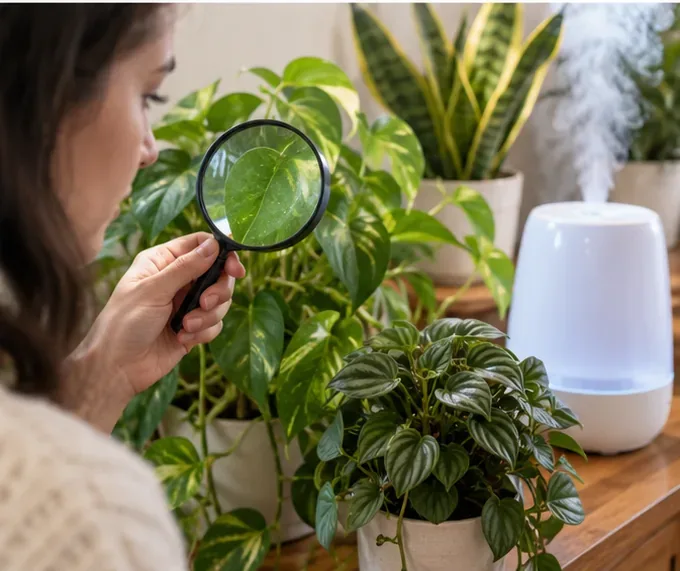
Check stems, leaf joints, and both sides of leaves every week or two. Common indoor pests include spider mites, mealybugs, scale insects, fungus gnats, and whiteflies. Catching a small problem early is easier than dealing with a collection-wide infestation. If you use a pesticide, follow the product label exactly and confirm that it is labeled for indoor use and for the plant you are treating.
At the same time, reduce fertilizer when growth slows. Fertilizer is not plant “food”; plants make carbohydrates through photosynthesis, while fertilizer supplies mineral nutrients. Iowa State recommends fertilizing only while houseplants are actively growing and reducing fertilizer during the short days of winter. A plant growing vigorously under strong supplemental light may still need nutrients, so again, growth matters more than the calendar.
| What you notice | Check first | Beginner response |
|---|---|---|
| Yellowing leaves while the mix stays wet | Overwatering, poor drainage, low light | Pause watering, confirm drainage, and improve light if the plant is in a very dim spot. |
| Dry, crispy leaf edges | Low humidity, inconsistent watering, mineral or fertilizer buildup | Check soil moisture habits and room RH before assuming the plant simply needs more water. |
| Plant leaning or stretching toward the window | Insufficient light | Move it closer to appropriate daylight or consider supplemental full-spectrum light. |
| Sudden leaf drop after a move | Light or temperature change, cold draft, watering mismatch | Stabilize the location and reassess moisture before making several changes at once. |
| Fine speckling, webbing, sticky residue, or cottony clusters | Houseplant pests | Separate the plant, inspect closely, identify the pest, and use a treatment labeled for that pest and plant. |
These symptoms are clues, not diagnoses. The same symptom can have more than one cause, so check the potting mix, light, temperature, humidity, and pests together before taking action.
Once a week, walk past each plant and do the same short inspection: feel the potting mix, look at the newest leaves, glance under a few leaves for pests, make sure the pot is not sitting in water, and notice whether the plant is leaning sharply toward a window. You are checking weekly; you are not necessarily watering weekly.
Every few weeks, wipe dust from large leaves with a soft damp cloth and rotate plants that are growing strongly toward one direction, as long as the species tolerates being turned. Reassess the setup after major weather changes, especially during very cold spells when windows and exterior doors become colder than usual.
As days lengthen and active growth resumes, water demand may increase. Fertilizer can also resume according to the plant’s needs and the product label. If a plant is genuinely root-bound or the potting mix has broken down, late winter to early spring is often a practical time to repot as growth starts to accelerate.
The best winter plant-care mindset is observational rather than automatic. Put the plant in useful light, keep it away from temperature extremes, check moisture before watering, drain thoroughly, support humidity only where needed, and watch for pests. Once those habits become routine, keeping houseplants alive through winter becomes much less mysterious.
Fix bitter, sour, or weak coffee at home with a practical guide to beans, grind size, water, ratio, temperature, pour-over technique, and tasting.
Learn beginner-friendly winter houseplant care for light, watering, humidity, temperature, fertilizer, pests, and the mistakes that commonly damage plants.
Declutter your home without chasing perfection. Learn which spaces to tackle first, how clutter may affect stress and attention, and how to keep results manageable.
Discover which smart kitchen gadgets are genuinely useful, what to check before buying, how to set them up, and common beginner mistakes to avoid.
Functional beverages promise energy, hydration, gut support, protein, and more. Learn which benefits have evidence, what labels can hide, and how to choose wisely.
Learn practical zero-waste cooking habits that reduce food waste, stretch groceries, use leftovers safely, and turn edible scraps into useful meals.
Plan a cozy dinner party with the right guest count, make-ahead menu, warm atmosphere, food-safety basics, and a realistic hosting timeline.
Refresh your home for fall 2026 with budget-friendly decor trends, practical tradeoffs, and smart ways to add warmth, texture, and personality.
Compare practical meal-prep methods by time, flexibility, texture, cost, and food safety so you can build a weekday system that actually fits your life.
Make five reliable fall comfort-food recipes with clear doneness cues, troubleshooting tips, storage guidance, and realistic ways to adjust texture and flavor.