Home
» Today
»
How to Register to Vote on National Voter Registration Day: A Step-by-Step Guide
How to Register to Vote on National Voter Registration Day: A Step-by-Step Guide
National Voter Registration Day can be a useful prompt to get your voter registration handled, but it is not a single nationwide registration deadline. In 2026, National Voter Registration Day falls on Tuesday, September 15. The event is nonpartisan and focused on helping eligible Americans register or update their information, while actual registration rules and deadlines are set by each state and territory.
That distinction matters. The best way to register depends on where you live, how quickly you need the application processed, whether your state offers online registration, and whether you prefer a digital or paper trail. The safest starting point is the federal Vote.gov registration page, which routes you to official state or territory instructions.
Before you start: National Voter Registration Day is not your deadline
National Voter Registration Day is a civic participation event, not a federal cutoff date. The official event organization lists September 15, 2026 as this year's observance. State deadlines can be very different: some states close registration weeks before an election, while others allow registration much closer to Election Day or even on Election Day.
That means the practical goal on National Voter Registration Day is simple: find your state's official rules, choose the registration method that fits your situation, submit accurate information, and then verify that your registration was accepted.
Step 1: Confirm that you are eligible and find your state's rules
Voter eligibility is not identical in every state. The U.S. Election Assistance Commission says that, in general, a person must be a U.S. citizen, be at least 18 by Election Day, and meet applicable residency requirements. Some states also allow preregistration for people under 18. North Dakota is unusual because it does not require voter registration.
Do not rely on a generic checklist alone. State law can affect eligibility rules, registration deadlines, identification information requested on an application, and how people with certain prior criminal convictions regain voting rights. Start at Vote.gov, choose your state or territory, and follow the official election-office link provided there.
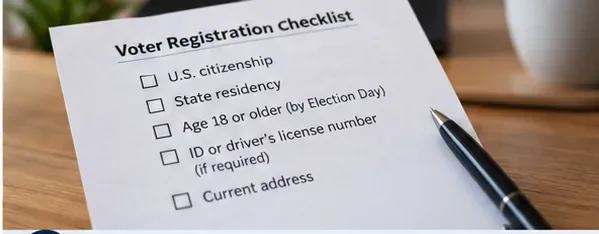
A voter registration checklist highlights common items such as U.S. citizenship, state residency, age, current address, and identification information that a state may request.
What information should you have ready?
Depending on the state, you may be asked for your legal name, date of birth, residential address, mailing address if different, and a driver's license, state identification number, or part of your Social Security number. Requirements vary, so use the form or portal provided by your state's election authority rather than assuming every field is universal.
Step 2: Choose online, mail, or in-person registration
There is no one method that is best for everyone. Vote.gov says most states offer online registration, while registration by mail and in person remain available in many places. The tradeoff is usually convenience versus paperwork and processing visibility.
Method
Best for
Main advantage
What to watch
Online
People whose state offers an official online portal
Usually the fastest and easiest way to submit information
Use only the official state link reached through Vote.gov or your election office
By mail
People who prefer paper or do not have convenient online access
You can keep a copy of the completed form
Mailing and processing take time; state-specific form rules matter
In person
People who want direct help or have questions about their situation
You can ask election staff for clarification
Office locations and hours vary; bring any information your state requires
Online registration: usually the simplest option when available
If your state offers online registration, this is often the most convenient choice. Use the official state portal linked from Vote.gov. Check the web address carefully before entering personal information, especially if you arrived through a search engine, social post, QR code, or third-party website.
Online registration is especially practical if you need to update an address or other registration information and your state allows those changes through the same portal.
Mail registration: useful when you want a paper process
The U.S. Election Assistance Commission maintains the National Mail Voter Registration Form. The form includes state-specific instructions, and its availability and use are subject to state rules. Read the instructions for your state before completing or mailing it.
Mail can be a good choice if you do not want to enter personal data online or if your state's online option is unavailable to you. The downside is time: you need to account for mailing and election-office processing, so sending a form close to a deadline can create unnecessary risk.
In-person registration: best when you want direct assistance
The Election Assistance Commission notes that registration may be available at state or local election offices and, in many cases, motor vehicle offices. In-person registration can be particularly useful if you are unsure which address to use, need accessibility assistance, or have questions about state-specific eligibility.
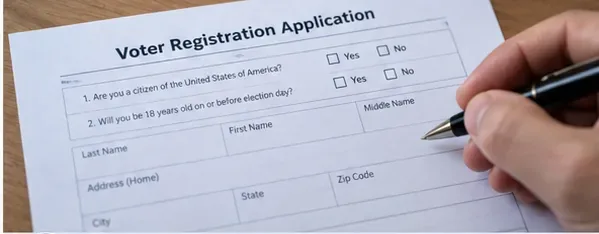
A voter completes a paper registration application, checking eligibility questions and entering identifying and address information carefully.
Step 3: Submit the application using the method your state accepts
Before submitting, review the application for spelling, address accuracy, date of birth, and any required identification number. If a paper form requires a signature, sign it where instructed. A technically complete application with incorrect information can still cause delays or require follow-up.
If you register online, save or print any confirmation page or reference number your state's system provides. If you register by mail, keep a copy of the completed form and note the date you sent it. If you register in person, ask whether you should expect a confirmation notice or whether the state provides an online status check.
A sealed envelope is placed into a U.S. Postal Service collection box, illustrating the mail-in option for states that accept the applicable voter registration form.
If you moved, changed your name, or changed party affiliation
You may need to update an existing registration rather than create a new one from scratch. The Election Assistance Commission says the update process is usually similar to registering. Vote.gov also lets you select your state to find official instructions for changing your name, address, or political party where applicable.
Party affiliation matters most for certain primary elections because state primary rules differ. It does not mean you are required to vote for that party's candidates in a general election.
Step 4: Verify your registration instead of assuming submission means approval
Submitting an application and being listed as an active registered voter are not the same thing. Processing times vary. After allowing time for your election office to process the application, use your state's official voter lookup tool or contact the election office to confirm your status.
Vote.gov can direct you to your state's registration-status page. Check that your legal name and residential address are correct. If your state displays party affiliation or district information, review those fields too. If the record is missing or wrong, contact the election office promptly rather than waiting until Election Day.
A “Your Vote Matters” sign stands outside a voting location, a reminder that registration is only the first part of getting ready to cast a ballot.
Which registration option should you choose?
Choose online if your state offers it, you have the required information, and you want the most convenient submission path. Choose mail if you prefer paper, want to retain a physical copy, or cannot use the online system—but send it early enough to avoid deadline and delivery problems. Choose in person if your situation is complicated, you want help from election staff, or you are close enough to a deadline that relying on mail would make you uncomfortable.
The right choice is the method your state officially accepts that you can complete accurately and on time. A faster method is not better if you use the wrong portal, enter incomplete information, or fail to confirm that the application was processed.
Common mistakes to avoid on National Voter Registration Day
Treating September 15 as a universal deadline. It is the 2026 National Voter Registration Day, not the registration cutoff for every state.
Using an unofficial website for sensitive information. Start with Vote.gov or your state election authority.
Assuming an old registration is still correct after a move or name change. Check and update it.
Mailing a form without reading state-specific instructions. The federal mail form includes different instructions by state.
Assuming submission equals registration. Verify your status after the application has had time to be processed.
How to self-check that you are ready
Once you have completed the process, confirm four things: your registration status is active or otherwise valid under your state's terminology; your legal name is correct; your residential address is current; and you know where to find official information about your polling place, early voting, or mail voting if you plan to use those options.
National Voter Registration Day is a good day to act, but the important result is not merely filling out a form. It is making sure your application follows your state's rules and then confirming that your voter record is ready before you need to cast a ballot.