Home
» Today
»
How to See the Aurora Borealis: Forecasts, Best Times, and Viewing Tips
How to See the Aurora Borealis: Forecasts, Best Times, and Viewing Tips
To see the aurora borealis, you need three things to line up: auroral activity, a dark sky, and a clear view from your location. A high forecast score by itself cannot guarantee a sighting. For a practical plan, check a space-weather forecast and your local cloud forecast together, then reassess close to viewing time.
This guide uses official NOAA, NASA, and University of Alaska Fairbanks guidance checked October 8, 2026. Forecast pages update as conditions change; the specific numbers and maps available tonight may differ. The goal is a better-informed outing, not a promise that lights will appear.
Step 1: Read an aurora forecast as a short-term estimate
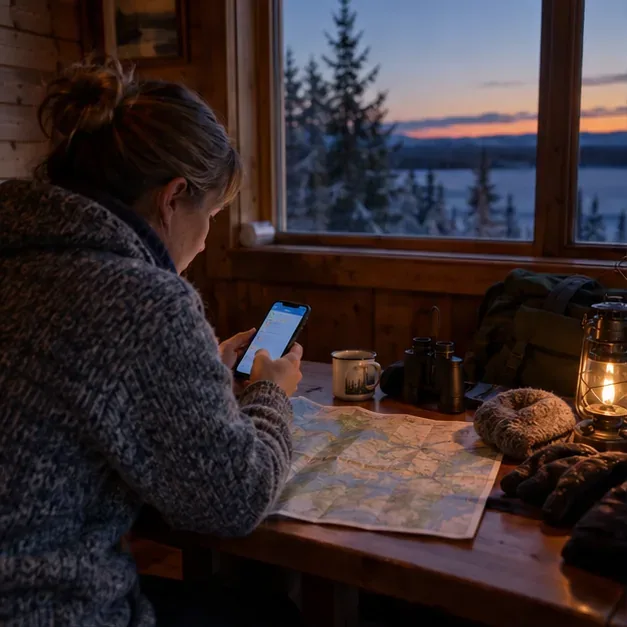
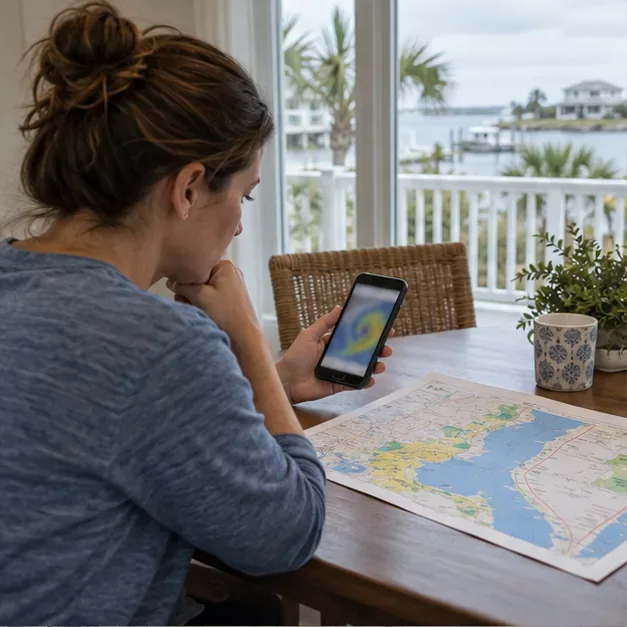
A traveler checks a phone and paper map before heading out, the planning stage for an aurora viewing trip.
Start with NOAA’s Aurora Dashboard and its 30-minute aurora forecast. The forecast estimates the location and intensity of aurora using the OVATION model. NOAA describes it as a 30- to 90-minute forecast because solar-wind measurements need time to reach Earth. It is useful for deciding whether to step outside soon, but it is not a guarantee for a particular town or a precise start time. If you are planning several days ahead, use NOAA’s three-day geomagnetic forecast as an early signal, then return to the dashboard and local weather forecast on the day of your outing. Forecast confidence changes with lead time, and the dashboard labels some products as experimental.
On NOAA’s polar map, the auroral oval is the band of expected activity around a magnetic pole. A brighter or more active oval can extend farther from the pole. If you are in the continental United States, look at the forecast for the northern hemisphere and compare the oval’s southern edge with your location. The oval is centered on Earth’s magnetic pole, so geomagnetic latitude matters; a simple geographic-latitude rule can mislead.
You may also see the Kp index, a scale from 0 to 9 that summarizes geomagnetic activity in three-hour intervals. Higher Kp generally means a greater chance of brighter auroras farther from the poles, but NASA cautions that Kp is a rough guide to intensity, not a clock for when an aurora will appear or a forecast of cloud cover at your address. A low Kp does not rule out a good display if you are already under the auroral oval. For Alaska-specific planning, the University of Alaska Fairbanks Geophysical Institute forecast offers regional guidance; do not treat an Alaska forecast as a forecast for the entire United States.
Step 2: Match aurora activity with weather and darkness
Next, check local cloud cover, precipitation, and the hours of darkness. Clouds can block the sky even during strong geomagnetic activity. Sunlight prevents viewing, and city lights reduce contrast. The National Weather Service forecast for your area helps with cloud and weather conditions; NOAA’s space-weather map does not replace it.
Choose a location away from bright streets and buildings, with a broad view toward the north if you are in the Northern Hemisphere. At high northern latitudes, aurora can appear overhead, while in much of the lower 48 states it may be low on the northern horizon unless activity is unusually strong. Use a legal, familiar viewing area with safe parking. Never stop on a highway shoulder or enter closed land to improve your view.
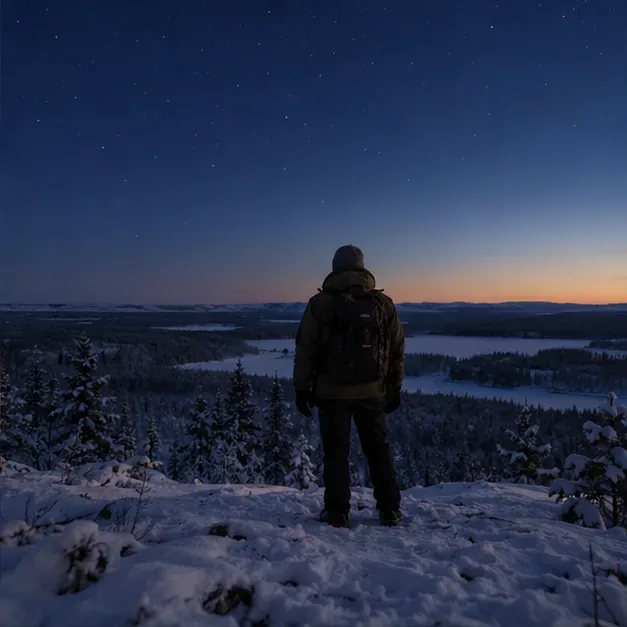
An open winter clearing gives the observer a wide view of the sky with fewer nearby lights.
The moon is a factor, not a deal-breaker. A bright moon can make faint auroral details harder to see, much as it reduces the contrast of stars, but a bright aurora can still be visible. If the forecast is promising and the sky is clear, do not automatically cancel because the moon is out.
When is the best time to look?
NOAA says auroral displays are often most active within an hour or two of midnight, roughly 10 p.m. to 2 a.m. local time. That is a useful starting window, not a strict schedule: activity can begin earlier or last later, and stronger events can broaden the viewing hours. In interior Alaska during winter, UAF describes a wider period—about 9 p.m. to 3 a.m.—with a higher chance of active displays.
For the season, prioritize enough darkness at your chosen latitude. In Fairbanks, UAF describes an aurora-viewing season of roughly August 21 through April 21 because summer nights are too bright there; dates vary with location and twilight. NOAA and UAF also note a statistical tendency for stronger auroral activity near the spring and fall equinoxes. That tendency does not make an equinox night certain, and clear weather and darkness still matter more to an individual outing.
Step 3: Choose a safe site and prepare to wait
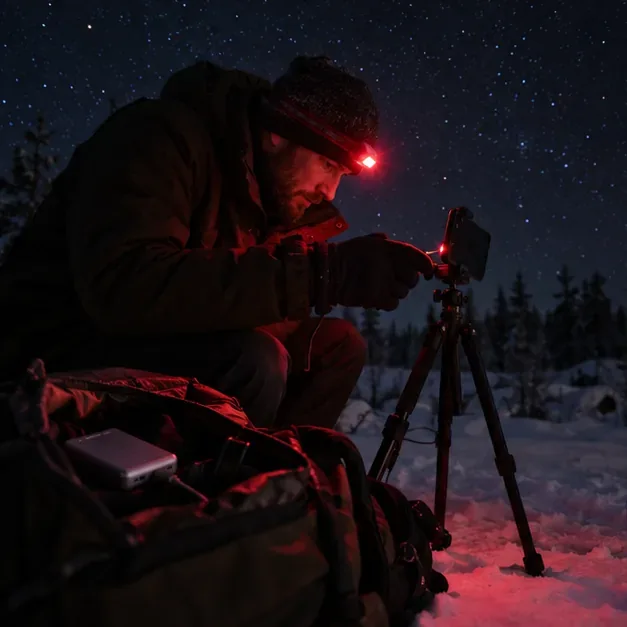
A red headlamp, stable tripod, warm layers, and a protected spare battery help during a long, cold wait.
Plan your route while it is still light. Check access hours and road conditions, tell someone where you are going, and bring enough warm layers to remain outside comfortably. NASA recommends warm clothing, a tripod for steady photographs, a red headlamp to help preserve night vision, and a spare phone battery kept warm in a pocket because cold can drain batteries more quickly.
Keep your eyes adapted to the dark. Bright phone screens and white flashlights can make faint features harder to notice for a short time. Use a dim screen or red light when you need to check the forecast. Give your eyes a few minutes to adjust after arriving, and scan a wide area of sky rather than staring at one small point.
If clouds are forecast to persist over your site, compare nearby local forecasts before deciding to move. Change location only when a clearer area is reasonably close and the route is safe. If the cloud cover is local and the aurora forecast remains favorable nearby, a short move may help. If the entire region is cloudy, driving a long distance on icy or unfamiliar roads may add risk without improving the odds.
Step 4: Watch for change, then judge what you can see
Aurora can look like a quiet pale arc, a diffuse glow, or moving curtains and rays. It may brighten and fade rather than remain steady. If the sky is dark and clear but the forecast is modest, wait and check NOAA’s short-term map again instead of assuming the night is over. If the forecasted oval is far north of your location and activity is quiet, set expectations accordingly: you may see nothing, or only a faint glow low on the horizon.
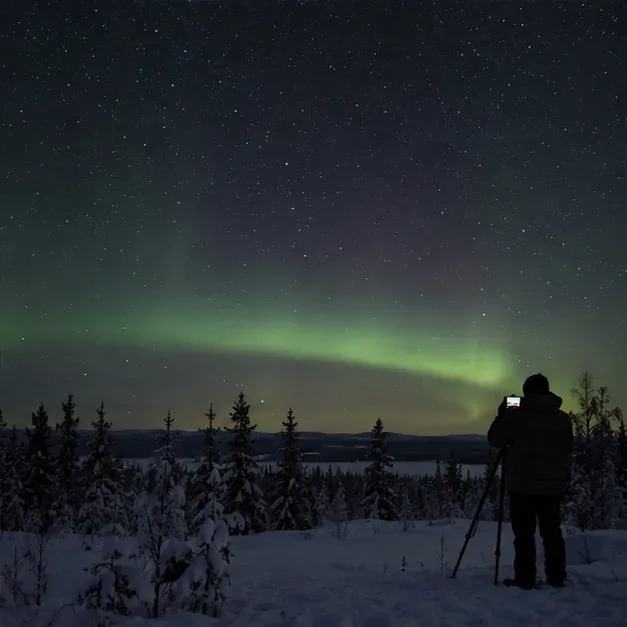
A subtle green arc over a dark tree line shows how a modest aurora can appear low above the horizon.
A phone camera may record color or structure that looks faint to the unaided eye because its sensor gathers light during an exposure. NASA notes that cameras can record auroras people cannot see clearly with their eyes. Treat a photograph as a record of what the camera captured, not proof that the same brightness or color was obvious in person. For steadier results, support the phone on a tripod, use its night or long-exposure option if available, and keep the lens clear. Camera features vary by model, so there is no single setting that works for every phone.
How to tell whether your plan needs to change
Strong space-weather forecast, cloudy local sky: check nearby cloud forecasts; move only if a safe, accessible site is likely to be clearer.
Clear sky, weak activity, and a location beneath the auroral oval: stay patient through part of the local midnight window and refresh the short-term forecast.
Clear sky but the forecast oval remains far north: find an unobstructed northern horizon if one is safely available, but lower expectations rather than assuming a display is imminent.
Bright urban sky or summer twilight at high latitude: a darker site or a darker part of the season may improve visibility more than repeatedly checking Kp.
Unsafe cold, poor road conditions, or fatigue: end the outing. The forecast cannot make a risky drive worthwhile.
A good result is not only a photograph. You should finish knowing whether darkness, cloud cover, location, or aurora activity limited the view, and whether staying or moving made sense. If you do not see the lights, that does not prove the forecast was wrong: aurora forecasts estimate conditions over a broad region, while your actual view depends on local clouds, darkness, horizon, and how bright the display becomes.
For a final check, open NOAA’s short-term forecast near your planned viewing window, confirm the local sky is clear enough, and make sure you can reach a dark site safely. Recheck if conditions change. This gives you a practical basis for deciding when to go out, when to wait, and when to try another night.