Home
» Today
»
OpenAI Mathematics: What the New AI Math Capability Means
OpenAI Mathematics: What the New AI Math Capability Means
OpenAI's latest mathematics announcement is a research release, not the launch of a product called “OpenAI Mathematics.” On October 6, 2026, the company published a collection of mathematical results produced by an internal frontier model. The practical significance is that readers can inspect manuscripts and supporting proof materials, while separating those results from capabilities available in ordinary ChatGPT sessions.
OpenAI says it is working toward releasing the model responsible for the results. The announcement does not establish a public access date, subscription entitlement, or API endpoint for that internal system. This reference explains what was released, how to assess the evidence, and what students, researchers, and developers can usefully take from it. Information was checked on October 7, 2026.
What the new announcement actually contains
In Sharing AI progress in mathematics, OpenAI describes publishing results on GitHub, releasing Lean formalizations for many proofs, and providing additional information about the research process. It also announces plans to support workshops, conferences, and other programs intended to help people understand important results.
These are distinct forms of access. Downloading a proof lets someone study the result. Downloading a formalization may let a suitably equipped reviewer check a mathematical statement. Neither gives that reviewer access to the model that originally produced the work.
A simplified view of the research collection separates manuscripts and proof artifacts and highlights their differing verification status.
Item
What it provides
What it does not establish
Research manuscript
A theorem statement and mathematical argument to inspect
Automatic correctness or independent acceptance
Lean formalization
A machine-checkable representation of a result
That every accompanying prose claim has been captured
Reasoning summary
Context about how an argument was developed
A complete, reproducible record of model execution
Public research repository
Access to released materials
Access to the internal model or its weights
How to read the numbers without overstating them
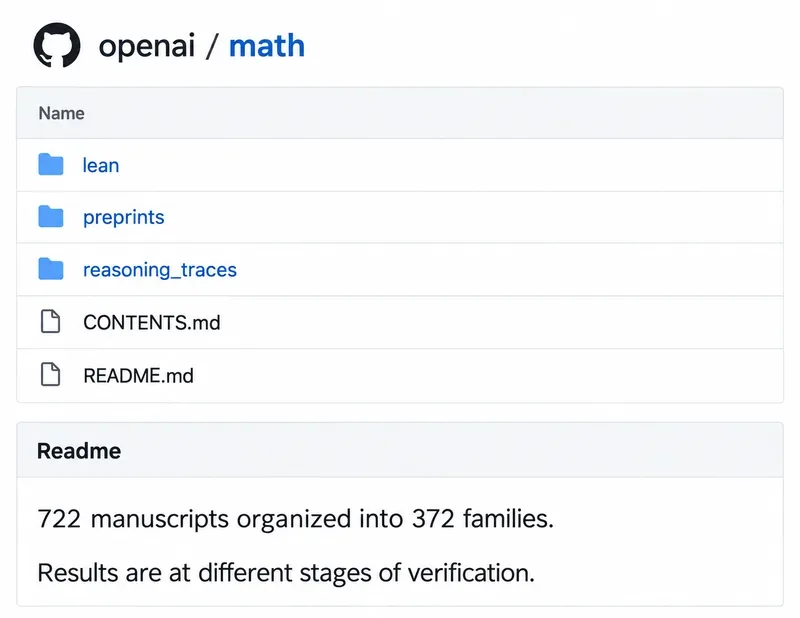
The openai/math repository lists 722 manuscripts organized into 372 families at the time of this check. A family groups related papers, such as a principal result and companion arguments, consequences, or alternative proofs. Consequently, neither number should be presented as a count of distinct, independently accepted breakthroughs.
The repository says approximately 4,000 problems were posed during the evaluation. It also warns that results are at different verification stages, that not every result has a Lean formalization, and that some unformalized results could contain issues.
Do not divide manuscript count by attempted-problem count to create a success rate. The units are different, related outputs can be grouped, and publication selection is not the same as a benchmark with one scored answer per question.
The reported average computation is expressed as roughly three hours of ChatGPT Pro thinking with the internal model. That is a compute comparison, not a promise that a public Pro user can reproduce a result in three hours, nor a dollar-price estimate.
Why Lean matters—and where its assurance stops
A mathematical proof written in prose can contain a gap that is difficult to notice. Formalization expresses definitions, assumptions, and reasoning in a form a proof assistant can check. In this release, Lean provides that additional layer of scrutiny for available formal artifacts.
The critical question is what was formalized. A checked theorem can be narrower than the headline, rely on assumptions that need attention, or use definitions whose connection to the intended problem must be reviewed. Machine checking and expert interpretation address different parts of the reliability question.
For a reviewer, the useful comparison is between the original problem, the manuscript's theorem, and the formal theorem statement. A successful build is evidence about the supplied formal artifact; it should not be described as an independent reproduction of the model's discovery process. No formalization was executed as part of preparing this article.
What the capability means for different readers
For mathematicians and research teams
The release creates material to investigate: arguments, potential lemmas, proof techniques, and connections worth assessing within a specialty. A productive first question is whether a particular result changes something you already understand—not whether the entire collection deserves one blanket verdict.
Inspect the assumptions and supporting references before investing in a follow-up project. Track the manuscript version you reviewed. If a result is revised, revisit any conclusions or software that depended on it.
For students and educators
Research-level theorem production should not be confused with learning support. A system's ability to produce a difficult argument does not ensure that a student understands the argument, or that every explanation from a different model is correct.
A separate March 10, 2026 announcement introduced interactive math and science explanations in ChatGPT, starting with more than 70 concepts. OpenAI described a rollout across plans for logged-in users, with visuals that let learners manipulate variables. That education feature is separate from the October research-model release.
For learning, ask for definitions, a small worked example, and a question you can answer yourself. Use the explanation to practice a method, then check your work against course materials. A convincing solution is useful only if you can identify why its steps are valid.
For developers and technical decision-makers
The announcement suggests that mathematical reasoning is becoming a more significant research capability. It does not specify the behavior of every available model on your workload. Treat the potential application as a hypothesis to evaluate.
For example, an optimization assistant might propose a derivation, while numerical code checks a candidate solution and a domain expert checks the modeling assumptions. Each component answers a different question. A correct derivation of the wrong objective remains the wrong solution.
Before changing a production workflow, evaluate representative tasks, including failure cases. Measure correctness, latency, cost, and how often a reviewer must intervene. Avoid using a frontier research headline as a substitute for those measurements.
Why publication standards are part of the story
The independent Advisory Group on Mathematics and Artificial Intelligence issued responsible-release recommendations on September 29, 2026. They emphasize attribution, clear exposition, disclosure of how results were obtained, formalization where practical, and support for human understanding.
The group's position is not an unqualified endorsement of proprietary research models: it explicitly asks labs to stop testing advanced mathematical problems on models inaccessible to the broader scientific community. It also recommends community-led understanding and appropriate scholarly repositories outside AI-lab control.
That distinction matters when reading OpenAI's statement that it consulted the group. Consultation does not mean the advisory group has certified each proof or approved every release decision. Public access to results, independent checking, clear authorship responsibility, and access to the generating model remain separate questions.
A practical checklist for assessing an AI mathematics claim
Identify the release: Is it a product feature, a benchmark score, a manuscript, or a formal proof artifact?
Identify the system: Was the work produced by a public model or an internal research system?
Read the statement: Does the actual theorem match the claim being discussed?
Check assumptions: What definitions, hypotheses, or imported results does the argument require?
Check verification status: Is there a formalization, and what independent expert review is documented?
Check provenance: Are related earlier results credited, and are methods and revisions traceable?
Separate availability from performance: What can you access today, and what remains a future release?
The October announcement makes a substantial collection available for examination. Its lasting value will depend on which results withstand scrutiny, how well people understand and build on them, and how access to the underlying capability develops. For now, the most useful response is to inspect a relevant result carefully and keep research evidence separate from product promises.