Greenlight Dashboard Error 500: Find the Failing Service

Trace a BigBlueButton Greenlight 500 error through application logs, PostgreSQL, Redis, environment settings, and Nginx without risking room data.
Want to know why a sweater that once looked like a hand-me-down became an American holiday party uniform—and why headlines call it a multimillion-dollar business? This five-step history is for readers curious about the tradition’s roots and its retail boom. It separates the older Christmas knitwear from the newer joke, and the documented sales of individual retailers from any claim about the whole U.S. market.
| What you need | Estimated time | Difficulty |
|---|---|---|
| No tools or supplies; this is a history explainer. | About 5 minutes to read. | Easy |
Holiday sweaters existed long before people called them “ugly.” In the 1950s, so-called jingle-bell sweaters featured reindeer and Nordic-inspired snowflakes. They were festive clothes, not necessarily a punchline. A history of the fashion in Canada’s History describes the designs as comparatively elegant and notes that entertainer Andy Williams helped popularize the look through his Christmas television specials.
The distinction matters: the garment’s roots are older than today’s party custom. The original sweater was meant to look seasonal. Its later appeal came from the gap between that earnest intent and the exaggerated patterns people came to find funny.
By the 1980s, louder Christmas sweaters—with big reindeer, snowmen, pom-poms, and bells—were part of popular fashion. Television sitcoms and holiday specials put conspicuous knitwear in front of large audiences. The MIT International Students Office’s Americanisms guide traces the “Jingle Bell Sweater” look from its 1950s popularity to the more excessive 1980s version, before the style faded in the mid-1990s.
People did not necessarily buy these sweaters to be ironic. Many were ordinary holiday clothes, knitted or gifted for warmth and cheer. Time changed their meaning: once the style fell out of fashion, wearing one could signal affection for a tacky family keepsake—or a willingness to look deliberately uncool.
The revival gathered force around the turn of the millennium. In the 2001 film Bridget Jones’s Diary, Colin Firth’s character Mark Darcy appears in a memorable reindeer sweater. As Canada’s History explains, the scene helped make the goofy sweater feel charming rather than simply embarrassing. The joke was affectionate: an old-fashioned garment could carry family nostalgia while letting the wearer laugh at the look.
Thrift stores became a natural source for the party version because they offered genuine older sweaters with unusual patterns. That made the trend inexpensive and personal. Friends could compete to find the most outlandish design without needing a coordinated costume or a polished fashion look.
In Vancouver, friends Jordan Birch and Chris Boyd organized an ugly Christmas sweater party in 2002 after spotting tacky penguin sweaters. Their event became an influential model for themed gatherings, according to Canada’s History. The precise “first party” claim is difficult to settle: contemporary reporting has also described ugly-sweater parties as beginning in Vancouver around 2001. It is safer to say the Vancouver events helped popularize the format than to present one party as an undisputed worldwide first.
The format worked because the sweater did the decorating. A host could invite guests to wear their loudest knit, add a prize for the most outrageous one, and create an instant shared joke. As the idea crossed into the United States, office parties, school events, bars, charities, and friend groups adopted it. The clothing shifted from an individual fashion choice into a social uniform: everyone looked silly together.
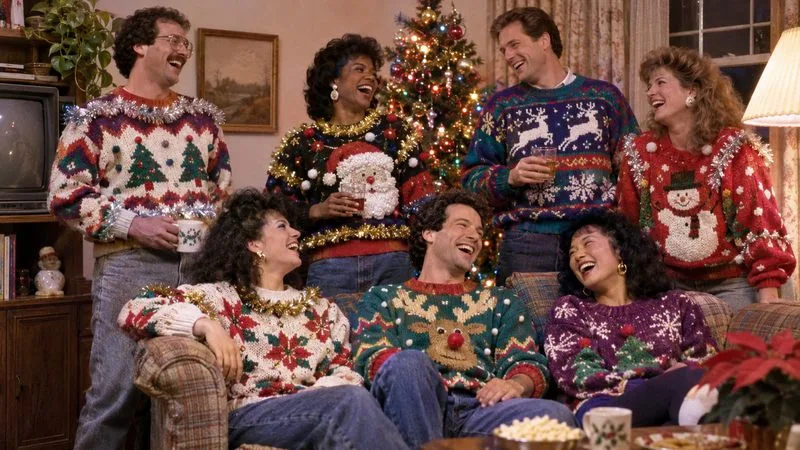
Once parties created predictable demand, retailers could sell new sweaters designed specifically to look outrageous. ABC News reported in 2011 that online sellers were buying thrift-store stock and launching specialty sites; one seller said the roughly 50 secondhand sweaters he bought sold out quickly. A separate company, Tipsy Elves, began in 2011 after its founders struggled to find sweaters for parties. In a profile from the University of California San Diego, the founders said they sold about 5,000 sweaters in their first year.
Retail reporting gives a concrete example of the “multimillion-dollar” label. Fast Company interviewed the founders of UglyChristmasSweater.com, who said the retailer earned $3.5 million in 2014 and $4.8 million in 2015, and projected $5 million to $5.5 million in 2016. Those are reported figures for one business, including a forecast—not an audited estimate of total U.S. ugly-sweater sales. The distinction keeps the headline in perspective: the trend clearly supported million-dollar specialty businesses, but the available figures do not establish a single comprehensive market total.
Mass-produced versions also changed what “ugly” meant. Early partygoers often hunted for real vintage sweaters; retailers began making fresh designs with oversized graphics, lights, three-dimensional details, and licensed characters. Online shopping made niche designs easy to find, while workplace and social-media photos gave each season a reason to repeat the joke. The business model is seasonal, but the ritual returns every December.
The holiday sweater does. The modern ironic party trend is much newer, taking shape around the early 2000s. Treating those as one continuous tradition makes the history sound more certain than it is.
No. Accounts credit Vancouver organizers with an influential early party in 2002, while some reporting places the start of the party trend in 2001. The tradition became popular in the United States, but its commonly cited party origin is Canadian.
No. A retailer’s revenue is evidence that the niche became commercially significant, not a national category census. The reported $4.8 million figure above belongs to one company in 2015; it should not be described as the total U.S. market or as current annual sales.
Festive sweaters were popular in earlier decades, but the ironic party trend took off around the early 2000s, helped by pop-culture nostalgia and themed gatherings.
They make holiday gatherings feel playful and low-pressure. The point is usually shared humor, nostalgia, and a little friendly competition—not looking conventionally stylish.
There is no single total established by the cited sources. Fast Company reported one specialty retailer’s 2015 revenue at $4.8 million and its 2016 projection at $5 million to $5.5 million.
Trace a BigBlueButton Greenlight 500 error through application logs, PostgreSQL, Redis, environment settings, and Nginx without risking room data.
Preview which published recordings exceed your retention period, then schedule BigBlueButton cleanup with a logged daily script and a dry-run safeguard.
Trace FreeSWITCH REGISTER requests, correct gateway or network settings, and confirm that your BigBlueButton SIP trunk registers successfully.
Enable a Jitsi Meet background, troubleshoot missing controls, and reduce video lag on slower laptops without risky configuration changes.
Trace M_FORBIDDEN to room power levels, membership, or Synapse server-admin access, then restore only the permission the blocked action needs.
Configure Synapse discovery, HTTPS, and proxy routing so other Matrix homeservers can find and contact your server.
Configure a Keycloak OIDC client and Synapse provider so Element Web users can sign in through your identity server without exposing client secrets.
Save a recovery key, verify your Element sessions, and check that encrypted message keys can be restored without confusing backup with your account password.
Diagnose Synapse out-of-memory failures during sync, adjust caching safely, identify request backlogs, and verify stable memory use.
Trace Matrix federation certificate failures to the correct server, repair the TLS chain or CA trust, and verify the fix without disabling security checks.