Home
» Today
»
Miami Airport Delays: How to Check Your Flight After the Taxiway Collision | Nov. 15, 2026
Miami Airport Delays: How to Check Your Flight After the Taxiway Collision | Nov. 15, 2026
Checked Nov. 15, 2026, at 12:14 p.m. Eastern Standard Time in Miami (EST, UTC−05:00; 5:14 p.m. UTC). Miami International Airport (MIA) is operating, but travelers should check their exact flight with the airline before leaving for the airport. The FAA’s latest MIA status snapshot available at the time of this check—updated Nov. 15 at 11:49 a.m. EST (UTC−05:00; 4:49 p.m. UTC)—reported gate-hold and taxi delays of 46 minutes to one hour for departures, with delays increasing, and airborne arrival delays of 15 minutes or less. The FAA attributed the departure delays to a traffic-management initiative related to a rocket launch. Its page showed no destination-specific delays and cautions that airport-wide conditions are not flight-specific.
The delay report followed a taxiway collision at MIA on Saturday, Nov. 14. The FAA says a Copa Airlines Boeing 737’s wingtip struck the nose of a UPS Boeing 767 while both aircraft were taxiing. The FAA is investigating. MIA said at the time that aircraft were being routed around the affected taxiways and that airport operations were not then disrupted. That initial assessment does not guarantee every later flight is on schedule; current departure holds are a separate, changing operational picture.
Highlights
FAA incident notice: a Copa 737 wingtip struck the nose of a UPS 767 on Nov. 14; the FAA is investigating.
The incident was reported at about 9 p.m. Miami time on Nov. 14 (EST, UTC−05:00), or about 2:00 a.m. UTC on Nov. 15.
The latest FAA MIA snapshot available when checked showed 46-minute-to-one-hour departure gate/taxi delays, attributed to a rocket-launch traffic-management initiative.
For a specific flight, use the airline’s app or website first, then cross-check the live MIA board; the FAA status page summarizes airport conditions rather than individual flights.
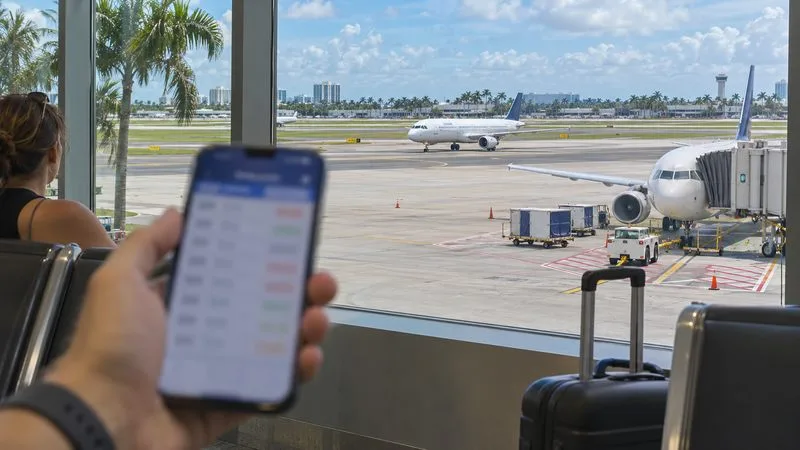
Illustration: a traveler checks flight information while aircraft taxi at an airport; this is not a photograph of the MIA incident.
What happened on the Miami airport taxiway?
The FAA’s preliminary public account says the wingtip of a Copa Airlines Boeing 737 struck the nose of a UPS Boeing 767 as the aircraft were moving on taxiways at Miami International Airport. The Copa aircraft was taxiing to its gate; the UPS aircraft was taxiing for departure to Bogotá, Colombia. The FAA says air traffic controllers had told the UPS crew to give way to the Copa flight and that it is investigating. The agency’s notice places the incident at around 9 p.m. local time Saturday, Nov. 14. Miami was observing Eastern Standard Time (EST, UTC−05:00) on that date, so 9 p.m. in Miami was about 2:00 a.m. UTC on Sunday, Nov. 15. The FAA’s time is approximate.
MIA’s communications director told CBS Miami that the aircraft made contact at the intersection of two taxiways at approximately 9:15 p.m., and that flights were being directed to other taxiways with no immediate impact to airport operations. The FAA notice confirms the aircraft and investigation details. Neither source says the collision closed the airport. A taxiway incident can require ground crews and controllers to route aircraft around an area, but the scale and duration of any knock-on delay depend on the specific operating conditions at the time.
Are current Miami flight delays caused by the collision?
The available official information does not establish that the collision caused the latest FAA delay snapshot. At 11:49 a.m. EST on Nov. 15 (UTC−05:00; 4:49 p.m. UTC), the FAA reported departure gate-hold and taxi delays ranging from 46 minutes to one hour and increasing, while arrivals were experiencing airborne delays of 15 minutes or less. It listed no destination-specific delays and attributed the departure holds to a traffic-management initiative associated with a rocket launch. Because this is a timestamped airport-wide snapshot, it may change quickly and cannot tell a traveler whether a particular flight has been delayed, canceled, or assigned a new gate.
At the time this article was checked—12:14 p.m. EST in Miami on Nov. 15—the FAA snapshot was about 25 minutes old. Check it again before making a decision. Do not assume the aircraft collision means MIA is closed, and do not assume the airport’s earlier statement that operations were unaffected means your flight will depart on time.
How can you check your MIA flight status?
Start with the airline. Open the airline’s app or website and search by flight number and travel date. Confirm whether the flight is on time, delayed, canceled, or rebooked. Airlines control passenger notifications, seat assignments, and rebooking; the FAA directs commercial travelers to their airline for flight-specific information.
Check MIA’s live arrivals and departures board. Match the flight number, not only the destination, and confirm the terminal or concourse and gate. MIA also links to a real-time flight tracker. Use the airport board as a useful cross-check, while treating airline messages as the place to confirm what to do about your reservation.
Use the FAA status page for the wider picture. Look for Miami International Airport (MIA) and note the page’s “last updated” time. The FAA says its status page describes general airport conditions, not individual flights. A reported taxi delay is an estimate of overall traffic conditions, not a promise that your aircraft will depart exactly that much later.
Refresh before you leave and on the way. Recheck after receiving a delay notice, before starting the drive, and again at the terminal. If the airline changes your departure time, follow its updated check-in and boarding instructions. Keep notifications enabled and make sure the airline has your current contact information.
If your flight is delayed, keep an eye on the airline’s revised departure time and gate, and ask the airline—not airport operations—about rebooking, meal or hotel arrangements, and checked-bag plans. If you are already at MIA, remain reachable and monitor both the app and terminal displays; a gate can change even when the flight number and scheduled time do not. If you are connecting through Miami, contact the operating airline as soon as a delay threatens your onward connection. A short taxi delay can still matter when a connection is tight, but only the carrier can confirm whether it will hold a connecting flight or move you to another itinerary.
For now, the practical takeaway is to treat MIA’s general delay estimate as context, not a personal flight forecast. The taxiway contact is under FAA investigation, while the latest delay report identifies a separate traffic-management initiative. Flight conditions can change between checks, so the airline’s current status for your flight number is the most useful next step.
FAQ
Is Miami International Airport closed after the taxiway collision?
No closure was reported in the official information reviewed. MIA said aircraft were being rerouted around taxiways and reported no immediate airport-wide operational impact at that time.
How long are delays at MIA?
The latest FAA snapshot available when checked on Nov. 15, 2026, at 12:14 p.m. EST (UTC−05:00) showed departure gate/taxi delays of 46 minutes to one hour and arrival airborne delays of 15 minutes or less. The snapshot itself was last updated at 11:49 a.m. EST and is not a flight-specific prediction.
Where should I check whether my flight is affected?
Check the operating airline’s app or website by flight number first, then verify the gate and schedule on MIA’s live arrivals and departures board. Use the FAA page only for general airport conditions.